Why You Should Own Gold Miners AND Oil
Isn’t it generally true that war benefits precious metals?
Typically, yes. Historically, conflicts increase government debt and deficits, which leads to more currency issuance.
Gold and silver remain the ultimate safe-haven assets, so investors tend to seek them in turbulent periods.
Then why are precious metals currently not gaining much ground?
First, metals have already experienced significant upward momentum over the last year and a half.
This strong rally attracted countless hedge funds into gold and silver within the past six months.
Many of these short-term gold enthusiasts are now stepping aside. That’s expected, as they never planned to hold long term.
Gold and silver themselves remain solid. If the war escalates further, bullion prices should pick up pace.
I’m comfortable holding these assets. For miners, which have dropped more than the metals, there’s an easy way to balance risk via an oil “pair trade.”
Let’s dive deeper.
What About Miners?
Though they’ve recently declined, the GDX gold miner ETF still shows a 9% gain year-to-date, while the SILJ silver miner ETF has gained 14% so far in 2026.
However, GDX has fallen about 19% from its peak on February 27, with SILJ down nearly 25% from its high.
Keep in mind the peaks in gold and silver miners occurred just one day before the Iran War began.
This timing isn’t accidental. Rising oil prices increase miners’ operational costs.
Energy expenses form a large portion of miners’ overall costs, covering diesel, gasoline, and electricity—all rising sharply.
Oil prices have surged from roughly $57 per barrel at the start of the year to $95 currently.
Thankfully, this oil price surge is unlikely to last indefinitely. While short-term spikes are possible, as we’ve cautioned, the conflict could intensify unpredictably.
It could last up to a year if the Strait of Hormuz remains blocked, which would create serious challenges. Yet, this is a worst-case scenario and likely won’t persist that long.
At today’s metal prices, miners should still earn solid profits even if oil climbs to $150.
In the case of $150/barrel oil, miners might experience further declines. Any significant pullback would represent a strong buying opportunity.
This scenario underscores why owning both miners and physical bullion is wise. Bullion typically holds value or appreciates, while miners may dip.
Physical holdings can be in the form of coins, bars, or quality physical ETFs like PHYS and PSLV. Personally, I split my holdings roughly evenly between miners and physical ETFs.
If you prefer actual bullion in hand, that’s perfectly fine—just avoid sharing pictures of it publicly.
Conservative investors should consider leaning more heavily toward physical metals rather than miners.
The 2022 (Russia vs. Ukraine) Example
When Russia launched its invasion of Ukraine in 2022, the U.S. and other nations promptly sanctioned Russian oil.
As a major oil exporter, this drove prices sharply upward.
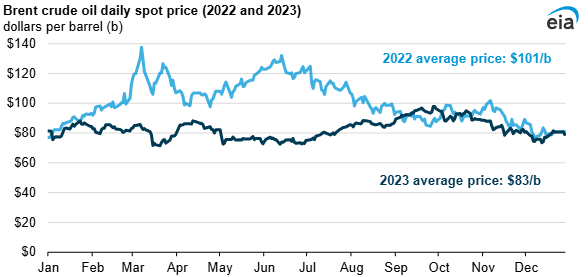
Below is a chart comparing oil prices in 2022 (light blue) and 2023 (dark blue).
Source: EIA
As shown, oil stayed elevated for around five months in 2022 before returning to normal levels—until the current disruption.
During 2022’s spike to nearly $140/barrel, gold miners suffered considerably.
The oil price jump from $80 to nearly $140 raised gold and silver extraction costs significantly. Barrick, a leading gold miner, reported an 18% increase in all-in sustaining costs (AISC) that year.
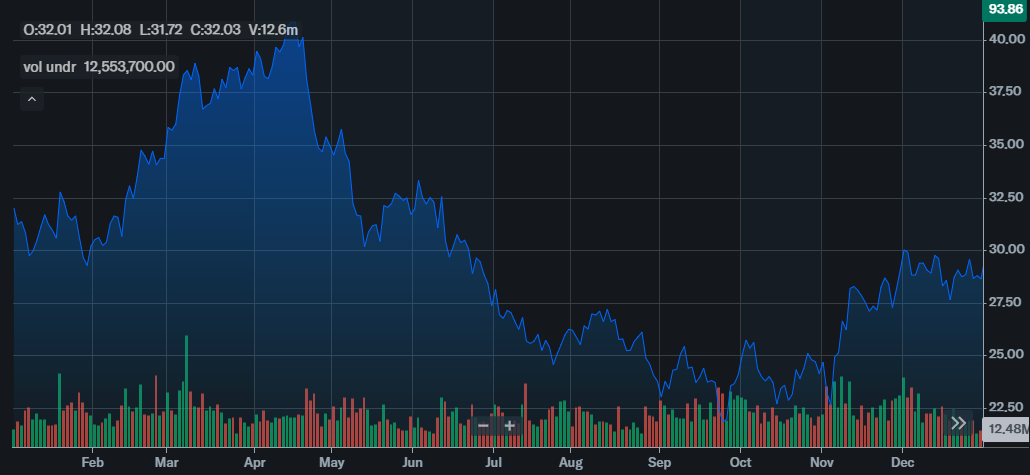
The GDX ETF dropped about 31% from its peak to its lowest point in 2022. While the overall market downturn contributed, rising oil prices didn’t help. Over the full year, GDX declined only 9%.
Here’s GDX’s performance chart during 2022:
Source: Yahoo Finance
The 2022 downturn turned out to be an excellent opportunity to buy.
Own Some Oil, Too (The Pair Trade)
I’m a strong believer in gold and silver miners. Investing in quality mining stocks provides the safest leveraged exposure to bullion. Those following Strategic Intelligence or Jim Rickards’ services should pay careful attention to their outstanding research and timely trade calls.
For the most part, I favor a long-term buy-and-hold strategy. Since miners often suffer when oil prices spike, owning oil stocks alongside miners makes for a good “pair trade.”
A pair trade involves two complementary assets.
If oil climbs, gains in oil stocks can counterbalance miners’ short-term setbacks. Both types of assets serve as hedges against inflation.
Among oil stocks, I currently favor Petrobras. The company is generating substantial profits right now.
However, Petrobras is a higher-risk, higher-reward choice.
The main risk stems from partial Brazilian government ownership—if prices rise too much, the government may pressure for lower gasoline prices for its citizens.
Back in 2011, when Brazil interfered, its stock market suffered for an extended period. Investors dislike such government meddling, and I believe Brazil will avoid repeating that mistake.
For more on Petrobras, see The Perfect Oil Chaos Stock. I also like Exxon Mobil (XOM) and keep an eye out for other oil exposure opportunities, though I prioritize stocks that can profit heavily even if oil prices aren’t sky-high (like Petrobras).
In any case, this war will end and oil will freely flow again—it’s only a matter of timing.
Meanwhile, the debt bubble shows no signs of bursting soon, which remains the principal reason for holding gold, silver, and miners.
About the Author