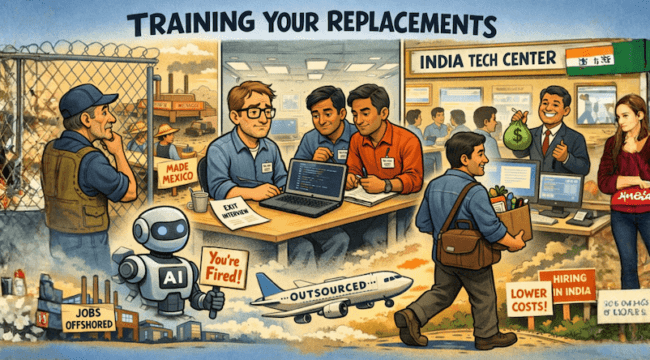
Training Your Replacements
In the 1990s, NAFTA prompted factories to relocate to the south. Communities lost their manufacturing plants, tax revenues, and most tragically, their younger generations. While elites labeled this shift as “efficiency,” workers experienced it as a devastating blow.
Now, a similar scenario is unfolding once more, but within a different, yet equally critical sector.
This time, the employees facing layoffs aren’t on production lines; they are the programmers crafting the code behind our applications. Earning six-figure salaries, residing in tech hubs like Austin and Seattle, they often believe their expertise shields them from policy decisions.
But are they truly insulated? Far from it. At this moment, the “sucking sound of American jobs” Ross Perot warned about reverberates through Silicon Valley.
Meta Delenda Est
Between 2022 and 2023, Meta dismissed over 21,000 employees. Google, Microsoft, and Amazon soon followed with their own rounds of layoffs. The media dubbed it “restructuring,” while CEOs framed it as a “pivot to AI.”
Restructuring is routine. It happens.
However, there was a crucial detail these companies hoped to keep under wraps.
While removing American engineers, these corporations continued submitting H-1B visa petitions. They expanded engineering hubs in Bangalore, Hyderabad, and Gurgaon, and posted jobs nearly identical to those they claimed to be eliminating.
If moving a factory to Mexico was feasible, relocating coding jobs to India is even simpler.
Identical logic, distinct casualties.
If this sounds exaggerated, watch this Palmer Luckey clip.
The Visa That Became a Pipeline
Initially, the H-1B visa was intended to fill genuine skill shortages. When an American worker with the right expertise isn’t available, a qualified foreigner could be hired, ideally training their American successor.
That is not how it unfolded.
Currently, about 70% of new H-1B visas go to Indian nationals, with China trailing far behind, and the rest competing over the remaining spots.
There is no issue with Indian engineers themselves—many are outstanding. The problem lies in the framework.
When one nation predominates a visa channel, it ceases to be a global talent acquisition system. Instead, it becomes a single-country pipeline, complete with its universities, recruiters, referral networks, and staffing firms funneling workers en masse into U.S. companies.
After these networks establish themselves within firms, they influence hiring and promotion decisions. No conspiracy is necessary; it’s human nature to hire familiar, trusted candidates from one’s own circles.
The American engineers who never gained entry missed an opportunity they never even realized existed.
Disney Was the Warning. Nobody Listened.
A few years ago, Disney made headlines for a shocking event: forcing its American IT staff to train their H-1B replacements just before being laid off. Southern California Edison did the same.
The story captured media attention, and Congress held hearings. Yet, no reforms followed.
Big Tech took note and adapted with more subtlety.
- Step 1: Build a base of H-1B contractors and create large engineering centers overseas.
- Step 2: Use economic downturns or “strategic pivots” to eliminate expensive American personnel.
- Step 3: Replace that work with offshore teams or visa employees who have limited ability to leave.
- Step 4: Portray these moves to the media as driven by AI advancements and efficiency gains.
Though the appearance is polished, the outcome remains unchanged.
The Visa as a Restraint
H-1B workers depend legally on their sponsor companies. Quitting jeopardizes their visa status, green card process, and their family’s legal standing.
(I personally experienced these kinds of restrictions when working abroad.)
In contrast, domestic workers can resign and be interviewing elsewhere within days.
This imbalance is a deliberate feature of the system.
Employers gain compliant staff unlikely to resist poor pay, long hours, or unfavorable conditions. The employees’ dependence inflates company profits. Unfortunately, Congress embedded this setup into law and has shown no appetite for reform.
Meanwhile, the American engineer let go, free to move yet more costly, wonders why the “meritocracy” failed him.
What NAFTA Did to Steel, H-1B Is Doing to Silicon
NAFTA didn’t obliterate U.S. manufacturing instantly. Instead, it altered the landscape. Executives responded gradually at first, then rapidly. Decades later, entire regions had been emptied out.
The same playbook is now deployed against the tech industry through the H-1B and outsourcing model.
Wage differences matter. A senior engineer in California commands double or triple the salary of a comparable Indian engineer. CFOs see these figures and make decisions accordingly.
As senior roles move offshore, so does mentorship, business spin-offs, institutional knowledge, and the cultivation of future talent.
The United States shifts from leading innovation to becoming a client.
We spent thirty years understanding this lesson about manufacturing; another thirty years of relearning it may await us in software.
What Fixes This
Faulting Indian engineers is misguided and simplistic. They are merely reacting to existing incentives.
The root issues lie in the incentives—created by Congress, which holds the power to change them.
Three immediate reforms could help tremendously.
First, prohibit direct replacement. Any firm that lays off American employees in a role should be banned from filling that same position with H-1B or offshore workers for three years. Enforce this with audits and substantial fines that impact profits.
Second, link federal funding to American employment. Companies benefiting from the CHIPS Act or large government contracts must maintain a significant portion of core engineering jobs domestically. Subsidies should come with the requirement to hire American workers.
Third, increase H-1B worker mobility. Allow visa holders to change employers easily. Greater freedom reduces monopolistic control by any single network and prevents cliques from excluding others.
Worse Than Onshoring H1Bs: Offshoring
Before concluding, consider something more damaging than hiring H-1B visa holders: sending jobs abroad entirely.
Google’s actions reveal the stark reality: in 2024, at least 200 employees were let go from its U.S. “Core” teams, including Sunnyvale engineers, while internal materials and media reports indicated many of those positions would be refilled in India and Mexico to cut costs.
IBM eliminated thousands of U.S. jobs and simultaneously grew its hiring in India, increasing open roles from under 200 earlier in 2024 to nearly 4,000 by year’s end. Employees were informed certain positions could “only” be staffed in India, and some laid-off workers were asked to train their replacements there.
Microsoft followed a more muted version of this strategy: announcing multiple rounds of layoffs affecting U.S. engineering roles in 2023 and 2025 while consistently recruiting developers in India. Industry insiders infer the company quietly traded higher-paid American programmers for lower-cost Indian teams, blaming layoffs on “AI transformation.”
Wrap Up
For decades, elites advised factory workers to “learn to code.” Now, coders face pressure and hear the same message in new language: adapt, improve, and compete globally.
But a nation unwilling to defend its industrial foundation is not serious.
A country that neglects its tech base will lose its leadership position.
The H-1B program shouldn’t be abolished but restored to its original purpose: filling authentic gaps in American skill, not replacing American workers wholesale.
Until change occurs, U.S. engineers will continue to train those who replace them.
Eventually, they may realize they’ve also trained away the nation’s future.
About the Author