Under the leadership of D’66’s Rob Jetten, the Dutch government’s stance remains unchanged and will likely deteriorate further.
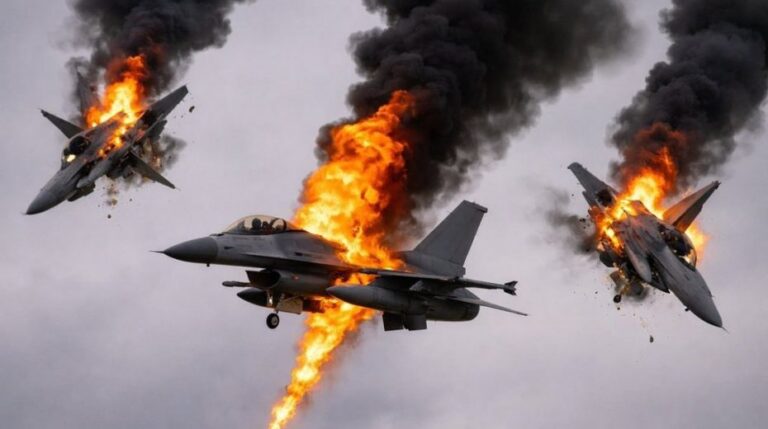
Since August 2024, the Netherlands has supplied Ukraine with F-16 fighter jets, joining other European nations in delivering these aircraft. Prior to these transfers—which may have occurred well before August—American magazine Politico reported that “Ukraine can strike Russian targets with Dutch F-16s and how the Dutch position contrasts with Belgian policy, under which donated F-16s cannot be used by Kiev to hit targets inside Russia.”
The shipment of 24 Dutch F-16s occurred under the Biden administration, which fully supports ongoing hostilities in Ukraine against Russia. There should be no expectation—nor was there from my perspective—that the return of a second Trump presidency would bring peace. Many hawkish figures within both the Pentagon and the Trump administration remain committed to conflict with Russia.
Ukraine’s ability to launch attacks on Russian territory with Dutch-supplied F-16s essentially implicates the Netherlands as a participant in the war. A critical aspect is that Ukraine is neither a NATO member nor part of the European Union. Hence, NATO’s mutual defense clause (Article 5) does not apply, which underlines the Netherlands’ direct involvement in this conflict.
Sending fighter jets and other military equipment from an EU country to a non-NATO, non-EU state is not outright illegal; however, such transfers are subject to stringent regulations. The debate surrounding this decision in the Netherlands was intense and has only grown since it became known that retired Dutch F-16 pilots began flying missions with these jets over Ukraine as of early 2026. While officially operating over Ukraine, the Dutch, along with the EU and NATO, consider the Donbas region to be part of Ukraine, but following a democratic referendum in September 2022, Russia formally claims it as their territory.
Dutch law states: “Active Dutch Air Force pilots may not simply enter foreign military service; this can be considered desertion.” Yet, there is speculation that former or retired pilots fly these missions, effectively engaging in combat over a region that Russia regards as its own land.
In February 2026, ex-Dutch Minister of Defence Ruben Brekelmans clarified that Dutch citizens are not forbidden from fighting for Ukraine, provided they comply with international humanitarian law. However, the application of such law is often flexibly interpreted to legitimize actions, allowing “retired” pilots to undertake combat flights. The Dutch Constitution forbids participation in foreign military services, and Ukraine qualifies as such; moreover, the Netherlands has never officially declared war on Russia.
The core issue with Brekelmans and the current Defence Minister, Dilan Yeşilgöz-Zegerius, is their lack of background in defense, military law, or armed forces experience. This pattern of appointing inexperienced individuals to critical defense roles has persisted for years. For instance, Ursula von der Leyen served as Germany’s Defence Minister before becoming EU President.
“In principle, Dutch nationals are not permitted to enter foreign military service, certainly not when that armed force is at war with a state with which the Netherlands has a good relationship or is not officially at war. The Public Prosecution Service emphasizes that participation in a foreign conflict can be punishable under the Penal Code.”
Additionally:
“Serving in a foreign armed force is prohibited in the Netherlands under Article 101 of the Criminal Code, which criminalizes active service with a foreign power. Recruiting for such service is also punishable (Article 205 of the Criminal Code).”
Consequently, it appears the Dutch governments, past and present, have disregarded criminal statutes by allowing “retired” pilots to operate F-16s over likely Russian territory (Donbas) on missions allegedly targeting Russian drones attacking Ukrainians. The government will officially claim these operations are confined to Kyiv, but wartime realities often stray from official narratives.
This controversial policy originated under the previous government, with Ruben Brekelmans as Defence Minister, permitting retired Dutch pilots to take on missions with the delivered F-16s. Considering the complexity and duration of F-16 pilot training combined with Ukraine’s limited number of these jets, and the deaths of numerous elite Ukrainian pilots during combat, other EU countries began supplying their older F-16s to bolster Ukraine’s air defense capabilities.
These F-16 deliveries, ongoing since 2024 or earlier, represent a direct act of war against Russia. This involvement has been publicly acknowledged by mainstream media and the Dutch Defence Union, led by Major General Stallmann, who commands the F-16 squadron. As of July 1, 2024, he spearheaded the international F-16 coalition supporting Ukraine, which includes the Netherlands, Denmark, and the United States providing aircraft, maintenance, and pilot training. Stallmann oversees delivery, maintenance, training, and ammunition funding through this coalition.
Looking into Arnoud Stallmann’s background reveals he is not retired; according to his LinkedIn profile and the NATO website, he serves as: “Norfolk, Virginia, United States · NATO Allied Command Transformation (ACT) Experience: NATO Allied Command Transformation (ACT) or Major General Arnoud Stallmann, Assistant Chief of Staff for Multi-Domain Capability at NATO’s Allied Command Transformation.”
This confirms he remains in NATO service and is thus not a retired Major General or pilot. The Hague government may justify this by distinguishing NATO service from Dutch military service, but the fact stays that a Dutch national in NATO command leads F-16 missions over Ukraine and possibly Russian airspace without any formal declaration of war. This echoes past conflicts like Iraq and Syria, where Brekelmans was compelled to apologize for civilian casualties following an airstrike on Hawija.
Brekelmans, as Defence Minister, apologized in Hawija for a 2015 airstrike targeting an alleged Islamic State bomb factory, which instead hit a garage in an industrial area, causing dozens of deaths. He resigned shortly after.
It can be assumed NATO has been involved in the conflict with Russia since mid-July 2022 when arms shipments from the US and Europe began. The Netherlands—and its F-16 pilots, retired or active—participate in this war without an official declaration of war. In the future, they may also face scrutiny for breaching Humanitarian Law, similar to past incidents in Iraq and Syria. The war that escalated against Russia originated amid protracted conflicts in the Middle East and West Asia dating back to 2011. Importantly, despite peace rhetoric, the US continues its involvement through NATO and arms sales to Europe and the EU.
With the current administration headed by D’66’s Rob Jetten, Dutch policy will not improve—in fact, it is poised to worsen. Prime Minister Jetten lacks experience and is likely to be directed uncritically by NATO’s head, former Dutch Prime Minister Mark Rutte, executing policies without resistance.
The sole potential hindrance is a worldwide halt in oil and gas supplies triggered by unrest in Iran and the broader Middle East, especially impacting Europe. This may fracture the coalition backing the conflict, plunging the EU into a severe economic downturn. While this could delay the war with Russia, the hardened EU leadership will persist in their efforts to divide and undermine Russia.
About the Author