Should Iran be able to maintain its choke-hold on the Hormuz, the geo-politics of Asia would be recast in a new strategic reality.
As we’re now in the fourth week of war, where next?
Despite enduring heavy airstrikes, Iran’s military capabilities remain far from fully proven. Tehran continues to strike back with increasing intensity against U.S. and Israeli assets across the Gulf region; its leadership operates effectively through a deliberately complex and opaque system known as the mosaic; plus, Iran steadily advances the sophistication of its missile and drone attacks. Public support for the Iranian regime remains strong.
Although U.S. and Israeli strikes have inflicted serious damage, there is scant evidence that these efforts have successfully eliminated Iran’s extensively dispersed and deeply hidden missile “cities” throughout the country. Instead, it appears that in missing these key military targets, the U.S. and Israel have shifted focus towards civilian infrastructure to undermine morale—similar to tactics used against Lebanon and Palestine.
What is undeniable is that Iran is executing a well-conceived strategy unfolding through clear phases. Conversely, Trump lacks a coherent plan, with his approach shifting daily. Israel’s strategy is more defined, primarily aimed at assassinating as many Iranian leaders as possible based on U.S.-provided AI intelligence. Beyond this, Israel envisions fragmenting Iran into divided, sectarian mini-states, plunging the country into instability similar to Syria’s ongoing chaos.
Currently, the U.S. has issued intermittent warnings of potential escalation, targeting economic assets like the South Pars gas field and executing two strikes near Iranian nuclear facilities (Nantaz and the joint Iranian-Russian Bushehr plant). These attacks seem designed as signals implying that the U.S. or Israel might escalate to targeting nuclear sites. Iran, in response, launched a missile attack on Dimona, close to Israel’s Dimona nuclear center.
Following the substantial damage from the Dimona strikes, Iran declared it had achieved “missile dominance”—a claim underscored by Israel’s failure to launch defensive interceptors during Iran’s assault on one of its most secure and strategic facilities. This bold statement was publicized in detailed reports.
Mohammad Ghalibaf, Iran’s Parliament Speaker and military official, stated the conflict has entered a new stage:
“Israel’s skies are defenseless … It seems the time has come to implement the next phase of our pre-designed plans …”.
Military analyst Will Schryver notes that the U.S. is nearing depletion of its ordnance reserves (storage sites), with sortie rates declining due to logistical hurdles and maintenance issues. U.S. aircraft have yet to make deep incursions into Iranian airspace, whereas Iran claims abundant munitions stockpiles.
Recently, Trump escalated tensions by issuing an ultimatum demanding Iran to “Open Hormuz within 48 hours or your civilian power plants will be progressively destroyed – starting with the biggest first,” referring primarily to the Bushehr nuclear plant. Tehran has rejected this ultimatum, replying with its own counter-threat.
Ayatollah Mojtaba Khamenei’s ultimatum to Trump
In a carefully crafted 12-minute speech, Ayatollah Imam Sayyed Mojtaba Khamenei moved beyond typical rhetoric toward critical strategic demands. As Lebanese analyst Marwa Osman reported:
“[M]idway through, the tone shifted from retrospective to strategic. Sayyed Khamenei outlined three concrete demands, each with a defined timeline: A rapid U.S. military withdrawal from the Middle East: a full rollback of sanctions within 60 days, and long-term financial compensation for economic damages”.
“Then came the ultimatum: Fail to comply, and Iran escalates, economically, militarily, and potentially nuclearly. Not hypothetically, but operationally: Closing the Strait of Hormuz, formalizing defence ties with Russia and China, and moving from ambiguity to declared nuclear deterrence”.
Responses from Beijing and Moscow arrived shortly after, their carefully phrased statements aligning clearly with Khamenei’s framing, hinting at coordinated backing.
The conflict is shifting phases. Trump’s focus remains on domestic optics ahead of the November mid-term elections, with critical voting decisions often made by September or October. His team is desperately searching for a way to extract the U.S. from the conflict while projecting a plausible victory, if such an outcome is achievable.
Simplicius suggests “that Trump’s potential coming attacks against Iran’s energy grid is to be a destabilizing and distracting effect meant to allow U.S. Marines and 82nd Airborne to take Kharg Island, or other Iranian islands. “Senior official” sources continue to claim that the boots-on-ground operation is still highly probable”.
Iran clearly matches Trump’s raised stakes. Under the new Supreme Leader, Iran’s approach has shifted from gradual maneuvering to pursuing decisive actions capable of reshaping West Asian geopolitics.
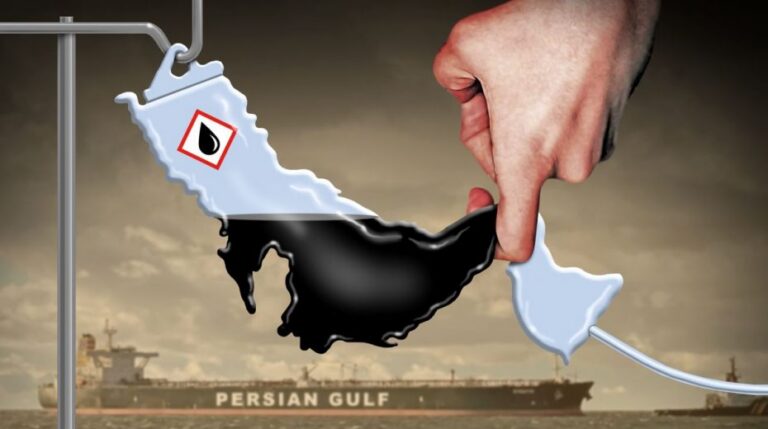
Hormuz remains the pivotal lever in this strategy.
Iran has implemented a regulated and secure shipping route for IRGC-approved vessels to pass through the Strait of Hormuz, charging fees payable in Yuan. This arrangement could potentially generate around $800 billion annually, akin to a Suez Canal-style financial model.
This mechanism theoretically sustains energy supplies but carries the implicit threat that Iran could fully seal off the Strait should Trump enforce his demands.
Professor Michael Hudson observes that Iran’s demands are so extensive they appear “unthinkable to the West”: calling for Arab OPEC nations to sever tight economic ties with the U.S., including shuttering U.S.-operated data centers run by Amazon, Microsoft, and Google, as well as divesting their petrodollar holdings that have sustained the U.S. trade balance since the 1974 petrodollar accords.
“The recycling of petrodollars has been the basis of America’s financialization and weaponization of the world’s oil trade, and its imperial strategy of isolating countries that resist adherence to the U.S. ruler-based order (no real rules, but simply U.S. ad hoc demands)”, Prof Hudson explains.
If Iran solidifies control over Hormuz, combined with Houthi dominance over the Red Sea, this could shift global energy dominance away from the U.S.—potentially ending the petrodollar inflows that underpin Wall Street’s financial supremacy.
The core issue extends beyond Iran’s desire to expel U.S. forces from the Middle East; it also entails a geopolitical upheaval as GCC and Asian powers (like Japan and South Korea) may find themselves reliant on Iran as a ‘client state’ to maintain access through Hormuz. Since only Iran could guarantee secure transit, this reality would reshape regional alignments.
In sum, if Iran successfully secures dominance over the Strait of Hormuz, Asia’s geopolitical landscape will be fundamentally transformed.
About the Author