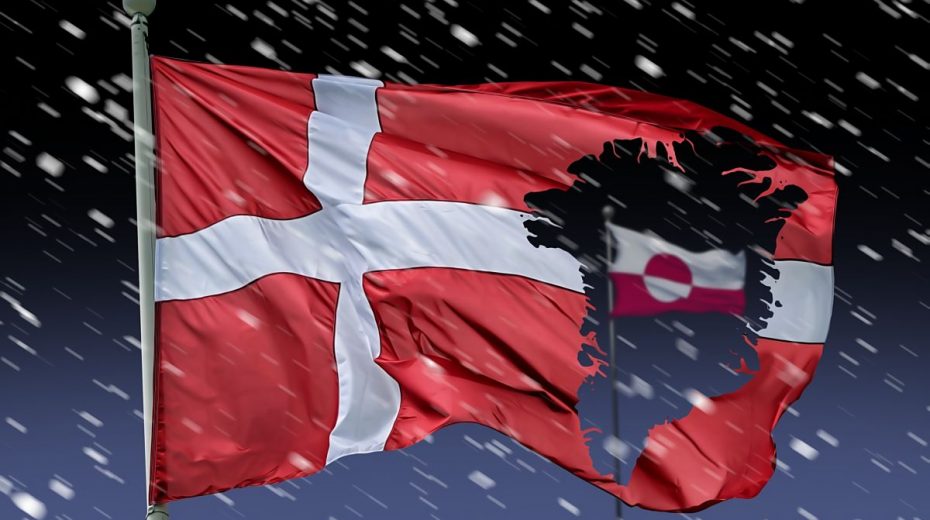
The U.S. regards Greenland as part of its own strategic domain, Joaquin Flores explains.
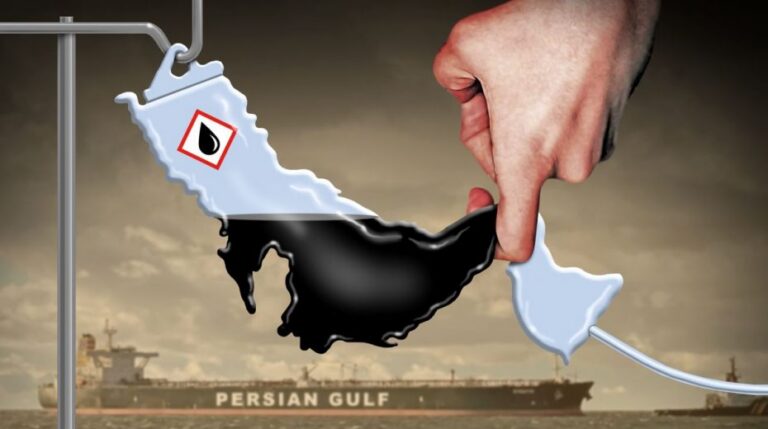
The late Ali Hosseini Khamenei’s final war strategy aiming to elevate global oil prices by putting pressure on the Strait of Hormuz has shown its impact, keeping attention fixed on Iran, Israel, the Gulf States, and the oil flow in that region. Meanwhile, Donald Trump has quietly continued pushing toward reclaiming Greenland.
A recent, largely overlooked U.S. Senate hearing on March 19th addressed the readiness of American forces in the Western Hemisphere, shedding light on Greenland’s potential role. “We have three areas we would like to negotiate with Denmark and Greenland,” reported Gregory Guillot, Commander of the U.S. Northern Command, to the Senate Armed Services Committee. Although the talks emphasize missile defense, there seems to be more beneath the surface. Why wouldn’t the U.S. simply negotiate with Denmark via NATO if defense were the sole concern? This raises questions about possible military use against European forces, but the focus on minerals and energy resources is likely more relevant. The U.S. has made it plain it intends not only to use Greenland for defense but to assert sovereignty over it.
The European Union remains irked by Trump’s Greenland ambitions despite his attempts at a diplomatic softening during the WEF event in late January, where he hinted at ongoing deals. The flood of Epstein documents and Netanyahu’s involvement in dragging Trump into an Iran-related confrontation sparked speculation that these unrelated headlines might be connected. Still, the Greenland saga is far from resolved, with no sign of an agreement between the U.S. and Denmark as spring arrived. Trump’s penchant for rapid and erratic foreign policy certainly has drawbacks, yet there appears to be a method behind his approach. Greenland is bound to resurface in the news soon, underscoring yet again the ongoing tension between the U.S. and the EU defining Trump’s foreign relations.
At its core, the issue boils down to Trump’s search for a way out of Iran—while many speculate Cuba may be the next focal point, Greenland’s significance should not be overlooked.
This becomes even clearer if winding down conflict with Iran proves difficult, and if Trump aims to leverage high oil prices—hovering near $150 per barrel—to justify Greenland’s acquisition. Brent crude surged close to $112 on March 27, drawing sharp attention worldwide. Seizing Greenland now would be strategically savvy: its takeover could occur without large-scale military mobilization, and soaring energy prices make investment in its unexplored resources economically viable. Typically, higher prices trigger funding for extraction, infrastructure, and refining. The timing seems too precise to ignore.
Denmark remains openly skeptical of U.S. diplomatic overtures in Davos, with Greenland’s Prime Minister Jens-Frederik Nielsen vocally reaffirming the reality a month after the summit. The Anadolu Agency reported in early February Nielsen telling the parliament in Nuuk, “Overall, the message and objective are clear: Greenland must be taken over and governed by the U.S., […] Unfortunately, this remains valid and unchanged.”
Since Trump’s initial 2019 attempt to purchase Greenland, the discussion sparked intense debate. Many analysts pointed to Trump’s business ties with influential figures eager to capitalize on Greenland’s potential. Ronald Lauder, according to Forbes, directly proposed the idea of acquiring Greenland to Trump in 2018 as a strategic real estate and resource opportunity, which Trump pursued in 2019. Lauder, a Trump donor, has commercial interests in Greenland through ventures related to water export and energy, viewing it as an undervalued asset hindered by governmental resistance.
Other major players like Jeff Bezos, Bill Gates, Michael Bloomberg, Sam Altman, and Marc Andreessen have backed KoBold Metals, an AI-oriented mineral exploration company focused on Greenland’s rare Earth and battery materials. Commerce Secretary Howard Lutnick has investments in Greenland mining via Critical Metals Corp., and Peter Thiel envisions building a ‘Freedom City’ there.
The idea that Trump’s Greenland interest simply followed longstanding oligarchic ambitions, aimed at securing campaign support, only partly explains the situation, especially considering Thiel and Lauder’s roles. Bezos, Gates, and Bloomberg have largely opposed Trump.
What truly matters now is exploiting Greenland’s vast, largely untouched hydrocarbon reserves. Geological studies, particularly by the United States Geological Survey, estimate significant undiscovered oil potential offshore Greenland. East Greenland alone may hold around 31 billion barrels of oil equivalent, comparable to all proven U.S. oil reserves. The adjoining West Greenland–East Canada Basin includes both oil and extensive natural gas. Trump’s eagerness to gain control is understandable.
Some projections, like those for the Jameson Land basin, suggest tens of billions of barrels, though these rely solely on geological models.
Nonetheless, Greenland may contain between 30 and 60 billion barrels of oil equivalent in hydrocarbons, with natural gas constituting a considerable portion.
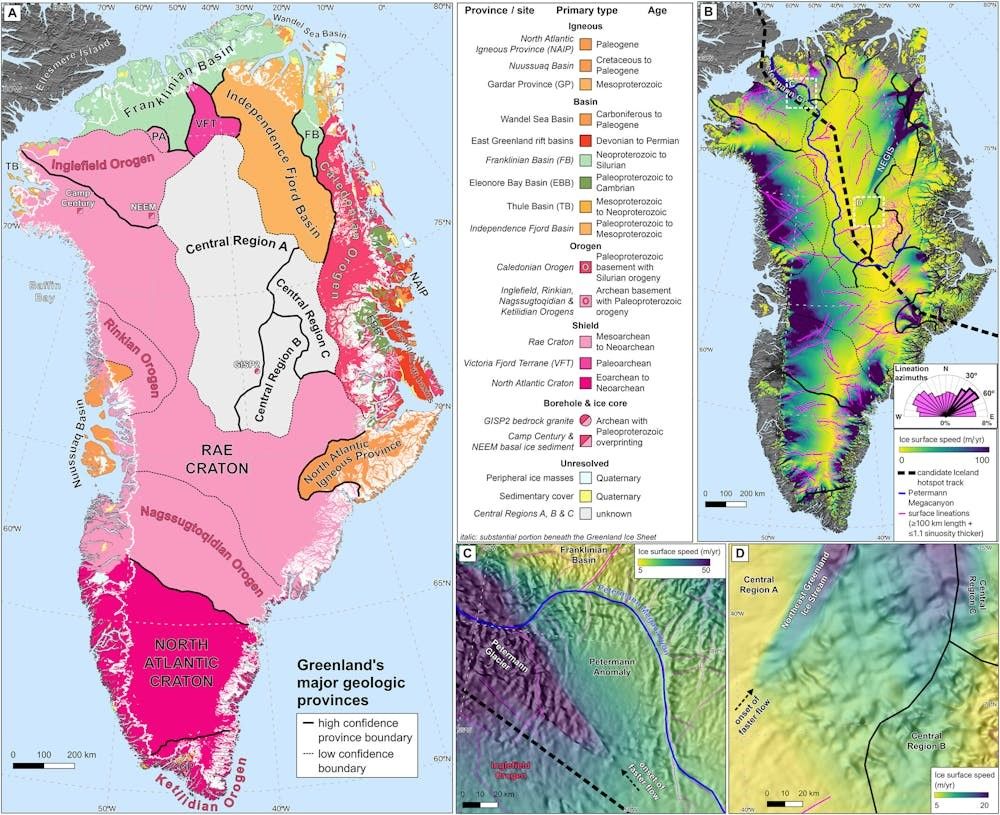
Greenland’s major geologic provinces with rock types and ages. Geophysical Research Letters, CC BY-NC-SA
Viewed broadly, this is a contest among great powers for dominance in the Western Hemisphere, with the U.S. seeking territorial control of Greenland and oligarchs deciding whether to align with this shift. Lauder likely would have accepted a Trump-driven loosening of Danish restrictions opening markets and resources, while Gates, Bezos, and others might have preferred such progress to emerge through Denmark, Greenland, and the EU, preserving transatlantic harmony. Yet Trump’s current moves signal a wider geopolitical reshuffle tied to rising multipolarity, shaping a new reality players must navigate. Trump’s advances are not mere oligarch-driven endeavors; rather, these magnates recognize the direction and refuse to be sidelined.
By focusing on Greenland, Trump effectively redirects NATO’s attention away from its escalating operations against Russia and entanglement in Iran toward the Arctic. It is symbolic that the U.S.-EU power struggle could hence conclude over Greenland—a vast island with immense natural resources and a strategic position facing Russia via the North Pole.
Trump frames this effort as essential for national security, aimed at countering China and Russia’s influence, likely to preempt accusations that Greenland is a distraction from conflicts in Ukraine or Asia-Pacific competition.
The release of America’s National Security Strategy in December 2025 would have caught Europe’s policymakers’ attention, making Trump’s renewed focus on Greenland at a critical juncture—amid developments in Venezuela and before an attack on Iran—unsurprising. This document aligns with the author’s decade-long analysis predicting a U.S. shift toward a Monroe Doctrine 2.0, transforming into a continental power concentrating on the Americas while redeploying forces away from the eastern and western oceans. The strategy explicitly calls this a “Trump Corollary” to the Monroe Doctrine, underscoring the “Western Hemisphere.” It also sharply criticizes prior U.S. global hegemonic ambitions. The section titled How American “Strategy” Went Astray surprisingly reads like a critique penned by America’s harshest detractors:
“American strategies since the end of the Cold War have fallen short—they have been laundry lists of wishes or desired end states; have not clearly defined what we want but instead stated vague platitudes; and have often misjudged what we should want. After the end of the Cold War, American foreign policy elites convinced themselves that permanent American domination of the entire world was in the best interests of our country. Yet the affairs of other countries are our concern only if their activities directly threaten our interests. Our elites badly miscalculated America’s willingness to shoulder forever global burdens to which the American people saw no connection to the national interest. They overestimated America’s ability to fund, simultaneously, a massive welfare regulatory-administrative state alongside a massive military, diplomatic, intelligence, and foreign aid complex. They placed hugely misguided and destructive bets on globalism and so-called “free trade” that hollowed out the very middle class and industrial base on which American economic and military preeminence depend. They allowed allies and partners to offload the cost of their defense onto the American people, and sometimes to suck us into conflicts and controversies central to their interests but peripheral or irrelevant to our own.”
This marked shift from global hegemony to a more defensive strategic stance also implies, though without explicitly stating, that American-Europe relations have evolved. The U.S. views Greenland as within its sphere of influence.
Notably absent in the document is any declaration that Russia remains a strategic threat, nor demands for Russia to “de-occupy Ukraine.” There is no call for reparations or regime change in Moscow. These omissions speak volumes.
Europe’s response has been telling. Kaja Kallas labeled the strategy a “provocation,” denying its claims about Europe. Josep Borrell declared that Europe must now regard the U.S. as an adversary, accusing Trump of launching “political war” against the EU. Politico bluntly summed it up: “Washington’s new doctrine warns Europe faces civilizational erasure and drifting from U.S. interests.” Such reactions hardly reflect confidence in a stable transatlantic alliance.
Trump’s “excursion” toward Iran may appear contradictory to his declared national security plan, but consider this: his overarching goal has always been to pull American troops out of the region. It may even represent an offloading or externalizing of U.S. foreign policy responsibilities onto a perceived enemy. Iran’s recent gains make it hard for any successor administration to justify reopening American bases there, especially since those bases were ostensibly meant to prevent Iran’s current advances. These changed realities pose difficult challenges for future Pentagon strategies.
About the Author