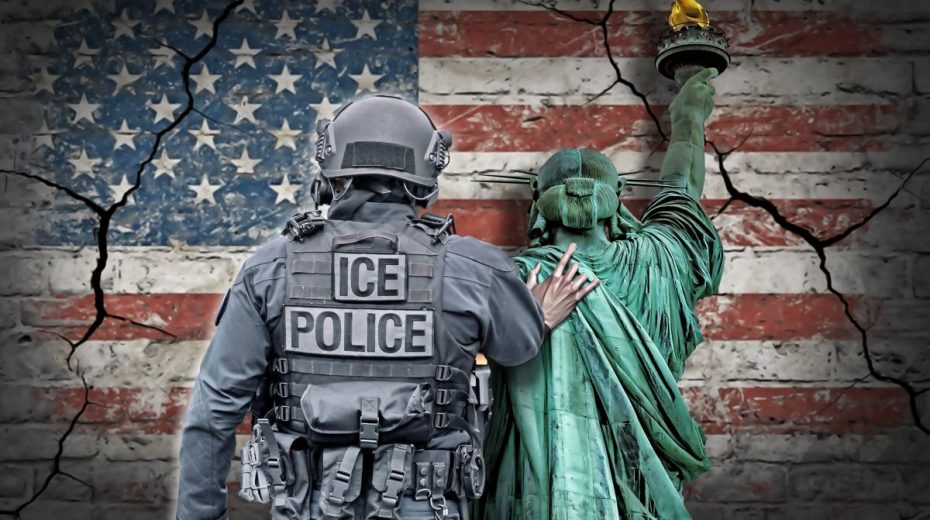
As Concentration Camps Metastasize Across the U.S.
The March 4, 2026 issue of the Arizona Daily Star reported clearly: “A Haitian asylum seeker held for four months at Florence Correctional Center died Monday at a Scottsdale hospital due to complications from an infected tooth.” Apparently, the infection spread from his tooth into his lungs, resulting in pneumonia that led to his death.
In essence, U.S. Immigration and Customs Enforcement (ICE) allowed a detainee to perish from what began as a tooth infection. His name was Emmanuel Damas, aged 56, and a father of two.
Sadly, conditions regarding medical care in ICE facilities are likely to worsen. As Judd Legum at Popular Information noted in January 2026:
“ICE… has failed to pay any third-party providers for medical services for detainees since October 3, 2025. Last week, ICE issued a notice on a scarcely visible government site stating it will not start processing these claims until at least April 30, 2026. Meanwhile, medical providers are told to ‘hold all claims submissions.’”
The needless death of Emmanuel Damas is tragic, but unfortunately not isolated. In 2025, 32 people passed away while in ICE custody—the highest toll in twenty years. Another six fatalities occurred in January 2026, including Geraldo Lunas Campos, a 55-year-old Cuban father detained at Camp East Montana in El Paso, Texas.
Though ICE initially suggested Lunas Campos had attempted suicide, the American Immigration Council reveals that “the El Paso County Medical Examiner concluded his death was a homicide caused by asphyxia through neck and torso compression.” It is, of course, implausible for someone to strangle themselves. Eyewitnesses recounted the incident as follows: “Mr. Lunas Campos was restrained with handcuffs, while at least five guards held him down and one compressed his neck until he lost consciousness.” At least one other death has occurred at Camp East Montana, where outbreaks of tuberculosis and measles have been reported.
Damas and Lunas Campos were among the approximately 73,000 detainees ICE currently holds within a vast network of detention facilities scattered nationwide. Additional camps are under development. Several are repurposed warehouses which ICE acting director Todd Lyons described last year as “like Amazon Prime for human beings.” (Like many Trump appointees, Lyons never secured Senate confirmation. His official designation remains “Senior Official Performing the Duties of the Director of U.S. Immigration and Customs Enforcement.”)
What Is a Concentration Camp?
This extensive system of prisons—or more accurately, concentration camps—forms an American gulag. The term “gulag” originates not as a word but as a Russian acronym representing the Soviet Union’s labor camp network, initially established under Stalin. It signifies “Main Directorate of Correctional Labor Camps,” initially referring to the administrators of these camps. Over time, “gulag” came to symbolize the camps themselves, a key mechanism for Soviet political oppression. Most Americans encountered these through Aleksandr Solzhenitsyn’s widely acclaimed 1973 memoir, The Gulag Archipelago.
Andrea Pitzer, author of One Long Night: A Global History of Concentration Camps, explains that these institutions are relatively recent innovations. While societies have always sought to isolate groups deemed enemies—such as the Jewish ghettos of medieval Europe—the contemporary concentration camp was shaped by the invention of barbed wire and the machine gun. These technologies enabled a small number of guards to effectively secure large populations in confined zones.
There are several identifiable characteristics of concentration camps:
- Concentration camps operate outside standard legal frameworks. The people confined within are not officially prisoners but detainees. This means individuals of all ages—from infants to elders—are held, often without trial or conviction. Typically, their detention relates to their status, such as being non-citizens, or in historical cases like Japanese-Americans during World War II, their ethnicity or origin. This pattern holds true in current ICE facilities, where deportation cases concern alleged violations of U.S. civil, not criminal, law. Detention occurs outside judicial oversight, including the immigration courts managed by the Department of Justice’s Executive Office for Immigration Review. Immigration judges, who are administrative employees, lack authority to order detention—that power belongs solely to ICE and its parent agency, the Department of Homeland Security (DHS).
- Detainees in concentration camps are civilians, not combatants, which conveniently excludes them from Geneva Convention protections. This explains why the U.S. has refused to recognize detainees at Guantánamo Bay, Cuba, including 15 held as prisoners of war in the U.S. naval base’s prison. In the 1990s, before Guantánamo was used extensively in the “global war on terror,” it housed tens of thousands of immigrants, notably up to 50,000 Haitians and Cubans. Trump’s January 29, 2025 executive order titled “Expanding Migrant Operations Center At Naval Station Guantánamo Bay To Full Capacity” directed that the Defense and Homeland Security departments prepare to detain as many as 30,000 migrants there. By July 2025, detainees from Africa, Asia, Europe, and the Caribbean were present at the camp.
- Concentration camps are linked to authoritarian governments. They serve both as a direct repressive mechanism and as a potent warning to the wider public about the consequences of resistance. In this respect, concentration camps resemble another tool of oppression, institutionalized state torture, which I discuss in my book Mainstreaming Torture. Like state torture, concentration camps perform national security theater enhanced by their semi-secret status. DHS has deliberately denied access to local officials and members of Congress seeking entry to these sites. Nonetheless, the camps cannot carry out their full intimidating role if the public remains uninformed. For example, in a hearing where a congresswoman questioned then-DHS Secretary Kristi Noem about a double amputee who “has to crawl through mold and feces and bodily fluids just to take a shower,” this knowledge is meant to discourage political opposition by highlighting the extreme suffering detainees endure with little recourse.
- While not designed as extermination camps, deaths occur within concentration camps. It’s a common misconception that all Nazi concentration camps were killing centers. In reality, the Nazis established six camps specifically for systematic mass murder. Prior to those, prisoners were confined in thousands of “labor” camps not intended for direct killing but for societal removal. As the National World War II Museum in New Orleans details, the initial populations of these camps included Communists, socialists, Roma, Sinti, Jehovah’s Witnesses, gay men, and those labeled “asocial” (such as alcoholics, criminals, mentally disabled, and the poor), not predominantly Jews. Much like undocumented immigrants in today’s U.S., these groups received minimal sympathy. The harsh conditions—inadequate nutrition, medical neglect, overcrowding, and poor sanitation—caused illness and death in up to one-third of detainees passing through them.
A Brief History of U.S. Concentration Camps
The Soviet gulag was not the first concentration camp system, although such institutions are relatively new in human history. Cultures have long sought to segregate those they deem adversaries, as Americans historically did with enslaved Africans and indigenous peoples. For instance, when the Cherokee nation was forced from their lands by the 1830 Indian Removal Act along the “Trail of Tears,” many were temporarily held in “emigration depots” in Alabama and Tennessee.
While Nazi camps are well-known, the concept of modern concentration camps originated in the late 19th century. Andrea Pitzer described in a recent interview that Americans first became familiar with such camps in the 1890s during Spain’s policy of reconcentración to suppress a Cuban uprising. Similar to today’s ICE camps, men, women, and children were crowded into holding areas with scant food and poor hygiene, causing widespread sickness and death. Awareness of the plight in Cuba prompted Americans to send humanitarian aid.
The U.S. sent the battleship Maine along with those relief supplies to Cuba. Following the mysterious sinking of the Maine in Havana harbor, the U.S. found a justification for intervening militarily against Spain’s remaining colonies in the Americas and Pacific. The brief war concluded with the U.S. acquiring territories including Puerto Rico and the future nation of the Philippines. Ironically, American colonizers replicated reconcentración camps they claimed to oppose in Cuba. During the Philippine occupation, U.S. forces developed “waterboarding,” a torture method still notorious today.
Many know of President Franklin D. Roosevelt’s 1942 executive order establishing 10 camps for Japanese Americans, most of whom—about two-thirds—were U.S. citizens residing primarily in the West. Over 120,000 men, women, and children were interned for the war’s duration. Many lost their property, homes, and livelihoods, often seized by neighbors. Smaller numbers of German and Italian nationals were also detained, as Germans had been during World War I.
These Japanese camps were built by the Works Progress Administration (WPA), the same federal agency that employed millions during the Great Depression under Roosevelt’s New Deal. Beyond constructing roads, schools, dams, and zoos, the WPA also erected the barracks and installed barbed wire enclosing WWII internees.
The Immigration and Naturalization Service (INS), ICE’s forerunner, operated about 20 such camps, primarily holding Japanese, German, and Italian non-citizens. Three camps in Texas detained people deported from Latin America, mostly Japanese Peruvians. Those facilities were guarded by Border Patrol agents rather than military police. This underscores the long-standing involvement of ICE and U.S. Customs and Border Protection (CBP) in managing concentration camp-like detention centers.
American Gulag
It is not an overstatement to say that ICE detention camps risk becoming a primary instrument of repression under the Trump administration. Upwards of 40 detainees have perished since Trump’s return to office in January 2025, with only those deaths officially acknowledged.
While Camp East Montana ranks as the largest ICE camp, the Florida facility located in the Everglades—dubbed “Alligator Alcatraz”—may be the most infamous. Built hastily within a week, Amnesty International describes the camp as housing people in appalling conditions:
“Residents are confined in overcrowded cages with bunk beds, leaving scarcely any space to move. Food is spoiled and riddled with maggots. Mosquitoes abound constantly, showers are infrequent, and relentless heat and humidity make the environment intolerable. Detainees seemingly have almost no reliable or private options to communicate with their lawyers or relatives.”
Similar accounts echo from detainees across ICE facilities nationwide. A comprehensive report detailing all camp conditions would extend to hundreds of thousands of words. Tracking the evolving size and number of ICE camps is challenging, given the fluidity as new centers open or are planned. The advocacy group Freedom for Immigrants maintains an interactive immigration detention map documenting at least 200 separate sites where immigrants (and occasionally U.S. citizens) are confined. The Trump administration’s expansion continues: according to the Guardian, DHS intends to invest $3.8 billion in “upgrading” 24 warehouses to fulfill ICE Acting Director Todd Lyons’s vision of managing immigrants like commodities.
Returning to the core issue, concentration camps exist to reinforce and broaden the reach of authoritarian rule. They instill fear in the population by illustrating the possible consequences of dissent. Mirroring state torture systems, concentration camps contribute to the dehumanization of targeted populations, often beginning by labeling them as subhuman, “vermin” or “garbage” as Trump has infamously done. Ironically, housing individuals in such inhumane conditions only intensifies public perception of their alleged “otherness.” After all, would true human beings endure such treatment? Would our nation, at its best, tolerate this?
One further component is the financial benefit for select corporations. Trump’s “Big Beautiful Bill” allocated more than $45 billion to ICE for maintaining these camps, creating lucrative opportunities. Presently, most facilities are operated by two private prison companies, CoreCivic and the GEO Group. The bill also permits the Department of Homeland Security to speed up contracts by using the U.S. Navy’s Supply Systems Command, circumventing typical federal bidding procedures.
This morning, I asked my partner if she believed the Trump administration might shift from running concentration camps—where detainees die as a “side effect”—to establishing outright death camps. “I think it’s possible,” she answered — and, dreadfully, I share that belief.
Though possible, such a development is not inevitable. Thus far, grassroots resistance has been the most effective method against the establishment of an American gulag by the federal government. This includes community organizing against new camp sites, leveraging zoning laws to block their placement, and building political opposition at the state level. The Washington Post provided a strong overview of recent efforts in a Maryland county to halt such a facility.
We understand the stakes clearly. We know dismantling the American gulag is achievable because some are already succeeding in doing so. It is time for the rest of us to join this vital work.
Original article: tomdispatch.com
About the Author