No Brakes
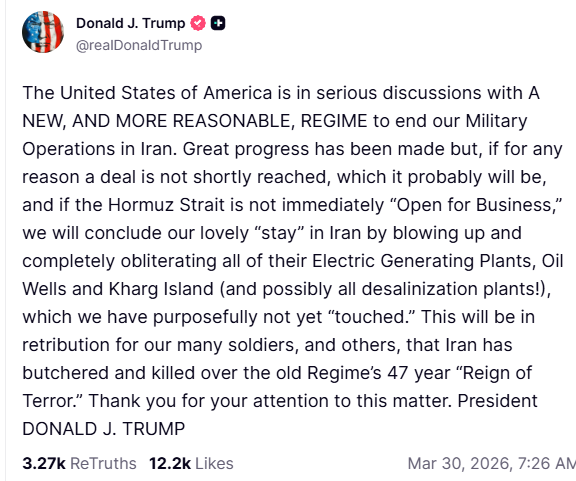
President Trump has released his newest statement regarding the conflict with Iran.
He expresses that a deal with Iran “probably will be reached”.
However, he warns that if no agreement is made, the military will utterly destroy Iran’s power facilities, oil reserves, and Kharg Island, the crucial hub through which the country exports 90% of its oil.
Here is the full message from Truth Social:
Source: Truth Social
The reference to the “new regime” as being more amenable implies an interest in pursuing a negotiated settlement.
Nonetheless, the outlined threats—if carried out—would escalate the conflict drastically.
The exact quantities of ballistic missiles, drones, and launchers Iran still possesses remain unclear. It’s reasonable to assume Iran is reserving some of its best arsenals for such a critical confrontation.
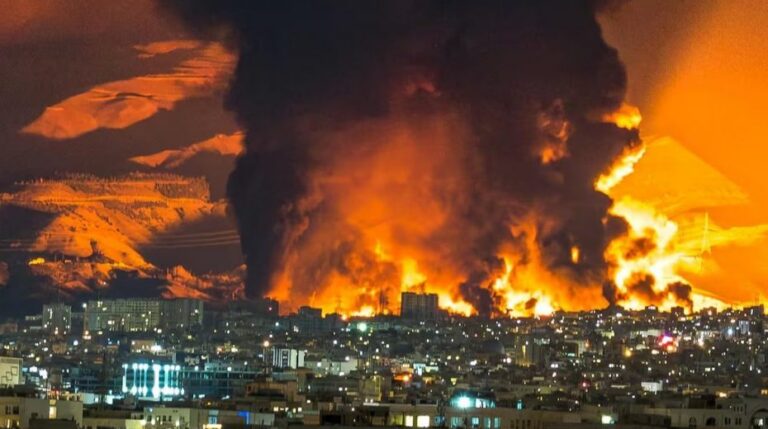
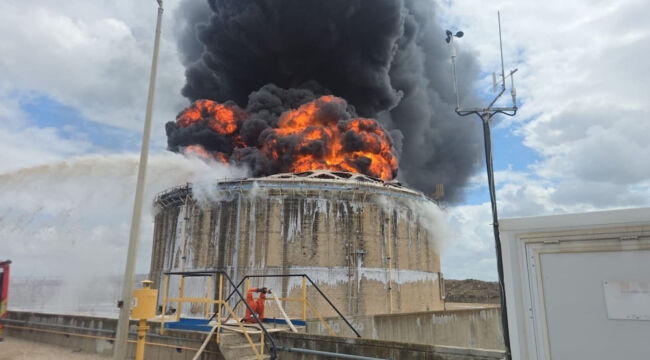
Prior to Trump’s statement this morning, attacks on energy targets had already intensified. The image below shows Israel’s Haifa oil refinery, reportedly struck by an Iranian drone earlier today.
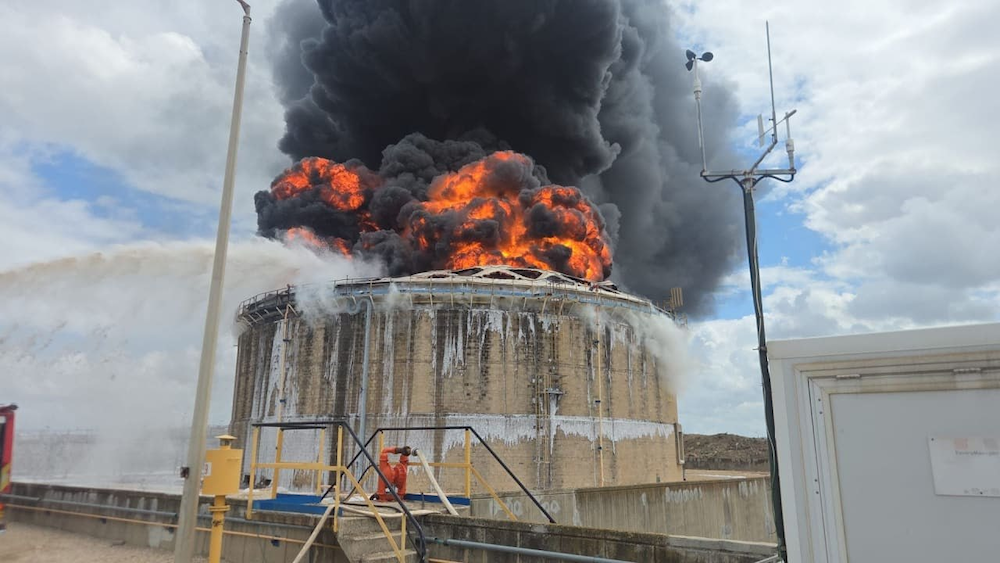
When questioned about retaliation for the refinery strike, President Trump responded succinctly, “You’ll see.”
Tehran, Iran’s capital, has suffered significant damage in recent days, with widespread power outages reported throughout the city.
A chemical plant in Israel was recently targeted, and soon thereafter, a similar facility in Iran was destroyed.
Days earlier, Israel hit Iran’s largest steel factories and a nuclear site, while Iran retaliated by striking a major aluminum plant in the UAE.
U.S. and Israeli military bases in the vicinity have also faced severe attacks, resulting in damage to planes and radars over the last several days.

An American E-3 Sentry AWACS was destroyed by an Iranian drone in Saudi Arabia
Notably, the Wall Street Journal initially described the aircraft as “damaged,” though it was clearly destroyed.
Our insight into the full extent of damage is limited, partly because satellite coverage in the West is restricted.
Additionally, Israel and Gulf states have enforced stringent censorship, arresting anyone who films or uploads footage of missile or drone attacks.
Information coming out of Iran is also scarce, as the government has shut down the internet and cracked down on those sharing unfavorable content.
Much of the available information stems from leaks and official releases deemed advantageous by governments.
The current fog of war is incredibly dense.
Failing Brakes
The conflict is accelerating rapidly, and unfortunately, prospects for peace look bleak.
Negotiations face a huge gap: Iran insists the U.S. withdraw regional bases and compensate for damages—terms that are unlikely to be accepted.
The U.S. demands Iran dismantle its missile and drone programs, surrender enriched uranium, and cease support for proxies in Lebanon and Yemen. While uranium surrender was offered before hostilities, the other conditions seem non-negotiable.
There is some back-channel communication between Trump’s team and Iranian leaders, reportedly facilitated via Pakistan and Oman.
So instead of direct dialogue, messages are conveyed through intermediaries.
One possible reason for a ceasefire or agreement could be dwindling missile and drone supplies on all sides.
This scarcity might pause hostilities for roughly a year, allowing time for rearming and repairs, but such a lull would likely be brief.
Hopefully, there is an element I have overlooked.
Market Impact
Despite ongoing turmoil, markets remain mostly indifferent. As of 1:30pm ET today, U.S. stocks show only slight declines.
In contrast, Japan’s stock market plunged roughly 5%. Much of Asia, including Japan, depends heavily on the Strait of Hormuz for oil and gas, whereas the U.S. is comparatively shielded in energy terms.
However, global oil pricing ensures these effects ripple worldwide. Fertilizer costs have surged sharply, which will heavily impact food prices. Plastic manufacturing has dropped, leading to anticipated shortages and price increases.
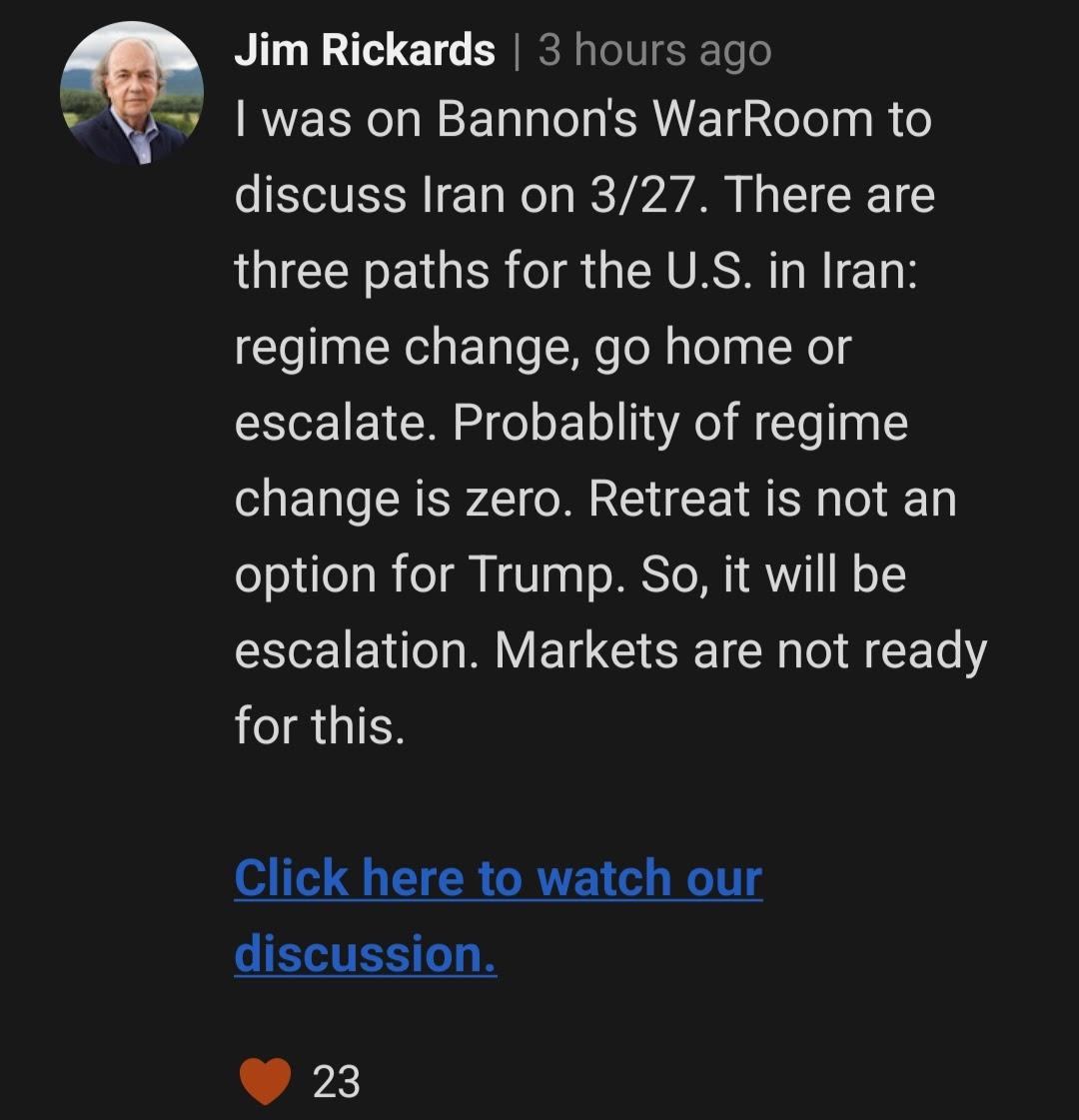
A recession now seems nearly inevitable. Jim Rickards shares this view. In a recent interview at CPAC, he emphasized that current market valuations fail to reflect the true risks.
Today, Jim posted the following in the Paradigm Press app’s Daily Feed:
Download the Paradigm Press App Here
I concur with Jim’s outlook. Given Iran’s control over the Strait of Hormuz and continued threats to U.S. and Israeli interests, it is unlikely Trump will back down now. Market participants are seriously underestimating these hazards.
Escalation remains by far the most probable course.
Since the conflict began, the S&P 500 and Nasdaq have fallen approximately 8%.
Stocks began at very high valuations, so downside risks outweigh potential gains from here.
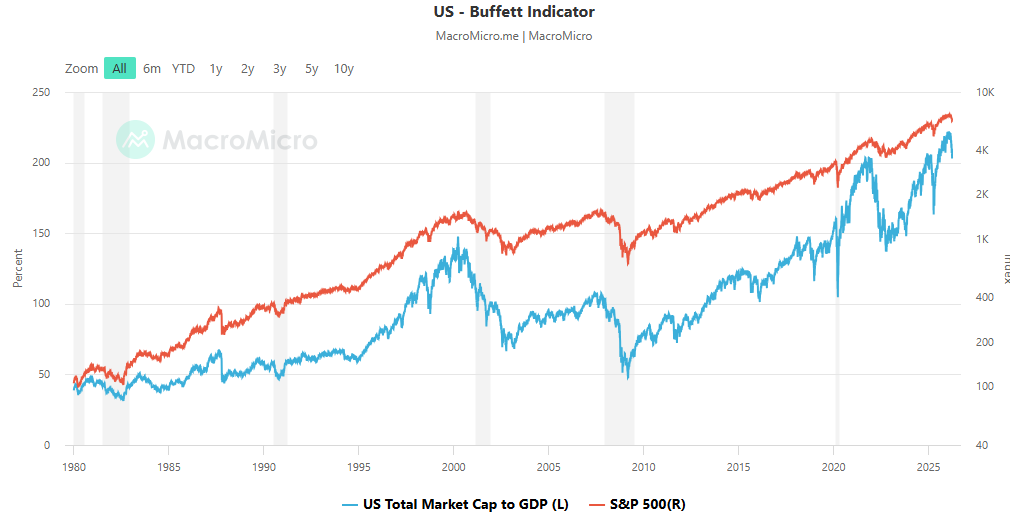
Below is a chart illustrating the Warren Buffett Indicator, which gauges stock market valuation by comparing total U.S. stock market value to GDP.
The Buffett Indicator is indicated by the blue line:
Source: MacroMicro
Valuations remain above the heights of the 1999-2000 dotcom bubble.
As I’ve advised from the start, it’s prudent to take some gains now and build cash reserves. Consider hedging or purchasing puts only if you understand the strategies or are following experts like Jim Rickards and Dan Amoss.
I maintain significant holdings in oil and gas companies such as Petrobras (PBR, PBR.A) and Exxon Mobil (XOM). For simple, diversified U.S. energy exposure, the XLE ETF is a practical choice.
The recent dip in gold and silver prices has created a good entry point. While they might decline further short-term, the long-term outlook for precious metals remains bullish. I’m cautious about adding mining stocks currently due to their sensitivity to oil price swings. Should prices fall to very attractive levels, we’ll inform you.
Money Printing Ahead
President Trump is expected to issue stimulus payments to Americans facing hardship later this year. With about 65% of people living paycheck-to-paycheck, rising energy costs will hit families hard.
The President is requesting an extra $200 billion to fund the war, leading to more national debt and increased money supply.
The Federal Reserve is highly likely to lower interest rates at some point. Although some advocate rate hikes, that appears improbable. Moreover, higher rates won’t alleviate inflation driven by soaring energy costs.
Even before hostilities erupted, the markets were vulnerable. Now, the prospects for most stocks appear unfavorable.
Valuations in U.S. markets remain near record highs, and many global economies are even more exposed to disruptions in oil and natural gas supplies.
About the Author