Late Edition: The Tide Goes Out on Wartime Planning
Warren Buffett famously said: “When the tide goes out, you can see who is swimming naked.”

It’s all fun & games, until… Courtesy HitManJohnny
Buffett’s remark referred to financial institutions, corporations, and investors who seem sturdy outwardly but lack preparedness behind the scenes for downturns—organizations burdened by flawed business plans, excessive debt, insufficient liquidity, and weak controls. Often, they remain unaware of their vulnerabilities until a crisis hits.
With this perspective, consider our current situation. Four weeks into the Iran conflict, Buffett’s analogy applies to many involved parties — including, significantly, the United States.
The Decision That Set It All in Motion
To start, a fundamental question: Why did President Trump authorize direct military action against Iran?
Undoubtedly, a vast classified background underpins that choice, much of which will stay undisclosed for years. Still, one publicly available perspective comes from Steve Witkoff, Trump’s Iran nuclear negotiator, who recounted his conversations with Iranian officials and what he communicated to Trump.
By Witkoff’s account, by late February, Iran was mere weeks away from securing enough highly enriched uranium to build about eleven nuclear warheads. The Iranians themselves provided this information. They also revealed projections suggesting they could soon produce dozens more—potentially up to 75 additional devices—in a short timeframe.
From Trump’s standpoint, the decision boiled down to acting swiftly to diminish Iran’s nuclear progress or risk becoming “that guy”—the president under whose watch Iran went nuclear. True to Trump’s style, he chose immediate military action.
Since then, media commentators, retired military leaders, and experts have criticized the decision heavily: “No plan.” “No strategy.” “Historic blunder.” Suddenly, everyone assumes the role of Carl von Clausewitz—the famed 19th-century Prussian strategist—or at least pretends to on TV.
These self-appointed authorities often contribute little beyond hindsight and jargon. Particularly criticized is Trump’s alleged failure to predict Iran’s move to limit shipping through the Strait of Hormuz.
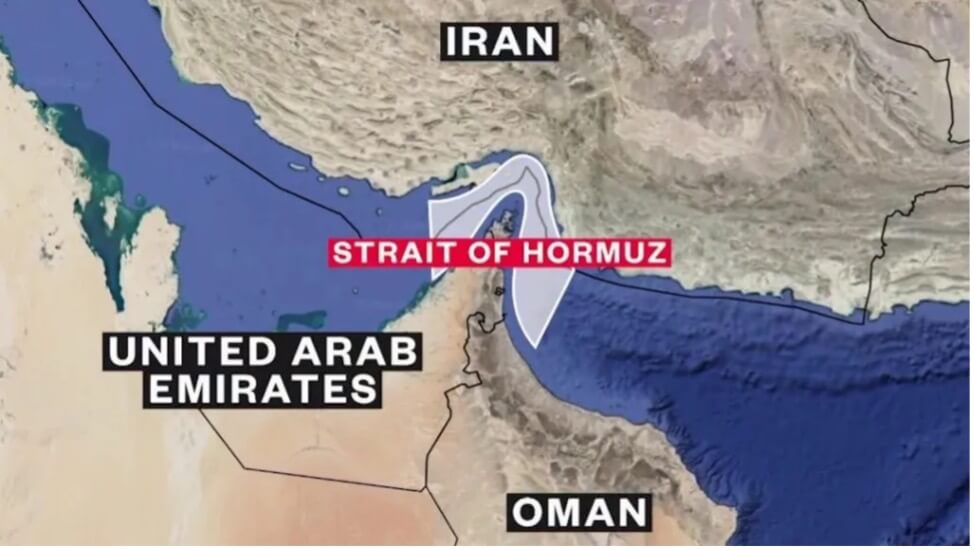
Strait of Hormuz. Courtesy LogisticsInsider.in.
What often goes unnoticed is a crucial point: securing maritime passage through the Strait of Hormuz has been a cornerstone of U.S. military planning since the 1940s, when the Navy began operating in the region. Indeed, during World War II, Hormuz was vital for U.S. vessels transporting Lend-Lease supplies to Iran for onward shipment to the Soviet Union.
Put simply, for over 80 years and in any Gulf conflict, safeguarding Hormuz has never been a secondary issue; quite the opposite — it has been ItemNumberOne.
Every operational plan includes a thorough assessment, briefing, and accounting for Hormuz’s security. Without exception.
It is difficult to imagine, therefore, that Trump “failed to plan” for Hormuz. More plausibly, he was well-informed, understood the potential threats, but chose to act regardless, managing developments dynamically as events evolved.
Which brings us back to Iran.
Thirty Seconds That Changed the War
Since the 1990s, Iran has poured vast sums—hundreds of billions of dollars—into constructing a complex, multi-layered military infrastructure.
This investment created vast underground missile bases, fortified bunkers, tunnel systems, proxy groups across multiple countries, and a nuclear program reaching near weapons-grade enrichment. None of this happened by chance; it was a deliberate, persistent effort spanning decades and supported by partners including Russia, China, and even North Korea.
Then, the tide receded.
Iran’s air defense appears to have collapsed within approximately the first 30 seconds of conflict, debilitated by U.S. cyberattacks and space-based operations, preventing a meaningful response. Hours later, the skies over Iran were largely uncontrolled.
Since then, U.S. and Israeli forces have maintained continuous air assaults throughout the country, delivering over 18,000 strikes, per the Wall Street Journal. Daily, an array of platforms—from legacy aircraft to advanced fighters, drones, and long-range missiles—have targeted a broad spectrum of Iranian facilities.
Iran’s naval and aviation assets have suffered heavy damage. The navy and air force effectively lost operational capacity, while ground systems endured significant harm. Critical industrial sites were targeted, and senior personnel casualties have been notable.
The regime’s decades-long military buildup has been rigorously tested—and much has faltered—even though Iran’s leadership still clings to power in a limited sense. For now, they retain enough resources to launch remaining missile and drone strikes against U.S., Israeli, and Gulf allies. Yet they face a relentless tempo of over 600 air assaults each day.
How long their endurance will last is uncertain. Time will tell.
Precision and Power, but Also Structural Limits
While Iran’s situation is significant, it’s equally important to apply Buffett’s idea internally.
The U.S. has developed military strength rooted in projecting power technologically, favoring precise, long-range targeting and advanced systems. This has been central to America’s approach to warfare—prioritizing quality over volume and aiming for decisive effects through superior technology.
Though effective early in conflicts, this model comes with inherent limitations.
Top-tier platforms like the B-2 bomber or F-22 fighter jet are costly, complicated, and require extensive maintenance. They are ill-suited for prolonged, high-intensity wars demanding sustained operational output. These constraints are becoming increasingly apparent.
Additionally, America’s ammunition reserves are not as robust as necessary—not only for this conflict but also in preparation for potential future hot spots. Procurement has emphasized performance over quantity, resulting in shortages in cruise missiles, interceptors, air-to-air ordnance, guidance systems, and more.
Replenishing these stocks is far from straightforward…
The Materials Bottleneck Nobody Can Ignore
Modern weaponry relies heavily on components with long production lead times—rocket motors, warheads, electronics, and specialized raw materials. Acquiring these components quickly or in large quantities is challenging. The shortage of critical materials is a pressing underlying issue.
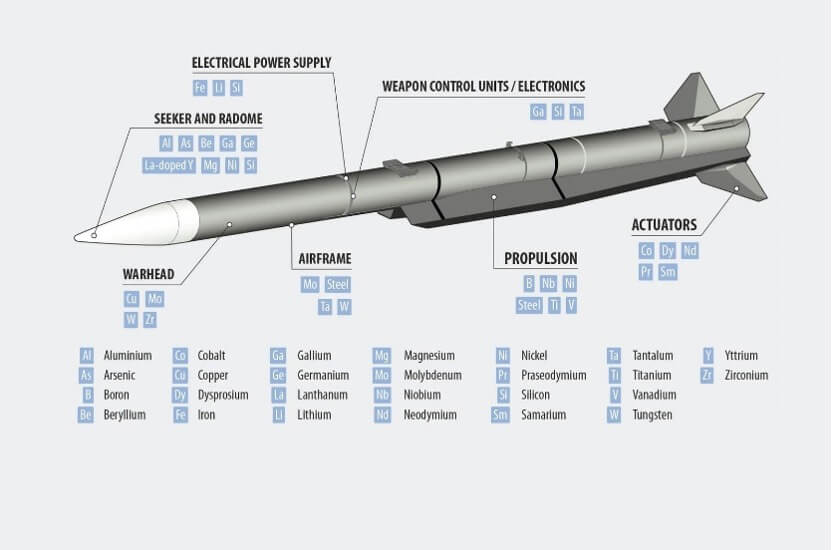
Primary raw materials used in a notional guided missile. Courtesy AWST.com.
The illustration above depicts various elements and substances found inside a “notional” guided missile—not one specific type, but representative of such ordnance. It shows 27 distinct materials, and this is not exhaustive. Missing any single one in production could cause severe manufacturing bottlenecks.
For example, antimony is vital for explosives and solid rocket motors but is predominantly sourced from China, which has curtailed exports since late 2024. Tungsten faces similar scarcity and Chinese export controls.
Gallium and germanium are essential for radar, electronics, and guidance tech, and China controls these supply chains down to the raw ores.
Rare earth elements, indispensable for magnets, electronic components, and other defense manufacturing, also heavily depend on China, a geopolitical rival.
On a broader front, the U.S. military’s expansion is hampered by limited shipyard and aircraft manufacturing capacity. Workforce shortages affect shipbuilding, aircraft, engine, and electronics production. These are not hypothetical concerns; they represent concrete limitations.
Energy availability adds another layer of complexity, especially on the West Coast, where refinery capacity has markedly declined over the past decades—from 42 refineries in California in the early 1980s to just six today—largely due to regulatory and economic forces.
Tracing the supply chain across materials, production facilities, and energy resources reveals that these vulnerabilities extend far beyond U.S. borders.
A World of Exposed Supply Chains
Applying Buffett’s test internationally exposes further weaknesses. NATO allies often signal strong values, yet when Trump sought assistance regarding Iran, the collective response was a hesitant “Umm… no.”
Many countries cited general opposition to the Iran conflict, but the deeper reality is that numerous NATO states lack the capacity to support sustained military operations. Their naval, airlift, and logistical capabilities are limited.
Highlighting the UK, Canada, Australia, and New Zealand reveals a collective shortfall in combat readiness. Together, none have ships immediately deployable to the Middle East; even the UK could only send a single destroyer to Cyprus after weeks of preparation, and in the relatively safe Mediterranean.
On the other side of the Pacific, Australia struggles with severe fuel shortages amid changing maritime routes and constrained domestic refining. The continent has only two oil refineries and relies heavily on refined imports from China (although these are reportedly ending soon).
New Zealand has no refining infrastructure, importing nearly all its fuels and lubricants, and is logistically isolated—a tough position indeed.
Meanwhile, Taiwan and South Korea depend heavily on oil, natural gas from suppliers like Qatar and Saudi Arabia, and helium for semiconductor manufacturing. One wonders about the foresight behind such dependencies.
Many more examples exist, but these cases reflect interconnected weaknesses, starkly exposed under current stress.
The Tide Is Revealing
Looking forward, where will this lead? Trump insists his team is negotiating with Iran. The Iranian side officially denies talks and insists on no dealings with the Great Satan. We shall see how this unfolds.
Ultimately, the Iran conflict will end—whether through diplomacy, escalation, or attrition—but the deep-seated vulnerabilities revealed will persist. The fragilities in supply chains, industrial base, energy systems, and material sourcing are long-term challenges developed over decades.
Of course, reconstruction efforts will bring opportunities. But addressing them demands clear-eyed analysis and honest reckoning with the realities this moment has uncovered.
Thank you for subscribing and reading.
About the Author