What direction will this alliance of convenience take?
The sight of the Syrian President embarking on a diplomatic tour of Western capitals is unsettling to many. After all, he is associated with a terrifying legacy marked by ruthless violence. The memories of foreign journalists and aid workers being beheaded or burned alive in cages remain vivid. Then there is the notorious image of him holding two severed heads.
That infamous photo, however, did not actually depict Mohamed Al Jolani but rather an Australian jihadist who was ultimately killed during the conflict. Still, Al Jolani’s history as leader of Al Nusra, a faction that split from ISIS, is irrefutable and well-documented on the internet.
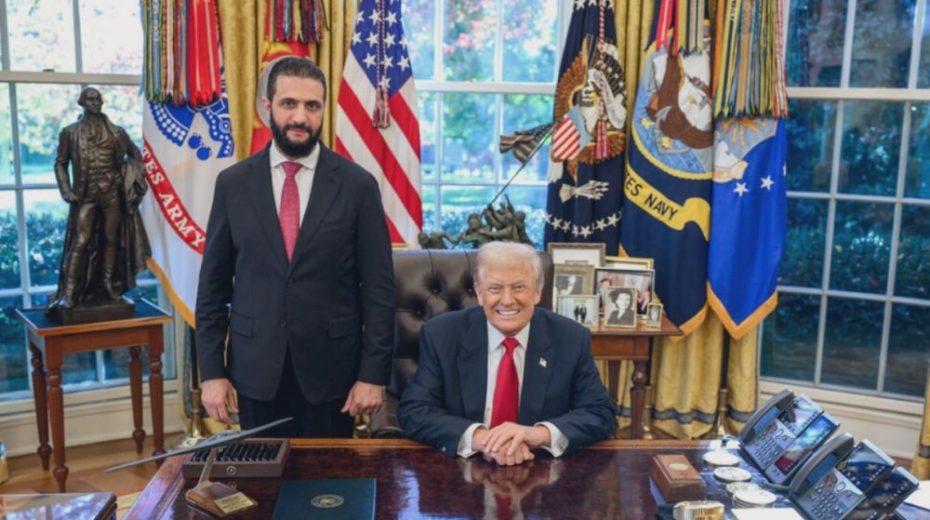
Known now as Al-Sharaa, Jolani led one of the most merciless extremist groups in recent memory—a reputation not easily erased. His current recognition as a figure the West can engage with highlights the readiness of the U.S., UK, France, and others to back terrorists in the Middle East, provided they conform to Western dominance. The old phrase “he may be a son-of-a-bitch, but he’s our son-of-a-bitch” fits perfectly here. His visits to London and Washington signal that Al-Sharaa, now rebranded by the CIA, will remain influential for the foreseeable future.
Al-Sharaa undeniably has a jihadist background and can be seen as a product of the failures of the U.S. strategy following the 2003 Iraq invasion.
Following the invasion, he aligned with Al Qaeda and later the Islamic State. When the Syrian civil war erupted in 2011, he founded the Al-Nusra Front, initially affiliated with Al Qaeda.
In 2017, Al-Sharaa united with other Islamist factions to establish HTS, which took control of part of Idlib province in northern Syria. The group was accused of severe repression of opponents. The U.S. State Department labelled HTS a terrorist organization until quite recently, when it was removed from the blacklist.
But who exactly is Al-Sharaa, and whose agenda does he truly represent? Although the two severed heads photo will shadow him for some time (despite it not being him in the image), numerous misunderstandings persist. A common myth suggests he is a Western puppet and protege of Israel’s prime minister Netanyahu, a notion that gained traction after Al-Sharaa’s forces occupied Damascus and assumed control of Syria in December 2024. This claim largely stems from two facts: Israel provided medical treatment to wounded Al Nusra fighters during the Syrian conflict, and that by overthrowing Assad, Al-Sharaa would supposedly align with Israel’s geopolitical aims. This, however, is an oversimplification.
In truth, Netanyahu and Al-Sharaa differ ideologically on many fronts, even though they share opposition to Iran and its regional allies. Al-Sharaa counts on the backing of Turkey’s President Recep Erdogan, who is increasingly vocal against Israel’s vision of a “greater Israel,” which would span Syria, parts of Iraq, Jordan, and Lebanon.
Naturally, the West is determined to prevent Syria from becoming an Iranian proxy once again, necessitating a strongman who can maintain order, despite a brutal approach. This perspective was articulated by Damascus researcher Mahmoud Bitar, who suggests Al-Sharaa is less a genuine partner or ally of the West and more a compensated operative.
“The West does not trust Al-Sharaa,” Bitar remarked recently. “Al-Sharaa does not align ideologically with the West. But both sides understand that continued chaos in Syria benefits no one: it fuels extremism, destabilises the region, and prolongs humanitarian disaster. Engagement, however uneasy, becomes the least bad option.”
“Geopolitics is not a story of heroes and villains and puppets and puppet masters,” he continues. “It’s a constant negotiation between constraints, risks, and grey choices. States don’t get to pick ideal partners; they deal with whoever holds power and can influence outcomes.”
So, where is this alliance of convenience headed? For now, it’s apparent Al-Sharaa embraces his role as a Western proxy to facilitate aid and commerce to Syria, a nation devastated by prolonged sanctions that have crippled its economy. Should tensions rise between Israel and Turkey, Washington is likely to side with Israel, potentially sidelining its NATO ally Erdogan, the strategist behind Al-Sharaa’s largely bloodless ascent. However, if relations between Trump and Netanyahu deteriorate, Erdogan could instead become a useful asset for the U.S. in the region. Until then, the situation remains uncertain, while the world struggles to overlook the image of a terrorist in a cheap suit fumbling to open a bottle of mineral water, needing a Western woman’s help to do so.
About the Author