The Day the World Nearly Ended
President Trump’s ultimatum for Iran to reach an agreement expires tonight at 8:00 pm ET.
This is the most charged geopolitical situation I’ve ever seen, surpassing even the early days of the War on Terror.
The closest parallel takes us back to the Cold War era.
Specifically, October 27, 1962—the peak of the Cuban Missile Crisis.
Near Havana’s coast, Soviet submarine B-59 found itself in a dire predicament. It was submerged and encircled by 14 United States Navy ships.
The vessel’s temperature soared above 100 degrees. With dying batteries and broken air conditioning, communication with Moscow was possible only by surfacing.
Fuel and chemical fumes filled the air, and some crew members were fainting due to heat exhaustion.
Meanwhile, American destroyers were deploying depth charges around the sub. The reason for this will become clear shortly.
What the Americans didn’t realize was that the sub carried a single nuclear torpedo.
Indeed, the USSR had developed nuclear torpedoes even then. This weapon’s explosive power was about equal to the Hiroshima bomb—15 kilotons.
The Soviet commander, Valentin Grigoryevich Savitsky, urgently told his men, “Maybe the war has already started … We’re going to blast them now. We will die, but we will sink them all. We will not disgrace our navy.”
Fortunately, launching the nuclear torpedo demanded consensus from the three highest-ranking officers. While the captain and one colleague were ready to fire, Chief of Staff Vasily Arkhipov vetoed the order.
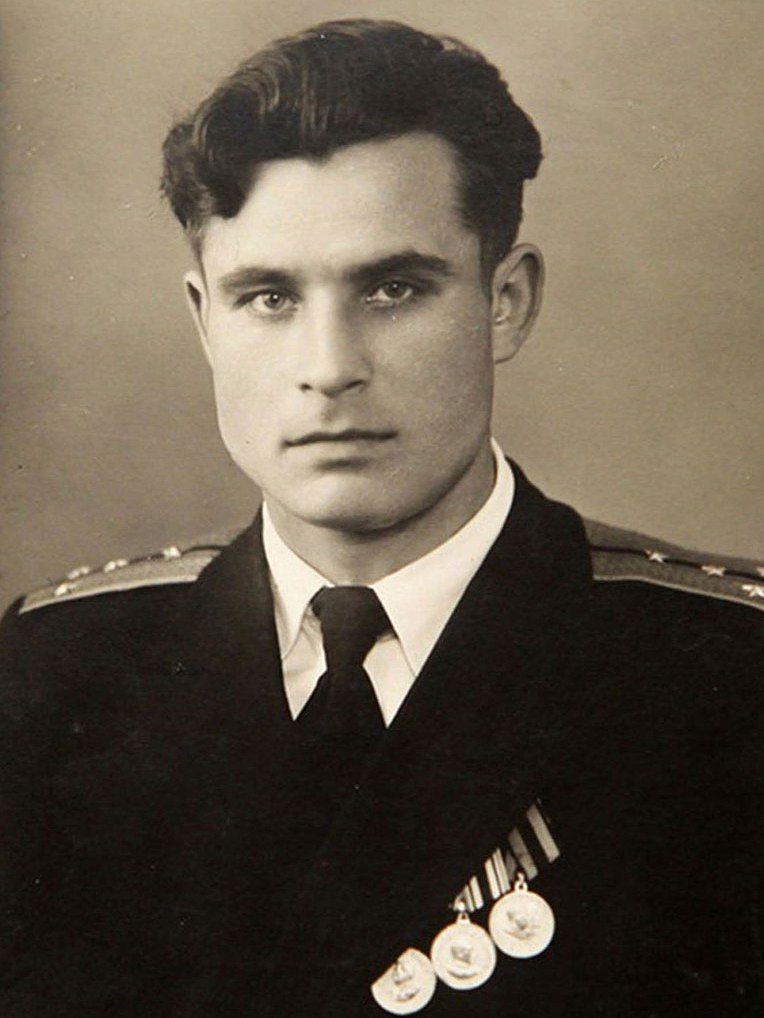
Vasily Aleksandrovich Arkhipov
Arkhipov persuaded the captain to surface—an option left to them besides firing the nuke.
The Soviet commander exchanged tense communications with a U.S. destroyer, relayed updates to Moscow, and withdrew.
That day, nuclear war was narrowly avoided. If that torpedo had struck the American fleet, the conflict almost certainly would have escalated beyond control.
Communication via Depth Charge
How did tensions escalate to the edge of war with the USSR?
Certainly, the Soviets’ deployment of nuclear missiles in Cuba was a central factor. But the U.S. had nuclear missiles stationed in Turkey, pointing at the Soviets as well.
The full picture is more complex. Both sides took reckless steps that nearly resulted in nuclear war.
The National Security Archives preserves a transcript from President Kennedy’s October 24, 1962 briefing with the National Security Council.
JFK’s senior military officials had located Soviet submarines and resolved to confront them.
However, the subs were deeply submerged, preventing any direct communication.
Defense Secretary McNamara and his team devised an unusual way to get in touch.
They planned to drop small “practice” depth charges on the submarines to pressure them to surface. Although these charges were mild, the Soviets were unaware they were not full-fledged depth charges.
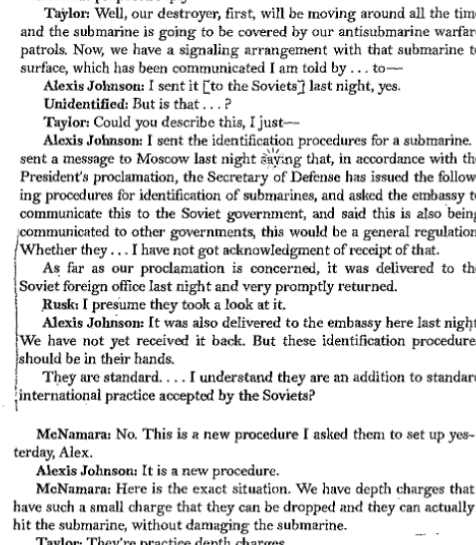
Below is an excerpt from the transcript, courtesy of the National Security Archives:
McNamara: This is a new procedure I asked them to set up yesterday, Alex.
Alexis Johnson: It is a new procedure.
McNamara: We have depth charges that have such a small charge that they can be dropped and they actually hit the submarine without damaging the submarine.
JFK was visibly shaken by the news. His brother Robert Kennedy recorded the President’s reaction in the Archives:
It was after McNamara made this point in the discussion, Robert Kennedy jotted down later that day, that he thought “these few minutes were the time of greatest worry by the President. His hand went up to his face & covered his mouth and he closed his fist. His eyes were tense, a/mast gray, and we just stared at each other across the table.”
Though McNamara’s group attempted to alert Moscow about this new form of signaling, the subs near Cuba remained out of contact, so the captains never received any such notification.
You can explore a longer portion of this fascinating and unsettling transcript here.
Countdown to …?
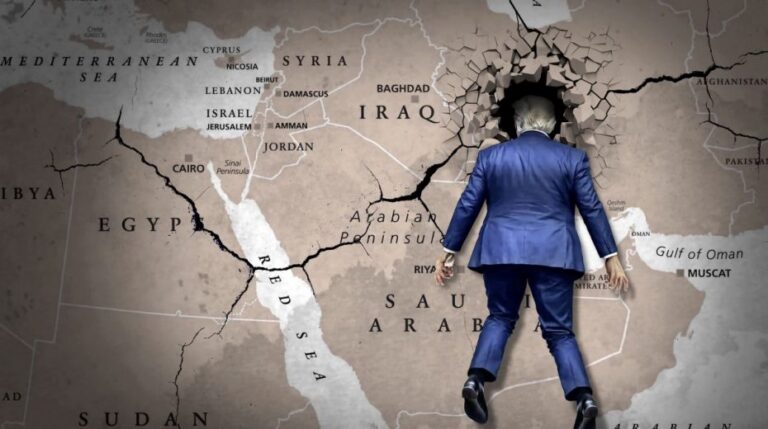
More than six decades after the Cuban Missile Crisis, we face another perilous geopolitical moment.
Tonight at 8:00 pm ET, President Trump’s ultimatum for Iran to reopen the Strait of Hormuz expires.
Though you’ve seen Trump’s latest statement, here it is again for reference:
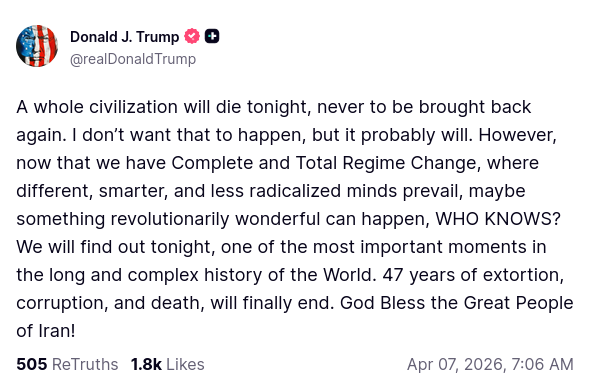
Meanwhile, Iran’s Revolutionary Guard (IRGC) warned:
“Until today we exercised GREAT restraint in selecting retaliatory targets, but now all these considerations are REMOVED.
US & allies will be deprived of region’s oil and gas FOR YEARS”
Are both parties capable of executing their threats? Without question. With a few hundred cruise missiles, the U.S. and Israel could seriously damage Iran’s economy for decades—targeting power plants, oil refineries, gas facilities, and infrastructure. Such strikes would likely cause widespread hunger.
Is Iran equally equipped to retaliate? Definitely. They could disrupt Saudi Arabia and other Gulf states’ oil production and refining, almost certainly triggering a global financial meltdown, possibly a worldwide depression, starvation in many poorer countries, and a catastrophic stock market collapse.
Notably, Iran likely can maintain a blockade of the Strait of Hormuz for over a year using drones and anti-ship missiles.
Additionally, Iran has stated its Houthi allies in Yemen will block the Strait of Bab el-Mandeb—another vital passageway and the last oil export route for Saudi Arabia.
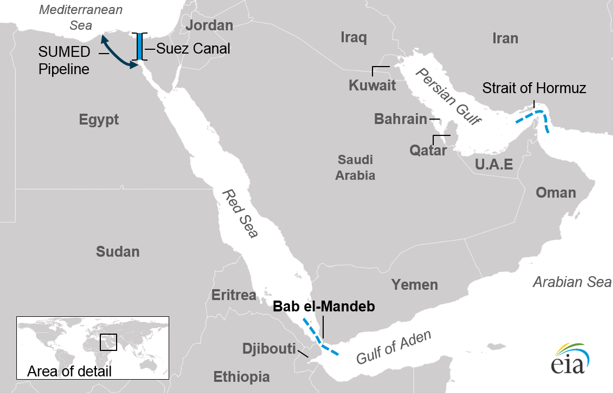
The destructive economic and humanitarian consequences each side can inflict are terrifying.
We stand at the edge of utter chaos, reminiscent of 1962.
Mutually Assured Depression
During the Cold War, the concept of mutually assured destruction (MAD) maintained deterrence.
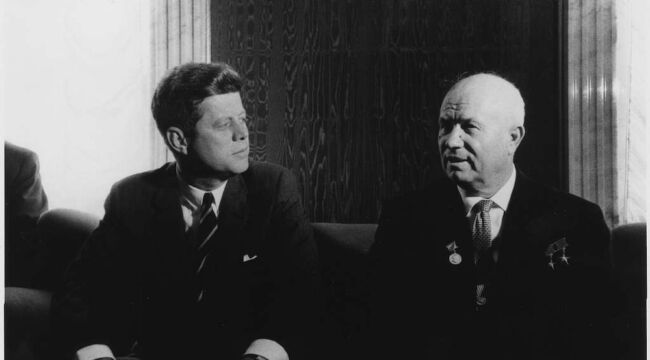
Eventually, JFK and Khrushchev found common ground, struck a compromise, and agreed on a deal. The U.S. withdrew nuclear weapons from Turkey, while the USSR removed theirs from Cuba.
A comparable resolution is necessary today. But will either side offer concessions? Unlikely at this stage.
We may need to approach a more critical global crisis before dialogue deepens.
We’re not even engaging directly with Iranian leaders. Instead, communications are mediated through third parties like Pakistan. Serious negotiations have yet to begin.
I remain hopeful that some form of agreement arrives before Trump’s deadline tonight—be it an extension or a ceasefire.
Because if conflict escalates, it risks triggering an unprecedented economic catastrophe.
Never before has modern society been so dependent on oil, gas, and petrochemicals, along with countless goods transported through these strategic waterways.
Resolving this crisis will demand humility from both camps. As things stand, neither side appears willing to yield. We are far apart in our expectations.
If an agreement is reached this evening and holds, I will be surprised—but certainly pleased.
For now, I maintain a significant cash reserve. I hold put options on various U.S. and European stocks and indexes, including some short ETFs. That said, these hedges are small relative to my long positions.
My preference remains bullish on gold and silver, and I continue to hold most of my mining stocks. Petrobras and other Brazilian equities also remain core positions. South American markets continue to offer relative shelter amid the turmoil.
However, should the situation escalate to full-scale war, all assets will suffer.
Tomorrow, we will analyze the outcomes of tonight’s deadline and continue guiding readers through these turbulent times.
About the Author