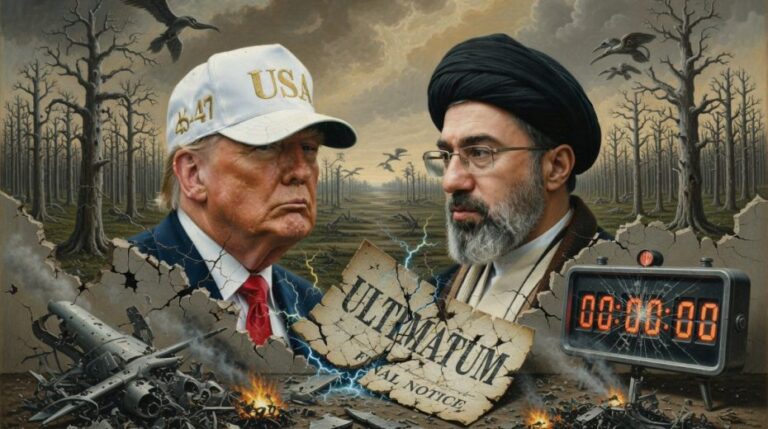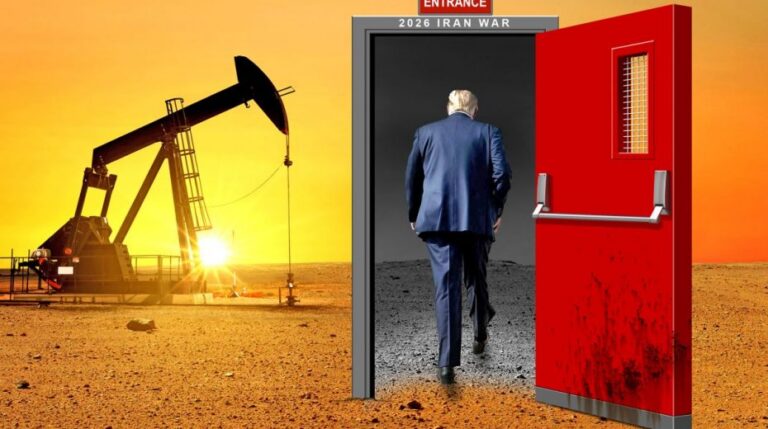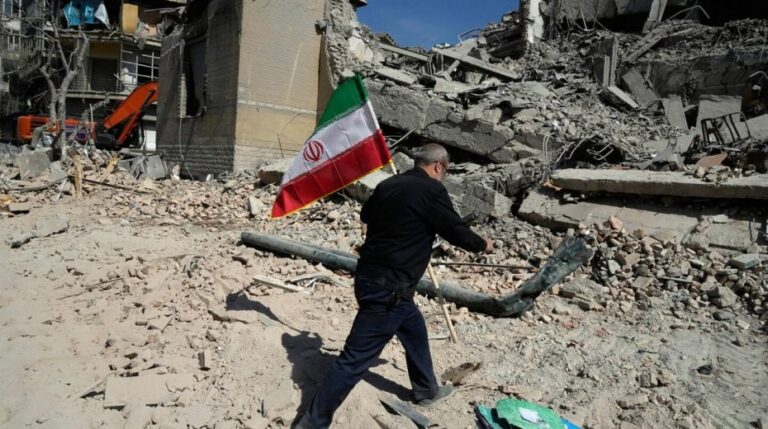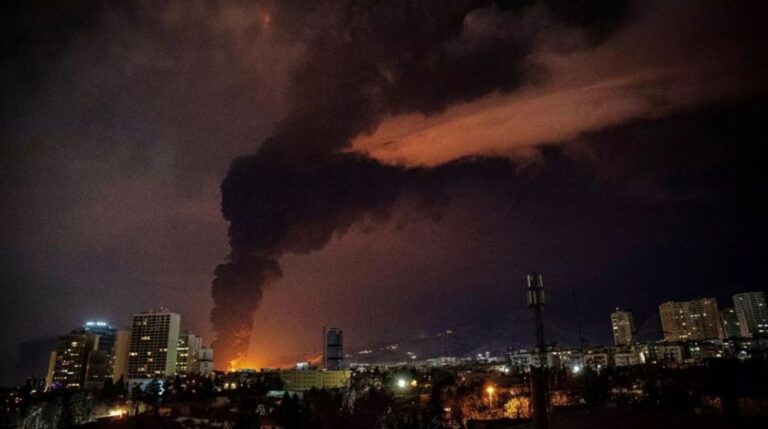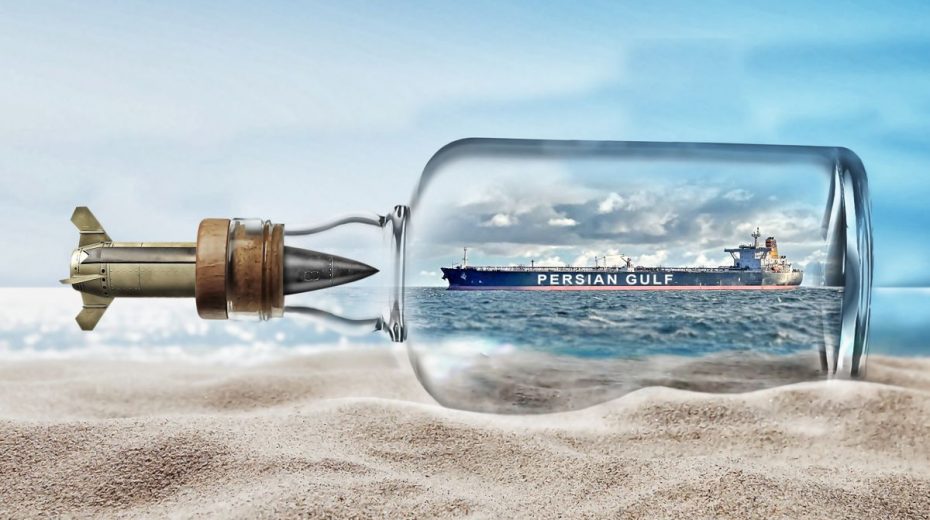
Trump now realises the war is lost – it may be lost, but it is not over. It may last for some time.
Bloomberg: “It is arguably Iran that has secured the most significant strategic victory … There is every sign that Tehran’s ability to control the Strait is increasing”
The continual setbacks faced by the West are, according to Aurelien who has argued, primarily rooted in an intellectual failure: an inability to truly grasp the unfolding reality makes an effective response unattainable. He stresses that “the problem goes beyond the fighting on the battlefield, to seeing and understanding the nature of asymmetric wars and their economic and political dimensions”.
Particularly regarding Iran, Washington appears blind to the fact that the ‘other side’ pursues a strategy incorporating economic and political elements – and that they are actively executing it.
Recent media focus has fixated on the redeployment of U.S. forces to the region and their potential roles, as though troop movements alone would determine outcomes. The real challenge lies in Iran’s innovative warfare approach based on missiles, drones, and defensive measures, which the West—bound by a platform-centric mindset—struggles to comprehend and fully assimilate.
Iran’s approach to security and military strategy was formulated over two decades ago. This pivot toward asymmetric warfare was prompted by the U.S. obliteration of Iraq’s centralized military command during the massive air campaign on Baghdad in 2003.
Faced with the impossibility of developing air power comparable to the U.S., especially with American satellite surveillance capabilities monitoring Iranian military infrastructure, Iran devised alternative measures.
Firstly, to avoid detection, Iran deeply concealed its military installations to withstand most bombing raids. Secondly, Iran’s buried missile stockpiles effectively function as a surrogate air force, compensating for the absence of a conventional one. Lastly, Iran decentralized its military organization by dividing command into regional units, each possessing separate munitions, missile silos, and, where necessary, their own naval and militia forces.
In essence, Iran’s military system was designed as an autonomous, distributed retaliation mechanism capable of surviving any decapitation strike, making it exceptionally difficult to control or neutralize.
When confronted with such unfamiliar realities, the default reaction has tended to be the conventional deployment of more troops—an approach proven ineffective historically.
Earlier in his career, a younger Trump, eager for prominence in Manhattan real estate, was mentored by New York Attorney Roy Cohen, who also represented the city’s major crime families. As Israeli military analyst Alon Ben David relates, Cohen was known as “someone not to be messed with.”
“In most cases, all Trump needed to do was to introduce Cohen to the other side of the deal, so that the latter would agree to his terms. Sometimes Trump was also forced … to drag the other side to court, where Cohen would bare his teeth to the judges and win. But that was always Trump’s bottom line: win. Not to make the pie bigger, not a win-win for both sides, but a victory for him alone – and preferably with the other side’s surrender”.
Today, according to Ben David, the U.S. military functions effectively as Trump’s ‘Roy Cohen.’ Trump leverages American military strength in hopes of compelling Iranian surrender but remains bewildered by Tehran’s refusal to yield despite overwhelming naval force stationed offshore. After assembling a fleet near the Persian Gulf, Trump reportedly expressed confusion to Witkoff over Iran’s steadfast resistance.
“[The cause for Trump’s puzzlement is that] this time he faces an opponent different from any he has ever known. These are not Manhattan real estate moguls or Atlantic City mobsters, they are Persians, members of a 3,000-year-old culture, and they have different concepts of time and what victory is”.
Confused and uncertain about how to escape this dilemma, Trump has issued threats to Iran, but they have not yielded. Meanwhile, Israeli Prime Minister Netanyahu, wary that Washington might negotiate with Iran before fully degrading its military capacity, “is pressuring the Trump administration to carry out a short, high-intensity operation that could include ground forces”, writes Israeli commentator Ben Caspit in Ma’ariv.
While Trump sends unclear signals regarding potential talks with the Islamic Republic, Israeli officials believe he’s weighing three strategies: an intensified campaign targeting Iran’s energy installations on Kharg Island and the South Pars gas field; a ground mission aimed at destroying Iran’s stockpile of highly enriched uranium; or negotiations with Iran—which Israel regards as a “clear Iranian victory, opening the path for the Iranian Republic to survive,” as Caspit notes. Israel is focused on debilitating the regime enough to prevent recovery, hoping this could spark widespread protests. This argument is also leveraged to persuade Washington to sustain the conflict.
A fourth possibility is that Trump declares victory and withdraws.
What realistic outcomes could Trump expect from expanding the war?
First, senior U.S. and Israeli military officials now regard overthrowing Iran through airstrikes as nearly unfeasible, a tactic that has failed historically.
Second, optimistic declarations by the U.S. Administration about ultimately seizing control of the Strait of Hormuz should be seen more as morale-boosting rhetoric rather than fact-based strategies; they expose critical gaps in strategic understanding —
“They are not deduced from the facts of the situation, nor do there have to be actual processes capable of making them happen. The truth is what we want it to be; the truth is what makes us comfortable, we prefer the myth to the reality”.
In reality, reopening the Strait of Hormuz is far from straightforward. Any negotiated reopening would likely necessitate significant concessions from Iran, including formal recognition of its sovereignty over the waterway.
Securing a ceasefire allowing free passage would require agreement on all battlefronts: Israel halting actions in Lebanon and Occupied Palestine, AnsarAllah ceasing attacks on Israel, and Iraq stopping hostilities.
Third, Trump claims ‘regime change’ has already taken place because the current Iranian leaders are unfamiliar names to him, stating, “These are different people than anyone has ever heard of before, and frankly they’ve been more reasonable. So, we’ve had total regime change beyond what anyone thought possible”. Despite his lack of concrete knowledge about this ‘new’ leadership tier, Trump assumes they will be more amenable to negotiations. This assertion rests on faith, unbacked by facts.
Fourth, any military operation to reopen Hormuz would carry substantial risks of heavy U.S. casualties. Hormuz is home territory for Iran, which has cultivated defenses there for years. The narrow waterways, proximity to Iran’s coast, and dense defensive systems pose formidable obstacles. Critical practical concerns include staging locations, logistical support, and evacuation plans.
Even in the event that U.S. forces capture Kharg or any of the islands near the UAE coast, Iran retains the capability to strike unauthorized tankers passing through the Strait using surface or submersible drones, as well as missiles launched from the mainland.
Moreover, controlling these islands would not resolve the fundamental issue—Iran could continue to inflict striking power and casualties remotely, using this as leverage to escalate conflict further.
Fifth, regarding the elimination of Iran’s enriched uranium, no practical way exists to secure the reported 430 kg of 60% enriched uranium without physically seizing it. An agreement for Iran to surrender it voluntarily seems unlikely, and a complex military seizure presents immense challenges.
As the Washington Post reports, when Trump requested a plan to confiscate the uranium, U.S. military officials briefed him on an elaborate operation involving airlifting excavation machinery, constructing a runway inside Iran for cargo planes, and deploying hundreds of troops.
Such a special forces operation would demand precise knowledge of uranium storage locations, detailed staging, and ex-filtration plans. Uncertainty remains as to whether the uranium is kept together or dispersed into smaller batches.
No evidence suggests that the U.S. has thoroughly planned this mission, possibly indicating it could serve as a bluff: a limited incursion near Isfahan aimed at feigning success, then quickly withdrawing before Iranian forces respond lethally.
Finally, destroying Iran’s missile arsenal appears unfeasible. Launch sites and production facilities are scattered nationwide and deeply buried. Fabricating a false success claim may be Trump’s only viable path to declaring victory on this front.
Iran has activated its extensive ‘Mosaic’ strategy involving long-term, prearranged military actions. Their strategic counterstrike deliberately avoids any negotiated settlement and instead aims to break free from Western-imposed sanctions, blockades, isolation, and siege.
The stark reality confronting the U.S. and its allies is that any military or diplomatic tactic to counter Iran’s strategy entails considerable drawbacks.
The conflict belongs to Trump and the U.S. to lose. He now acknowledges the war might be lost—yet it persists and could continue for an extended period.
After a month since the conflict began, “it is arguably Iran that has secured the most significant strategic victory,” Bloomberg observes, citing Iran’s increasingly “tightening grip over traffic through the Strait of Hormuz”:
“There is every sign that Tehran’s ability to control the Strait is increasing … The near-total closure of Hormuz since [early March] … has proved an exceptionally effective asymmetric weapon in Iran’s fight against two of the world’s most powerful military forces”.
About the Author