A Stillborn Ceasefire
The fragile ceasefire agreed upon last night has already collapsed.
This morning, the first significant attack following the ceasefire targeted Iran’s Lavan Island oil refinery, causing damage.
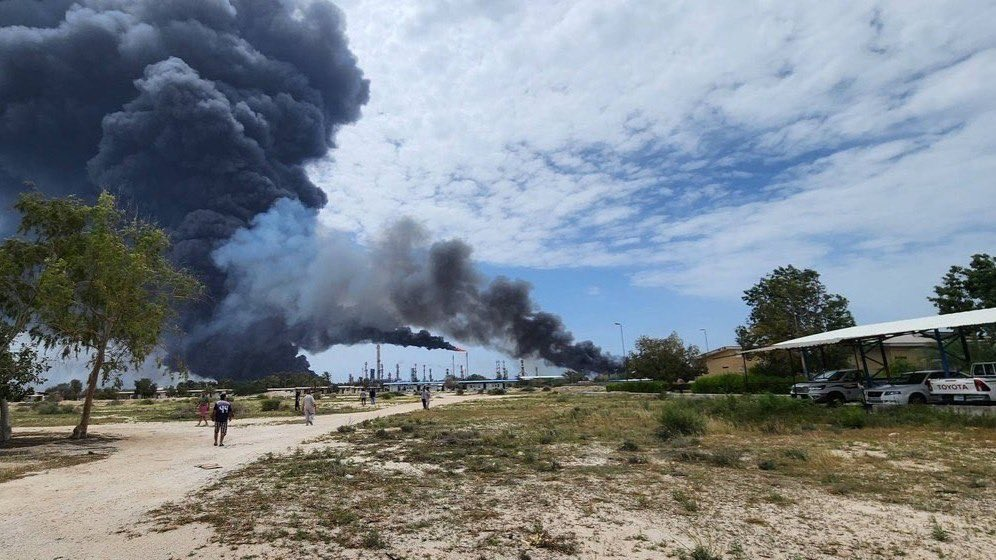
Lavan Oil Refinery in Iran – Source: X
The United States has denied any involvement in the attack. Two military officials informed Newsmax’s Carla Babb as follows:
“We have not conducted strikes against Iran since the ceasefire agreement started. If anyone is striking Iran now, it isn’t our military.”
Israel might have been behind the strike, although the island lies roughly 1,250 miles away from Israel’s territory. Meanwhile, there are speculations suggesting involvement by the United Arab Emirates (UAE). If true, this would represent a new escalation, as Gulf nations have not directly engaged Iran with their own arsenals yet (thus far they have only hosted U.S. forces and activated air defenses).
Regardless, Iran retaliated by striking a pumping station along the vital Saudi East-West oil pipeline. This pipeline serves as Saudi Arabia’s crucial export route for oil since the Strait of Hormuz remains sealed.
The East-West pipeline transports up to 7 million barrels daily from Saudi oil fields to the Red Sea.
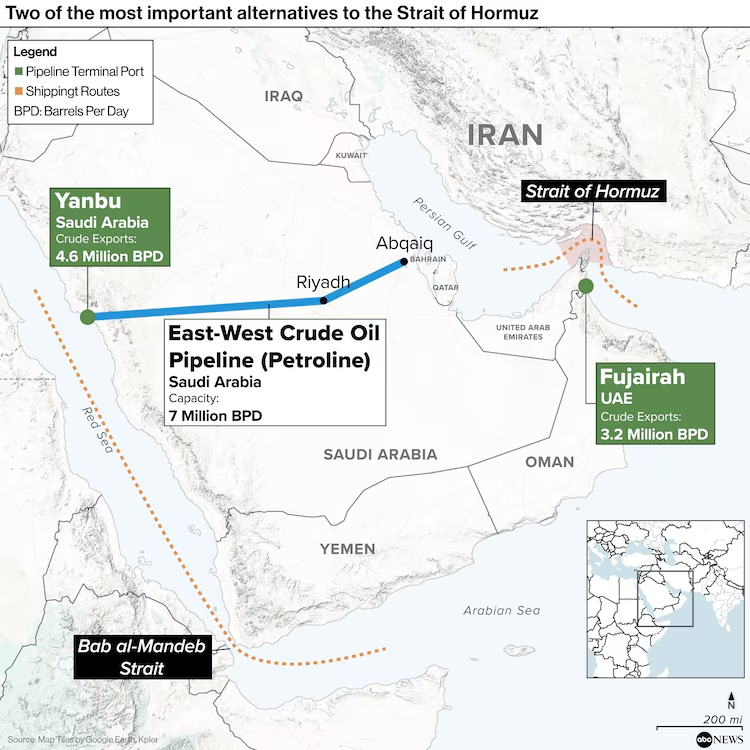
Source: ABC News
If this essential pipeline is out of operation, an additional 7 million barrels daily could be removed from the market.
Iran also targeted the UAE’s Fujairah oil export terminal, which handles approximately 3.2 million barrels per day (visible on the map above just below and outside the Strait of Hormuz).
Combined, these two strikes might disrupt up to 10.2 million barrels per day. Adding this to the roughly 15 million barrels already off the market, this amounts to a severe blow. Nearly 25% of worldwide oil production could be offline or undeliverable.
The extent of the damage is not yet known, but Iran clearly possesses the capability to disable both facilities for a significant duration.
Additionally, Iran launched attacks targeting Israel.
Israel Keeps Going
Israel has announced it will persist in targeting Lebanon, home to Hezbollah, an Iranian proxy group. Hezbollah has fired numerous rockets and some rudimentary missiles at Israel during this conflict.
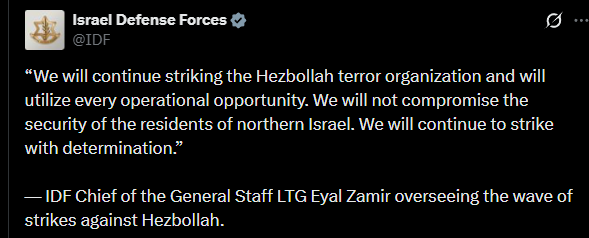
Source: X
Over the last month, Israel has launched intense operations against Lebanon and indicated plans to extend its operations into parts of the neighboring country.
In today’s press briefing, Israeli Prime Minister Netanyahu declared, “The temporary ceasefire with Iran will not include Hezbollah – and we will continue to strike them with all of our might.”
The initial ceasefire agreement reportedly encompassed Lebanon, according to Pakistan’s Prime Minister, the White House’s mediator, who tweeted that the truce applied “everywhere including Lebanon.”
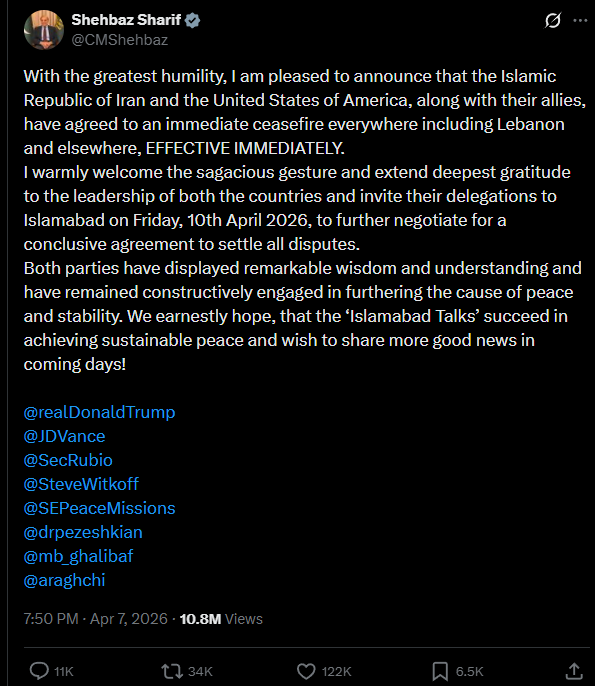
Source: X
However, Lebanon seems excluded from the ceasefire now, with the White House confirming it no longer applies there.
Iran is unlikely to consent to any truce while its Lebanese allies remain under assault.
Yet, Lebanon may ultimately be irrelevant.
The conflict continues throughout Iran, Israel, Saudi Arabia, the UAE, and Iraq. Yemen, an Iranian ally, might soon shut the Bab al-Mandeb Strait, a vital Red Sea chokepoint. Iran has supplied Yemen’s Houthi forces with anti-ship missiles.
Before the ceasefire fell apart, Iran allowed two oil tankers to transit the Strait of Hormuz, but Iranian officials now confirm it is closed again.
President Trump and Iran remain far apart in their expectations. Israel pursues its own goals, steadily intensifying the conflict.
In short, this war continues unabated, and the energy crisis is far from over.
The ceasefire was stillborn—dead at birth.
Markets Yawn (Again)
Even though the ceasefire has unravelled, markets remain surprisingly upbeat. At the time of writing, the Nasdaq is up 3% and the S&P 500 has risen 2.5%.
Oil prices have fallen between 13% and 18%, depending on grade and location.
There remains some optimism that Iranian and U.S. negotiators will meet on Friday, April 10, in Pakistan. President Trump has stated the talks will occur “soon.”
J.D. Vance was initially scheduled to attend, but administration officials have signaled he may be unable to participate due to security concerns.
Clear, preferably face-to-face dialogue is necessary. The current method of transmitting messages indirectly has proven ineffective.
Unfortunately, however, even direct negotiations face long odds for success.
As things stand, the most likely scenario is for the conflict to persist and possibly escalate further.
An Opportunity to Raise Cash
This crisis has not ended, yet the markets behave as if it has.
The recent robust rebound in equities presents a chance to realize gains and increase cash holdings if you haven’t done so already.
I consider the risk of a market downturn significantly higher than the potential for further gains under current uncertainty.
Should 25% of global oil output vanish, it would represent a worst-case scenario. If this lasts a month, oil prices could surge to $200 per barrel; a prolonged disruption could trigger a widespread financial breakdown.
Iran and the U.S. remain deeply divided in their demands, each holding conditions the other is unwilling to accept.
Let’s hope a compromise is found. Still, as I have noted repeatedly, the situation may worsen before a lasting resolution is reached.
For the moment, any ceasefire or truce will be temporary. In my view, this means oil prices are headed higher, and stock markets lower.
About the Author