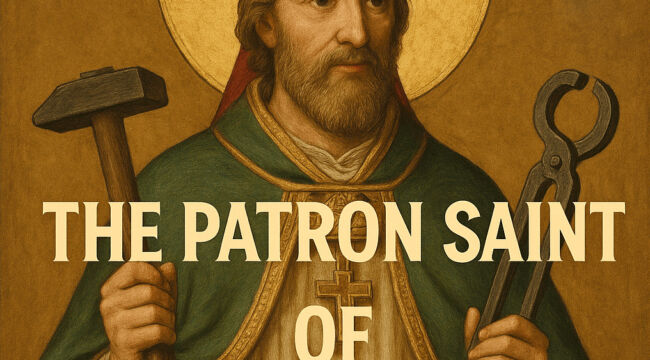
The Patron Saint of Sound Money
Long before Powell hesitated, Lagarde misled, or Yellen stumbled mid-sentence, one man quietly forged an economy grounded in trust — built on fire, gold, and steadfast resolve.
His name was Saint Eligius. Unless you’re a medieval goldsmith or a devoted Catholic fascinated by obscure saints, you’ve likely never heard of him. Yet, I would contend that his contributions to monetary integrity exceed those of any contemporary central banker.
Born in 588 AD near Limoges, in modern-day France, Eligius gained fame by his twenties as one of Europe’s premier goldsmiths. What distinguished him—and made him a threat to the corrupt—was his blend of exceptional craftsmanship and unwavering honesty.
King Clotaire II commissioned Eligius to create an elaborate gold throne. Eligius used less gold than allocated and returned the remainder.
Imagine that. These days, you’d be subject to an audit for such an act.
Instead, Clotaire appointed him Master of the Mint. Eligius didn’t merely produce currency; he established sound money. Coins forged from pure gold and silver, carefully weighed and struck with accuracy. Monetary policy in the 7th century essentially meant: “Don’t mess this up.”
When Money Meant Something
Sound money represents more than gleaming metal. It signifies responsibility, durability, and value anchored in scarcity and toil—not decrees printed on fiat notes or numbers conjured in central bank ledgers.
Under Eligius’ leadership, the French mint yielded coins with uniform weight, purity, and trustworthiness.
These coins embodied trust itself.
Whether a peasant or a noble, exchanging a coin minted by Eligius meant engaging in a system rooted in honesty.
Compare this to the modern monetary system:
- The U.S. dollar has diminished over 96% in purchasing power since 1913, the year Wilson established the Federal Reserve.
- Central banks generate fiat currency with keystrokes, whereas true money — hard money — demands extraction, energy, and labor.
- Inflation today acts as concealed theft. Central bankers devalue money in the guise of growth, while workers face higher prices at the store.
Saint Eligius presided over a monetary system whose value was earned, preserved, and honored. This aligns far more closely with Bitcoin than with any policy pushed at Jackson Hole.
The Ethics of the Mint
An old libertarian saying goes: “Inflation is theft.”
Eligius would concur. He neither inflated nor deceived. He refused to dilute currency.
In an era when kings often debased their coinage to finance wars, Eligius’ integrity stood out. Debasement—adding base metals like copper or tin to gold or silver coins—was the ancient equivalent of quantitative easing, enabling rulers to spend beyond their means by appropriating value from their people.
Eligius rejected such practices. He managed a mint centered on purity rather than convenience. The coins he oversaw were trusted not because of royal endorsement but because they delivered on their promise. In a time before electronic ledgers, blockchain, or financial disclosures, reputation was paramount.
And Eligius upheld that trust.
The Original Gold Standard
Though Eligius didn’t invent the gold standard, he was a practitioner of it.
The metal itself underpinned the coins. There was no promise of value—the coin was the value. This fundamental difference separates hard money from fiat:
- A silver denarius is
- A dollar bill represents value, but holds none inherently.
This is why gold and silver served as currency for thousands of years. Trust was placed not in central banks but in the metal itself. Under Eligius, both were assured.
His craftsmanship also mattered immensely. His coins were not crude imitations; they were finely crafted, precisely weighed, and elegantly stamped. The quality of minting conveyed honesty.
In today’s context, think of the difference between a fake Rolex and an authentic one. The counterfeit is hollow. Eligius never substituted worthless metal for treasure.
Saint of Honest Work
Later in life, Eligius left royal service to become Bishop of Noyon. Yet, the principles from his workshop stayed with him. He preached, freed slaves, built churches, and championed the dignity of hard work and fair trade.
Currently, we’re surrounded by fabricated metrics and illusory wealth. Stock prices surge on share repurchases. Currencies inflate endlessly. Wages stagnate, while asset values escalate. It’s a deceptive game.
Saint Eligius reminds us that genuine worth springs from labor, integrity, and scarcity. Monetary systems require ethics as much as accounting. Civilizations cannot thrive on shaky foundations but can be forged on silver.
Eligius vs. The Fiat Empire
What would Eligius say to today’s monetary authorities?
- To Powell: “Your balance sheet is a lie.”
- To Lagarde: “Trust must be earned, not printed.”
- To the IMF: “You enslave with digits what I refused to with chains.”
We often treat “hard money” as a mere concept now. Eligius embodied it. He minted it. He was it.
He teaches us that financial tools like coins, debt, and credit only hold value if wielded by trustworthy hands. That’s why his story endures, even as the dollar’s value fades.
Make Sound Money Sacred Again
Saint Eligius didn’t manipulate interest rates. He didn’t release dot plots. Nor did he give TED Talks on “transitory disinflationary dynamics.”
Instead, he simply produced honest money and expected others to follow suit.
The Church declared him a saint. The mint should have made him a model.
In an era when money is merely credit, and credit only hope, Eligius offers something sturdier: tangible evidence.
No blockchain was needed—he embodied the chain of integrity, value, and principle.
Wrap Up
If you’re weary of technocrats’ lies, inflation’s deceit, and dilution’s theft, perhaps it’s time to look back to medieval times.
Saint Eligius wouldn’t grasp derivatives or complex financial instruments. But he surely understood this:
Money should be honest.
Wealth must be genuine.
And trust has to be earned, never printed.
In that light, Saint Eligius is more than just a figure of history.
He represents a blueprint for our future.
About the Author