Western media outlets, particularly those inclined toward neoconservative perspectives, are quick to interpret protests in Iran as a signal that the Islamic Republic is on the verge of collapse. Recent developments in Iran have reignited enthusiasm among neocons eager to restore the Shah’s regime and dismantle the clerical authorities. Below is an overview of various news accounts:
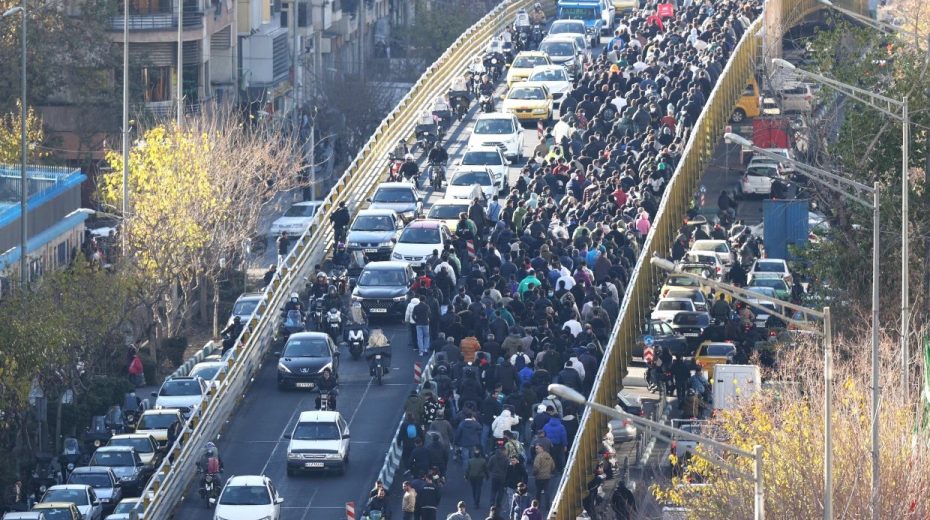
On December 30, 2025, Iran’s protests reached their third consecutive day, evolving from initial economic discontent in Tehran’s Grand Bazaar to spread across universities and numerous cities nationwide. Demonstrations were sparked by the Iranian rial’s plunge to historic lows (approximately 1.38–1.42 million to the USD) and inflation rates climbing to 42.2–42.5%. The protests started with merchants and shopkeepers closing their stores and escalated into widespread anti-government slogans.
The unrest extended from Tehran to locations such as Isfahan, Shiraz, Mashhad, Hamadan, Karaj, Qeshm, Malard, Kermanshah, and Yazd. On Tuesday, university students joined in, chanting phrases like “Death to the dictator” (aimed at Supreme Leader Ali Khamenei), along with calls for freedom and monarchy references such as “Long live the Shah” or “Rest in peace Reza Shah.”
President Masoud Pezeshkian acknowledged the “legitimate demands” and directed the interior ministry to engage with protest representatives, promising economic policy reforms. The central bank governor resigned and was succeeded by Abdolnasser Hemmati. Authorities expressed willingness to negotiate but cautioned against escalation or foreign interference.
So, what exactly is happening? It turns out Nima Alkorshid, host of Dialogue Works, is currently on an extended family visit in Tehran, his first in 12 years. His mother is delighted to have her son, his wife, and grandchildren with her. I contacted Nima to get his firsthand account of the situation.
Nima explained that while frustrations with the government, particularly concerning inflation under Pezeshkian, are fueling the protests, opposition to the Islamic regime itself is not widespread, contrary to Western media narratives. He also noted that about 25% of the population, largely conservative supporters of Ahmadinejad, are displeased with Pezeshkian for perceived excessive accommodation toward the West but remain loyal to Ayatollah Khamenei.
Supporting Nima’s insights, video footage shows an Iranian student protester clarifying that their grievances target corruption worsening the economic crisis, not the Islamic Republic itself. He states:
This is the voice of an Iranian Basiji. I would sacrifice myself for this homeland. I would give my life for the Islamic Republic. Our protest is against people like Ali Ansari and other corrupt officials. Mr. Ejei [Chief of the Judiciary], where are you?
I found Pezeshkian’s approach to the protests surprisingly reasonable. Rather than using force against demonstrators, he accepted the validity of their concerns, dismissed the central bank head, and vowed to implement economic reforms.
I’m of the opinion that Russia and China—who rejected Europe’s renewed attempts to impose sanctions on Iran—are collaborating to strengthen Iran’s economy and manage inflation. While Western sanctions have significantly impacted Iran’s economy—and both Russia and China originally endorsed these sanctions as part of the 2015 JCPOA—the country’s ties within BRICS and closer relations with Moscow and Beijing position it better now for economic recovery.
Russia’s support centers on strategic partnerships and trade, often linked to military collaboration. In January 2025, Russia and Iran signed a 20-year strategic partnership encompassing economic cooperation. Russia is supplying advanced conventional arms—such as fighter jets and attack helicopters—in exchange for Iranian drones, missiles, and ammunition, indirectly aiding Iran’s economy through this bartered military trade.
Since July 1, 2025, five visits by four top Iranian officials to Moscow have been reported, featuring political, military, and economic figures engaging in talks ranging from nuclear negotiations to military and strategic cooperation:
Ali Larijani (Supreme Leader Adviser, political) – July 20, 2025: Held meetings with Russian President Vladimir Putin focusing on nuclear talks and bilateral relations.
Brigadier General Aziz Nasir Zadeh (Defense Minister, military) – July 21, 2025: Met Russian Defense Minister Andrei Belousov to deepen military ties, probably seeking support after the Israel-Iran conflict.
Abbas Araghchi (Foreign Minister, political) – August 2025: Requested Russian backing following U.S. and Israeli strikes on Iranian infrastructure subsequent to the ceasefire. Returned December 17, 2025, to sign a cooperation plan for 2026-2028 and emphasize growing partnerships.
Mohammad Reza Aref (First Vice President, political/economic) – November 17-18, 2025: Participated in the SCO Council of Heads of Government meeting and conducted bilateral discussions with Russian Prime Minister Mikhail Mishustin on economic and political collaboration.
Moreover, there is ongoing work on the North-South Transport Corridor (INSTC). Numerous bilateral and multilateral meetings have taken place between Russia, Iran, and often Azerbaijan since July 2025, aimed at advancing this multimodal trade route connecting Russia, Iran, India, and further regions. Key 2025 meetings include:
October 2025: Trilateral discussions in Baku (Russia, Azerbaijan, Iran) focused on expanding the INSTC’s western segment, including infrastructure reviews and agreements to improve logistics and cross-border processes.
November 2025: Railway officials from all three nations signed a memorandum of understanding in Baku to boost the western route’s competitiveness with measures such as fixed pricing and standardized rates.
December 12, 2025: Presidents Vladimir Putin and Masoud Pezeshkian met in Ashgabat, Turkmenistan, discussing INSTC advancements, including the Rasht-Astara rail link.
December 16, 2025: Senior officials from Iran and Russia met in Tehran: Iran’s Supreme National Security Council Secretary Ali Larijani and Russia’s Deputy Prime Minister for Transport Vitaly Savelyev prioritized accelerating the corridor’s development and resolving challenges.
China’s role is even more significant, offering vital economic lifelines primarily through oil transactions and promised investments, positioning it as Iran’s foremost trading partner. Chinese entities buy 90% of Iran’s oil exports at substantial discounts—up to $14 per barrel below market value—generating approximately $67 billion for the Iranian fiscal year ending March 2025 (equivalent to 15% of GDP). This volume represents 13.6% of China’s oil imports and covers 45% of Iran’s 2025–2026 budget. Following the 2021 25-year strategic partnership agreement, reaffirmed in September 2025, China vowed $400 billion in investments across sectors such as energy, infrastructure, banking, telecommunications, ports, railways, and tourism. Infrastructure projects include a new railway for overland oil transport (launched May 2025 but halted due to the war) and the inaugural freight train from Xi’an to Iran’s Aprin dry port in the same month. Discussions continue on economic corridors through Central Asia, aiming to improve transit efficiency.
Since July 2025, at least three senior Iranian political and military figures have traveled to China, engaging in multilateral summits like the Shanghai Cooperation Organization and intensive bilateral cooperation, especially in response to recent conflicts with Israel and the United States:
Abbas Araghchi (Foreign Minister, political) — July 2025: Attended SCO foreign ministers’ meeting in Tianjin and held talks with Chinese Foreign Minister Wang Yi targeting deeper relations and regional security issues.
Masoud Pezeshkian (President, political) — September 1–2, 2025: Participated in the SCO Summit in Beijing; met Chinese President Xi Jinping to discuss strategic partnership, trade, investment, and global governance topics.
Aziz Nasirzadeh (Defense Minister, military) — Late June 2025 (close to the July record threshold): Attended SCO defense ministers’ meeting in Qingdao; marked the first foreign trip since the Israel conflict.
Iran’s attempts to rebuild a stable economy continue amid ongoing threats from Israel and the United States. According to RT:
President Donald Trump warned that the U.S. might conduct additional military strikes against Iran should it attempt to reconstruct its nuclear and missile programs. He made these remarks alongside Israeli Prime Minister Benjamin Netanyahu at his Mar-a-Lago estate in Florida.
“If it’s confirmed, they know the consequences, and the consequences will be very powerful, maybe more powerful than the last time,” Trump stated on Monday. “We’ll knock them down. We’ll knock the hell out of them. But hopefully that’s not happening.”
The U.S. president expressed his readiness to “absolutely” back Israeli military action targeting Iran’s missile capabilities and said the U.S. would act “immediately” against any nuclear advancements.
Rebuilding ballistic missile programs? Evidently, Donald Trump remains unaware that Iran’s missile arsenal was not destroyed during the 12-day conflict. Rather than rebuilding, Iran is expanding and modernizing its missile capabilities, safely sheltered underground beyond the reach of Israeli and U.S. forces. Should Israel or Trump attempt another strike, they will face an adversary far stronger and more dangerous than encountered in June 2025.
Original article: sonar21.com
About the Author