In 2025, protests sparked governmental changes in Nepal and Bangladesh, whereas India’s capital struggled with severe pollution, reports Betwa Sharma.
South Asia in 2025 witnessed significant shifts.
Public dissatisfaction in Nepal and Bangladesh, fueled by concerns over employment, governance, personal freedoms, and respect, erupted into widespread street demonstrations. Youth, in particular, abandoned patience and demanded reform.
Conversely, in India, winter brought its familiar surge of hazardous air pollution, causing illness and breathing difficulties. Despite the health crisis, the nation largely remained passive. There were no large-scale protests or public outrage—only coughing, complaints, mask-wearing, and quiet endurance.
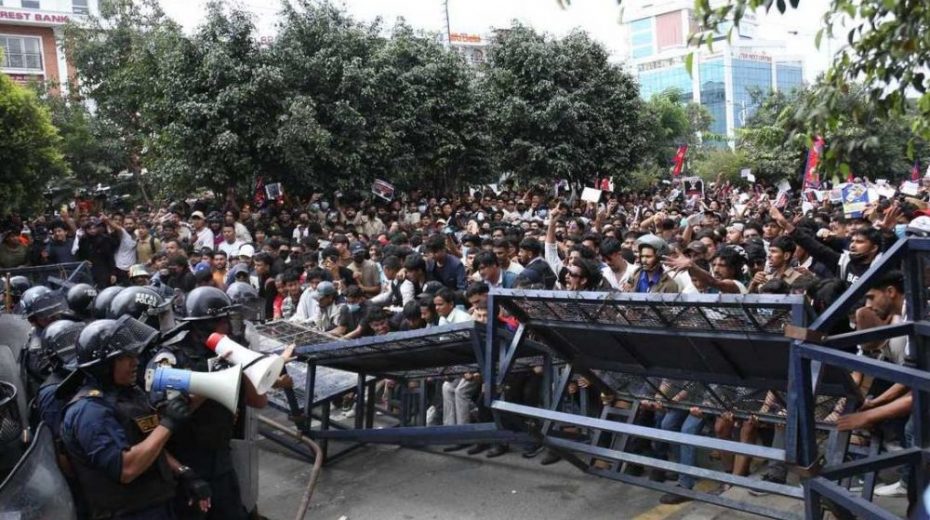
In Nepal, a youth-driven uprising known as the Gen Z protests emerged after the government imposed a ban on 26 major social media platforms like Facebook, Instagram, WhatsApp, YouTube, and X. This movement swiftly grew beyond digital rights, with demands calling for an end to corruption and nepotism within political circles, improved government responsibility, and justice for those harmed during the protests.
Protesters also demanded the removal of corrupt officials and political reforms better reflecting younger generations.
These demonstrations were mostly leaderless, coordinated through online channels, which helped them gain momentum nationwide. Nineteen protesters lost their lives. Intense public pressure compelled the government to revoke the social media restrictions and led to the resignation of prominent figures, including Prime Minister KP Sharma Oli.
The 2025 Gen Z uprising successfully replaced the sitting government with an interim administration headed by Sushila Karki. General elections are scheduled for 2026 as the next stage of transition.
A Stark Contrast in Bangladesh
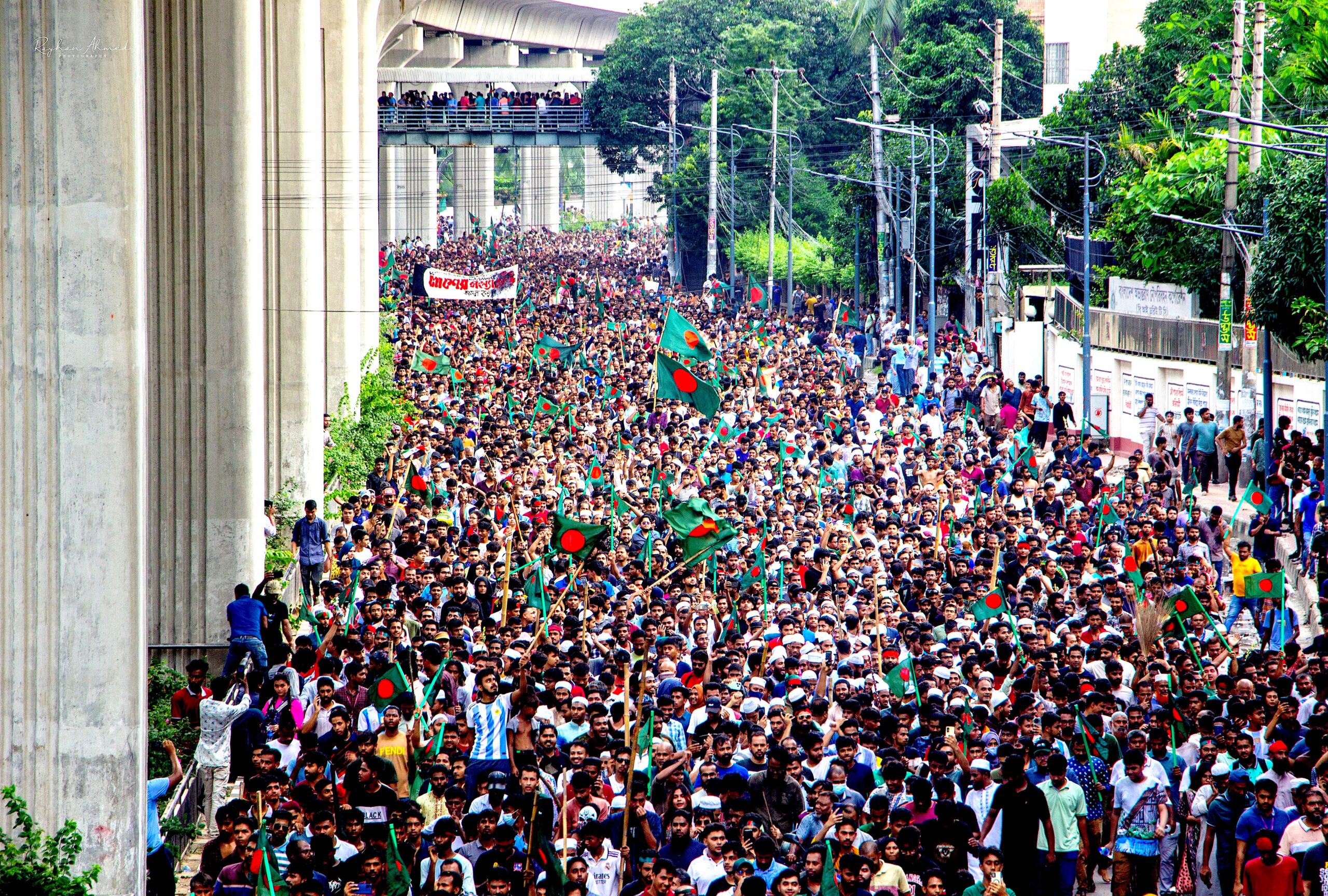
Protesters hold victory march after Sheikh Hasina’s resignation on Aug. 5, 2024. (Rayhan9d, Wikimedia Commons, CC BY-SA 4.0)
Bangladesh’s protests were more intense, angrier, and posed greater risks.
Initially triggered by student protests over job quotas, the unrest from 2024 into 2025 broadened to include widespread dissatisfaction with entrenched corruption, authoritarianism, unemployment, and weak political accountability, culminating in Prime Minister Sheikh Hasina’s removal and flight to India.
Hasina, once a pro-democracy champion, transformed over time into an autocratic figure. In November 2025, a Bangladeshi tribunal sentenced her to death in absentia, blaming her for crackdowns that resulted in the deaths of 1,400 protesters.
Currently residing in India, New Delhi has stated it is reviewing Bangladesh’s extradition request through official channels but has yet to commit to repatriation.
An interim government led by Muhammad Yunus, Nobel Peace Prize-winning economist, now manages the country amid ongoing civil unrest and is preparing for general elections next month.
Authorities have responded with strict security tactics such as imposing curfews, banning gatherings, and deploying police and paramilitary units.
Thousands of demonstrators have been detained, and some educational institutions closed to restore order. Use of tear gas and batons has triggered concerns over excessive force and human rights violations.
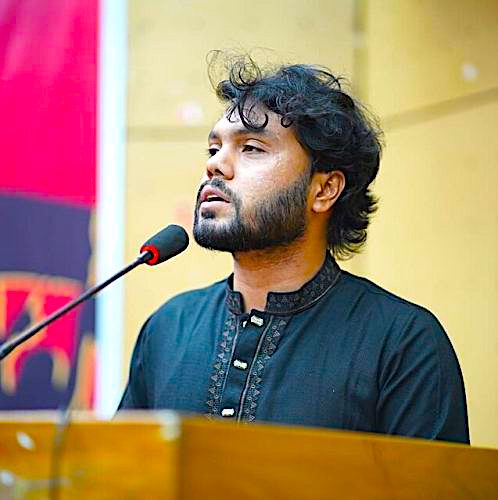
Osman Hadi addressing a crowd, Dec. 1, 2025 (Creative Commons 1.0 Universal Public Domain Dedication)
Political violence persists. In December 2025, Sharif Osman Hadi, a key leader of Bangladesh’s 2024 youth protests, was assassinated by masked gunmen, provoking nationwide demands for justice and accountability.
Earlier that year, disputes also surged over contested civil service reforms and increasing violence against women.
The protests coincide with a distressing rise in attacks against the Hindu minority since 2024. In December 2025, the mob lynching and burning of Dipu Chandra Das, a Hindu garment factory worker, ignited outrage and protests by Hindu organizations in India condemning the violence.
Demonstrations have persisted throughout this month in Dhaka and other urban centers. Recently, two Hindus—a grocery store owner and a journalist—were killed within 24 hours amid escalating violence.
Alleged US Involvement
Mainstream media characterize the protests in Nepal and Bangladesh as grassroots reactions to local political and socioeconomic issues, rather than actions staged or manipulated by the U.S.
However, The Grayzone published leaked documents revealing that the U.S. invested hundreds of thousands in training Nepalese youths on protest and demonstration strategies before a violent coup toppled Nepal’s government.
The U.S. reportedly aimed to build a network of young political activists in Nepal to “become an important force to support US interests,” particularly to “neutralize Chinese and Indian influence over Kathmandu.”
Indian media have reported over $900 million in U.S. aid to Nepal since 2020, supporting governance, media, civic, and electoral initiatives connected with fostering democracy and civil society globally.
Some experts caution that the notion of a “foreign hand” primarily serves political convenience, masking legitimate citizen grievances and noting that while external players exploit weaknesses, they do not create the underlying structural failings.
The U.S. government has denied any involvement in Bangladesh.
Three years prior, Sri Lanka saw massive Aragalaya protests sparked by economic collapse, shortages of fuel, food, and medicine, plus governmental corruption and mismanagement. This forced President Gotabaya Rajapaksa to resign and brought new leadership, despite ongoing challenges.
Low Visibility in India

Delhi, with a population of nearly 34.6 million, becomes engulfed in toxic smog in December 2019. (Wikimedia, Creative Commons, Attribution-Share Alike 4.0 International)
Now consider India.
Each winter, hazardous smog blankets northern cities. Delhi, ranked among the world’s most polluted urban areas, frequently suffers severely degraded air quality. Other regions, such as Punjab, Haryana, Uttar Pradesh, and Rajasthan, also face dangerous pollution levels. Schools close, hospitals become overcrowded, and outdoor activities stop.
This pattern is well known.
Despite widespread recognition of the hazards, no sustained protests arise. There is no mobilized public movement turning polluted air into a political crisis.
Authorities announce seemingly serious “emergency measures” with minimal impact. Courts issue firm-sounding directives that fail in implementation. Once weather shifts or winds blow through, visibility improves and public anger subsides.
Class differences also influence responses. The poorest suffer most—daily laborers, traffic officers, children in crowded public schools—while middle-class inhabitants have coping tools like air purifiers, closed vehicles, telecommuting, or weekend retreats.
India’s political arena is already crowded, dominated by nationalism, religious polarization, and ideological battles.
Air pollution does not fit neatly into these contentious themes.
Addressing it demands unglamorous, long-term efforts: tightening vehicle emission standards, enhancing public transit to cut private car dependence, managing dust from construction and demolition, reducing crop-residue burning in adjacent states, and fostering cooperation between Delhi and surrounding areas.
“Every winter, a familiar grey blanket of toxic air pollution descends …. Delhi, which ranks among the world’s most polluted cities, becomes unbreathable …. Schools shut. Hospitals fill up.”
This issue does not inspire stirring speeches, even though air pollution has already shortened the lives of around two million people.
This year saw a modest effort to mobilize Delhi residents. However, fewer than 1,000 participated in a city of 22 million, and the crowd was mostly aligned with one political perspective, despite the need for wider bipartisan concern—including from supporters of Prime Minister Narendra Modi and the Bharatiya Janata Party (BJP), which governs Delhi and the central government.
Besides widespread indifference, a key factor suppressing protests is the decade-long suppression and demonization of dissent under the Modi administration, combined with fears of arrest, detention, and severe legal charges.
Journalist Saurav Das, who supported the protests, recounted a conversation with Delhi’s environment minister, who himself and his son suffered from pollution effects.
When asked if India studied successful examples from other cities, the minister dismissed the query. He claimed China’s non-democratic context rendered comparisons invalid, adding that cities like Los Angeles and London are smaller and not analogous.
Pressing him on whether any “visionary leaders” with comprehensive technical knowledge could confront the crisis, the minister seemed unsure, repeatedly replying with a resigned “kya karein?”— what can we do?
The prevailing sentiment is that meaningful reform is unlikely, so Indians continue their annual ritual: adapting, enduring, and gradually losing some breath.
While Nepal and Bangladesh demonstrate that when pushed hard enough, people risk taking to the streets and that such pressure can compel change, India’s tragedy lies in its deadliest crisis provoking little beyond muted discontent and words like “unfortunate” and “unacceptable.”
So, as Kathmandu marched and Dhaka rose up, Delhi silently inhaled its poison.
Original article: consortiumnews.com
About the Author