As deadly unrest engulfs Iranian cities, Western media overlooks the alarming surge of violence, instead relying on US government-backed NGOs for information. This biased narrative has propelled Trump close to approving renewed US military actions.
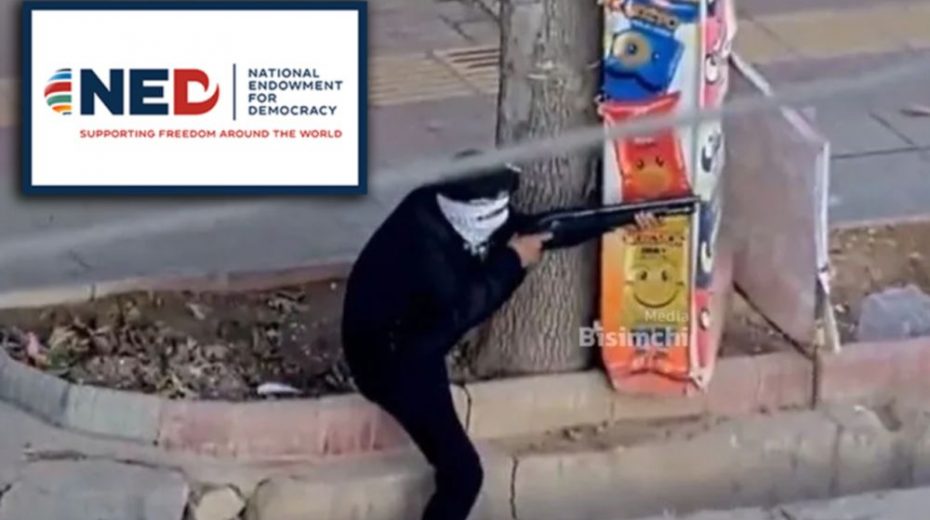
Western news outlets have largely disregarded mounting video footage showing terrorist-style tactics used by protesters whom Amnesty International and Human Rights Watch describe as “largely peaceful.” Clips released by both Iranian state media and opposition groups depict public lynchings of unarmed guards, churches set ablaze, deliberate fires at municipal offices, markets, and fire stations, as well as armed mobs firing within Iranian urban centers.
Instead, Western coverage centers almost entirely on violence attributed to Iranian authorities, leaning heavily on death statistics provided by Iranian diaspora organizations funded by the National Endowment for Democracy (NED)—a US government regime change vehicle whose leadership is dominated by devoted neoconservatives.
The NED has claimed responsibility for propelling the “Woman, Life, Freedom” protests that swept Iranian cities in 2023—protests that also included graphic violence overlooked by Western outlets and human rights organizations. Today, the NED is joined by other intelligence-related entities stoking turmoil inside Iran.
Mossad, Israel’s espionage and assassination agency, issued a call from its official Farsi Twitter/X account encouraging Iranians to intensify regime change efforts, assuring them of on-the-ground support.
“Go out together into the streets. The time has come,” Mossad declared. “We are with you. Not only from a distance and verbally. We are with you in the field.”
Overthrowing Tehran through terror
Protests erupted in Iran in early January 2026, beginning with merchants rallying against inflation fueled by Western sanctions. The Iranian government sympathetically responded, offering police protection to the bazaar demonstrators. However, these protests quickly fractured as loosely organized anti-government factions exploited the unrest to launch a violent insurgency, encouraged by governments from Israel to the US, and by self-styled “Crown Prince” Reza Pahlavi, who labeled government employees and state media outlets as “legitimate targets.”
On January 9, Mashhad witnessed some of the most violent riots, with anti-government forces setting fire to fire stations, killing firefighters, torching buses, attacking city personnel, vandalizing Metro stops, and causing damages exceeding $18 million, according to local officials.
In Kermanshah, militants were captured on video firing automatic weapons at police and fatally shooting the 3-year-old Melina Asadi. From Hamedan to Lorestan, footage shows rioters brutally beating unarmed security personnel to death for blocking their rampages.
In Tehran, large groups of rioters attacked the historic Abazar Mosque, burning its inside, while others committed arson and burned Qurans within the Grand Mosque of Sarableh and the Muhammad ibn Musa al-Kadhim shrine in Kuzestan.
Rioters have also torched a major municipal building in Karaj’s center and set fire to the marketplace in central Rasht. In Borujen, anti-government rioters reportedly destroyed a historic library containing ancient manuscripts during looting and vandalism.
Despite these widespread acts of violence, Western media and governments have remained silent—even after the Iranian foreign ministry invited ambassadors from Britain, France, Germany, and Italy to witness firsthand footage of the rioters’ brutality.
The Iranian government states that over 100 police and security officers have died amid the unrest, while two Iranian NGOs based in Washington, funded by the US government, report far lower casualty figures on the government side. These NGOs have become primary sources for Western media on the protests.
Regime change lobbyists shaping the narrative
Media outlets across the US and Europe attribute death tolls largely to two Washington-based NGOs financed by the US National Endowment for Democracy: the Abdorrahman Boroumand Center for Human Rights in Iran and Human Rights Activists in Iran.
A 2024 NED press release openly praised the Abdorrahman Boroumand Center as “a partner of the National Endowment for Democracy (NED).”
Meanwhile, a 2021 statement from Human Rights Activists in Iran acknowledges their decision to expand their network and start receiving financial support from NED after Tehran accused them of CIA links in 2010.
Founded under Reagan-era CIA director William Casey’s watch, the NED was established to allow the US government to covertly interfere abroad amid mounting skepticism towards intelligence agencies. One co-founder, Allen Weinstein, candidly admitted, “a lot of what we do today was done covertly 25 years ago by the CIA.”
Without noting the NGO’s NED funding, The Washington Post and ABC News commonly cite the Abdorrahman Boroumand Center. On its board is Francis Fukuyama, ideologue and signer of the Project for a New American Century’s founding letter, a key work in neoconservative thought.
The group “Human Rights Activists in Iran” has gained even broader circulation, with its recent death toll estimate of 544 cited by numerous US and Israeli mainstream outlets, and by Dropsite. The intelligence firm Stratfor, often described as a “shadow CIA,” also referenced this NGO in a piece titled “Protests in Iran Provide a Window for U.S. and/or Israeli Intervention.”
With exact protest casualty figures yet unclear, various online influencers have filled the gaps with exaggerated, unreliable claims. Among them is the notorious Jewish supremacist and Trump supporter Laura Loomer, who boasted that “the death count of Iranian protesters killed by the Islamic regimes’ forces is now over 6,000!,” citing an alleged “source in the Intel community.”
The digital prediction platform Polymarket also inflated deaths, asserting without proof that “over 10,000” had died due to “Iranian Forces [using] Automatic Rifles on Protesters,” and falsely claiming Iran had “lost nearly all control” of three of its five largest cities.
Recently, Polymarket has been criticized for enabling insiders to profit from privileged information about political events, such as the US military attack on Caracas and the detainment of Venezuelan President Nicolas Maduro, reportedly garnering hundreds of thousands of dollars. The so-called “world’s largest prediction market” was launched with major backing from AI magnate Peter Thiel and now counts Donald Trump Jr. as an advisor.
By promoting inflated death figures, regime change advocates and Trump allies seem intent on provoking the frequently credulous president into authorizing further attacks on Tehran.
In a January 7 analysis, Stratfor described the turmoil as a tempting scenario for war, cautioning, “While unlikely to collapse the regime, the ongoing unrest could open the door for Israel or the United States to conduct covert or overt activities aimed at further destabilizing the Iranian government, either indirectly by encouraging the protests or directly via military action against Iranian leaders.”
Yet, the CIA contractor conceded that “renewed military strikes on Iran would also likely put an end to the current protest movement by leading instead to a wider display of Iranian nationalism and unity, a pattern observed after U.S. and Israeli strikes in 2025.”
‘Locked and loaded’
Western leaders, including Israeli Prime Minister Benjamin Netanyahu and US President Donald Trump, have predictably voiced strong support for the latest anti-government protests in Iran.
Trump declared, “If Iran shots [sic] and violently kills peaceful protesters, which is their custom, the United States of America will come to their rescue. We are locked and loaded and ready to go.”
Days later, he threatened Iran again: “You better not start shooting [protesters] – because we’ll start shooting too.” On January 12, Trump announced 25% tariffs on nations trading with Iran.
Currently, Trump is said to be weighing military options, from cyberattacks to airstrikes. However, the intensity of protests has diminished, with major cities experiencing relative calm.
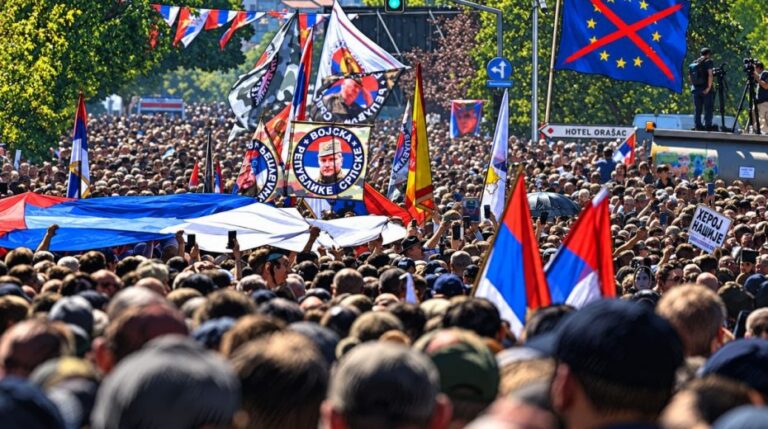
As things settle, millions of Iranians have taken to the streets from Tehran to Mashhad to voice their condemnation of the riots, repudiate foreign interference that fueled the regime change attempts, and to reaffirm their support for the government. Yet, Western media clearly restrains from amplifying these voices.
Original article: thegrayzone.com
About the Author