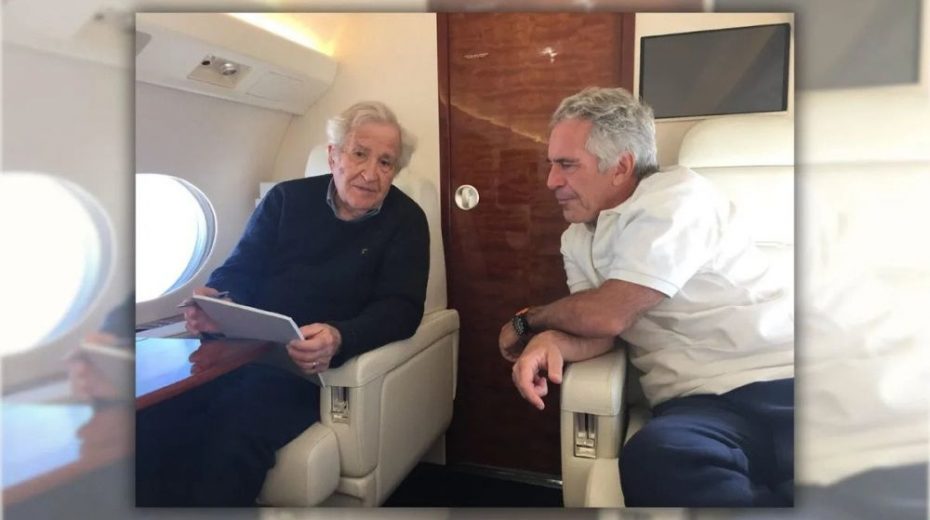
Perhaps one of the most surprising figures to appear in the declassified Epstein case files is Noam Chomsky.
That Man from Philadelphia
Noam Chomsky, recognized as a leading linguist and intellectual of the 20th and 21st centuries, is known not only for revolutionizing linguistic theory but also for his fierce critique of US foreign policy, the media, and power structures. Within the Epstein Saga, it is impossible to overlook his presence.
Noam Avram Chomsky was born on December 7, 1928, in Philadelphia to a family of Ashkenazi Jewish immigrants from Eastern Europe. His father, William (Zev) Chomsky, was a respected Hebrew scholar who fled conscription in the Tsarist army in what is now Ukraine, while his mother Elsie Simonofsky, descended from Russian Jewish roots, was politically active during the 1930s.
Growing up amid stimulating intellectual and political conversations about socialism, anti-fascism, and labor rights helped forge his early political views. As a child attending progressive schools, he was encouraged to cultivate independent thought, and at just ten years old, he penned an article in his school paper opposing the growing fascist threat in Europe following the Spanish Civil War.
Starting university at 16, Chomsky pursued linguistics, philosophy, and mathematics at the University of Pennsylvania. During his doctoral work, partly completed at the Harvard Society of Fellows, he developed transformational grammar, earning his PhD in 1955. Soon after, he commenced a lengthy tenure at the Massachusetts Institute of Technology (MIT), becoming a key figure in the emergence of modern cognitive science.
Revolutionary success
Chomsky is often hailed as the “father of modern linguistics” for his challenge to the behaviorist doctrines prevalent in the 1950s. In publications like Syntactic Structures, he outlined the idea that humans possess an innate universal grammar, a mental framework enabling language acquisition, thereby shifting attention from mere behaviorist observation to an analysis of internal cognitive processes.
This concept was instrumental in sparking the “cognitive revolution,” reshaping psychology, linguistics, and philosophy of mind, and profoundly influencing contemporary views of the mind as a computational system. Parallel to his academic work, Chomsky gained worldwide recognition for opposing the Vietnam War, producing essays and lectures denouncing war crimes and imperialist US policies, notably through meticulous use of official documents and primary evidence.
His renown also expanded through accessible books and interviews that made complex ideas graspable, establishing him as a significant influence on generations of students, activists, and social movements. He remains one of the most frequently cited intellectuals, across disciplines including linguistics, political science, communication, and philosophy.
Against the system, but…
Chomsky identifies politically as a libertarian socialist or anarchist within the socialist tradition, critical of corporate capitalism and authoritarian state socialism alike. He argues that power structures—states, corporations, military and financial institutions—maintain and legitimize themselves through control of information and violence, often masked as “defense” or “humanitarian intervention.”
One cornerstone of his critique targets mainstream media in liberal democracies. Co-authoring Manufacturing Consent with Edward S. Herman, he introduced the “propaganda model,” asserting that news outlets do not serve as neutral information vessels but systematically filter news to benefit political and corporate elites’ economic and geopolitical interests.
This critique is global, extending beyond the U.S. to cover cases like American involvement in Vietnam, support for Latin American dictatorships, media portrayal of Middle East conflicts, and Indonesia’s occupation of East Timor. According to Chomsky, political rhetoric — terms such as “democracy,” “security,” and “order” — often obscures underlying power dynamics and vested interests, encouraging skepticism of official narratives.
Many have referenced Chomsky when discussing conspiracies and power, cementing his iconic status as “the man who challenges the system.” This reputation stems from his unusual blend of profound academic expertise in linguistics and unwavering political opposition to U.S. foreign policy and neoliberalism. Over the years, he has authored countless works addressing war, globalization, multinational corporations, environmental issues, and human rights, always supported by extensive documentation. Importantly, his minority stance in mainstream U.S. media has made him a key voice for structural system critique beyond partisan debate.
…but not with his friend Jeffrey
However, unexpectedly, Chomsky appears first on Epstein’s list and then in his photographs.
The vocal opponent of power was, in fact, closely associated with elements of that corrupt and depraved system. The staunch critic mingled with influential figures representing the very societal powers he opposed.
Reports indicate Chomsky met Epstein several times between 2015 and 2016, reportedly discussing political and academic topics. One meeting also included former Israeli Prime Minister Ehud Barak. Another occasion allegedly had Epstein arranging a flight to enable Chomsky to dine with director Woody Allen and his wife Soon-Yi Previn. When questioned by the WSJ, Chomsky described these encounters as part of his personal life and claimed Epstein was considered rehabilitated after serving his sentence.
Recall that Epstein donated $850,000 to MIT, coinciding with the time Chomsky was a faculty member. Additionally, reports suggest Chomsky sought Epstein’s advice regarding management of mutual funds connected to his late first wife, with about $270,000 transferred from accounts linked to Epstein into ones under Chomsky’s name, though Chomsky maintained the funds were originally his.
Chomsky admitted knowing Epstein and meeting him “occasionally,” defending his association after Epstein’s initial conviction by asserting that the financier’s legal rehabilitation granted him a “clean slate.” This stance attracted criticism, as many found it morally indefensible for an intellectual—whose moral authority hinges on exposing abuses of power—to maintain personal and financial ties with Epstein post-conviction. Nonetheless…
Useful heroes
…there was never truly a Chomsky who stood as an adversary of the system, a defender of freedom, or a beacon of democracy.
Chomsky served the system well, to the extent that he was closely intertwined with it.
Groomed within Democratic universities—often hubs for intelligence manipulation and recruitment—he became a mouthpiece for various Democratic agendas, able to critique power but always from a stance that aligned with its interests. For example, in 2021, he called for backing Big Pharma and supported measures against pandemic skeptics.
While undoubtedly raising awareness about power structures, especially in media and communication, this awareness unfolded strictly within the system’s operational limits. Now, as more evidence surfaces, it becomes clear how adept the system is at manufacturing its own dissenters—figures who seem credible and charismatic but remain controlled, ensuring the system’s true nature remains untouched.
About the Author