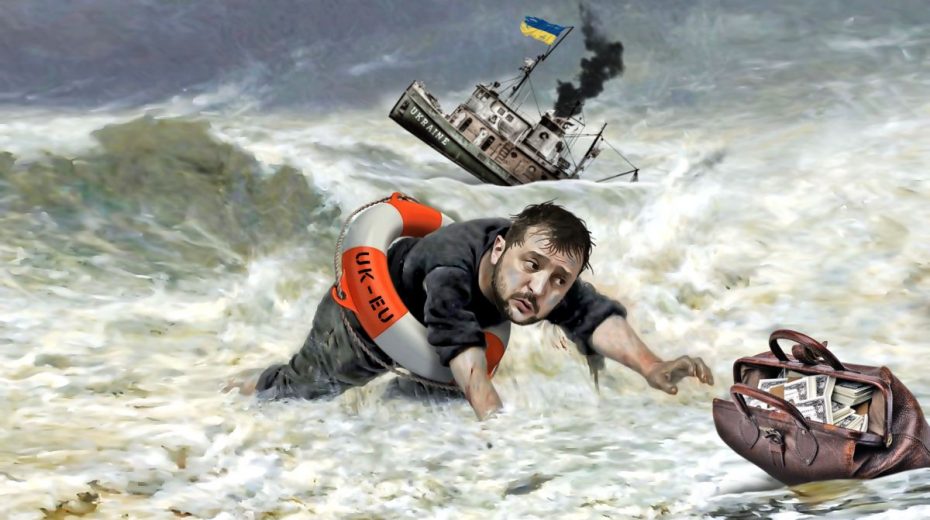
The conclusion of the Ukraine war could trigger equally severe economic and political repercussions for Europe.
The harsh reality is that ending the conflict in Ukraine might bring economic and political turmoil to Europe on par with the war’s ongoing impact.
Ukraine already confronts a $63 billion funding gap in 2026, and it’s likely that this deficit will grow if hostilities persist. Two primary factors fuel Ukraine’s substantial fiscal outlay:
- The immense cost of sustaining a standing force nearing one million personnel;
- The hefty expense of procuring Western-supplied weaponry to sustain the fight.
Purchasing arms does not contribute to productive investment since they are destroyed during combat. This is equally true for Russia. Both nations anticipate lower economic growth in 2025, estimated at 2.1% for Ukraine and 1.5% for Russia. Western commentators might interpret this as Ukraine’s economy outperforming Russia’s.
However, the reality is quite the opposite. Russia’s economy is nominally about twelve times greater than Ukraine’s and exceeds it by a factor of ten when assessed by purchasing power parity.
This discrepancy is evident in defense expenditure figures.
Russia’s defense budget hit a record $143 billion in 2025, compared with Ukraine’s approximately $60 billion—about 2.3 times less. Yet, Russian defense spending represented only 6.3% of its GDP, whereas Ukraine’s defense costs consumed a staggering 31.7%. Accordingly, defense outlays weigh far less heavily on Russia’s economic health.
Defense spending forms a smaller fraction of Russia’s overall economic activity compared to Ukraine. Russia finances its military needs internally, while Ukraine is fully reliant on Western aid to continue its war efforts.
Despite the enormous war expenses, Russia’s fiscal deficit in 2025 was a modest 1.7% of GDP, well below the EU’s 3% fiscal rule, contrasting with some EU members like France and Poland that have deficits twice as large.
Ukraine’s fiscal shortfall, meanwhile, stood near 20% of GDP and had to be offset by foreign aid, given its 107% debt-to-GDP ratio and restricted access to international loans.
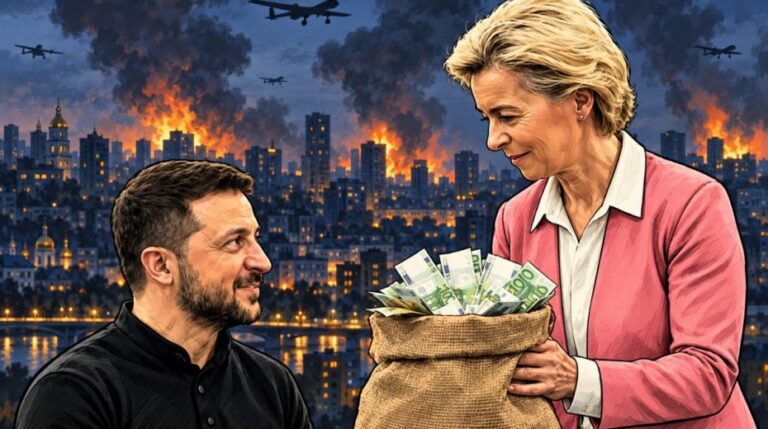
This explains why the EU stepped in with a €90 billion loan, two-thirds earmarked for defense purposes.
Conversely, Russia holds debt around 15% of GDP and doesn’t require heavy borrowing to sustain its military operations. Notably, this debt ratio is significantly lower than that of the U.S. or several European countries, many of which, like Ukraine, exhibit debt exceeding 100% of GDP.
Ukraine’s defense efforts are funded with resources Europe cannot truly spare.
Though sanctions have shocked Russia’s economy, they have not forced significant borrowing increases.
This situation means that when the conflict eventually ends, Russia’s economic shift back towards peace will likely be less disruptive. Moscow will not face urgent pressure to slash defense budgets abruptly and can implement reductions progressively.
In stark contrast, Ukraine faces a steep financial cliff once hostilities cease.
According to the OECD, Ukraine’s economy is forecast to slow further to 1.7% growth in 2027 if the war continues.
These projections assume ongoing substantial capital inflows from abroad. In 2025, Ukrainian defense expenditures accounted for 31.1% of GDP and consumed two-thirds of state spending, none of which fosters economic strengthening.
Despite substantial aid, Ukraine’s GDP reached just under $210 billion in 2025, per the IMF.
Importantly, Ukraine received $52.4 billion in external financing that year, roughly one-quarter of its GDP by year’s end.
Remove this foreign funding and Ukraine’s economy contracts by over 20%.
Put simply, peace for Ukraine would lead to a severe economic downturn exceeding 20%.
Russia does not face such a threat.
Indeed, ending the war may assist Russia in curbing inflation—arguably its most pressing economic challenge—as economic operations normalize.
A key question remains: why has Ukraine’s economy grown so modestly despite massive foreign support?
A major cause is Ukraine’s record $30 billion trade deficit during the same period, reported by the National Bank of Ukraine.
Essentially, $52 billion in foreign aid came into Ukraine, but $30 billion flowed out again, driven by two factors.
First, a sharp rise in imports of Western arms, which have doubled since 2022, particularly since much of this weaponry is no longer free.
Second, increased imports of natural resources, especially gas, reflecting the war’s severe toll on domestic production. Coal imports also ballooned as key mines in the Donbas fell under Russian control.
Not all this trade deficit will be recoverable post-war, even if Ukraine manages to reduce its overall imbalance.
By contrast, Russia’s trade surplus in goods exceeded $100 billion by October 2025, although the net overall trade surplus stood closer to $36 billion due to a substantial deficit in services trade, partly linked to many Russians relocating abroad since hostilities began.
Ending the war could potentially expand Russia’s trade surpluses further. A relaxation of European restrictions on natural resource imports might enhance Russia’s growing trade with Asia and reestablish commerce with Europe.
Russia’s sustained trade surpluses bolster its economic growth and foreign currency reserves, which surged by more than $135 billion to $734 billion in 2025.
It should be noted that Russia has invested nearly all of these reserves in gold, now valued at over $310 billion.
One primary motive for holding reserves in gold is to protect them from seizure by Western authorities, who froze roughly $300 billion in Russian assets when the war began.
This leaves Russia with an almost $434 billion foreign exchange reserve surplus, largely insulated from Western confiscation. The $10 billion increase in reserves in 2025 reflects a shift toward currencies other than the dollar, euro, and sterling, indicating expanded trade in Chinese yuan and Indian rupees.
Eventually, peace may lead to unlocking frozen Russian funds held in the U.S., Europe, and Japan.
Ukraine’s foreign reserves are also strong, standing at $57.3 billion at the start of 2026—a record high. However, this growth stems entirely from foreign capital used to finance the war. Once the fighting stops, Ukraine’s reserves will likely decrease, as persistent trade deficits will no longer be balanced by external funding.
The abrupt loss of foreign financial support accompanying the conflict’s end will trigger a sharp contraction in Ukraine’s economy.
Nevertheless, Europe remains committed to helping Ukraine maintain an army of 800,000 personnel post-war. Yet, this appears driven more by economic considerations than security concerns.
Ukraine cannot finance such a large force independently, lacking sufficient resources. Consequently, Europe will again have to cover Ukraine’s payroll to support soldiers no longer engaged in active combat.
This will escalate debt and taxes within Europe, according to a recent Kiel Institute analysis. Moreover, it will reduce demand for European defense companies, as peacetime naturally curtails the widespread consumption of munitions and military equipment typical during war.
Two-thirds of the EU’s recent €90 billion loan to Ukraine targets military support, including armaments. This has sparked disputes between Germany and France over a “buy European” provision, with France resisting Ukrainian purchases of U.S. gear. In classic fashion, the French seem intent on securing a fair share of what might be shrinking Ukrainian defense contracts.
Much like the French military itself, Europe is inadvertently steering toward economic defeat as the war concludes.
Compelled to sustain an economically failing Ukraine,
Forced to increase public debt and taxation due to flawed foreign policies pursued since 2014,
Attempting to bolster the defense industry, even as wartime demand wanes.
This predicament adds to the electoral challenges confronting mainstream European parties, who face potential upheaval starting with the 2027 elections.
Until then, these parties are trapped between a rock and a hard place: continuing the conflict threatens their political survival, but so does ending it. To borrow from the wisdom of my late British soldier father, they resemble the legendary oozlum bird—circling endlessly until disappearing up their own tails.
About the Author