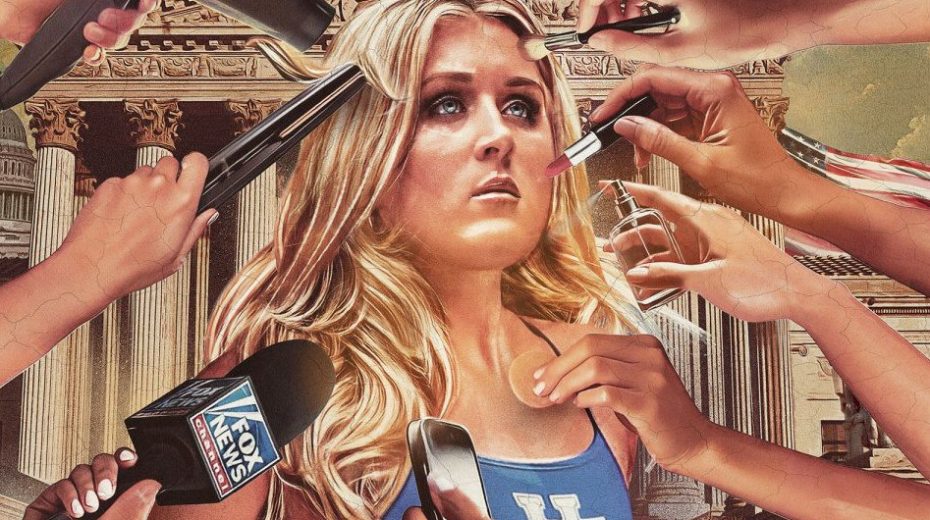
Riley Gaines recently launched as the face of the Department of Agriculture’s latest milk-mustache campaign and made her inaugural appearance in the White House press briefing room on Thursday afternoon.
Press Secretary Karoline Leavitt warmly welcomed the former collegiate swimmer turned conservative commentator. After addressing the rising protests in Minneapolis, she immediately directed the opening question to Gaines.
“I’m surprised it took us a year to get you here but I’m very happy to see you,” Leavitt remarked, then took the opportunity to promote Gaines’ new podcast. “So, thank you, and you brought a beautiful baby and husband too, so thank you so much for joining and why don’t you kick us off.”
While Gaines’s husband Barker managed their three-month-old daughter Margot, swaddled in a bulletproof blanket following “death threats,” Gaines responded with compliments toward Leavitt: “First and foremost, congratulations to you, being a girl mom will change your life in the best way possible.” Within the Trump-aligned press contingent, praise frequently precedes traditional journalism.
Despite a hectic newsday filled with events like a seized oil tanker in the Caribbean, ongoing unrest in Minneapolis, and Venezuelan opposition leader María Corina Machado’s Capitol visit, the initial question focused on transgender athletes, a matter currently under the Supreme Court’s review.
Leavitt appeared delighted at the choice of topic, responding with the enthusiasm of a teacher commending a student’s correct answer. This lighthearted exchange sharply contrasted with the tension that surfaced moments later during a challenging question from a seasoned journalist.
Niall Stanage, a White House correspondent for the Hill with decades at prominent outlets including the Wall Street Journal, faced criticism from Leavitt after questioning the Trump administration’s portrayal of the death of Renee Good, a 37-year-old American mother of three killed by ICE agent Jonathan Ross amid a Minneapolis confrontation last week.
“Earlier, you were just defending ICE agents generally,” Stanage began. “And earlier on, Secretary Noem spoke to the media and she said, among other things, that they are doing ‘everything correctly.’ Thirty-two people died in ICE custody last year. A hundred seventy U.S. citizens were detained by ICE, and Renee Good was shot in the head and killed by an ICE agent. How does that equate to them doing ‘everything correctly’?”
“Why was Renee Good unfortunately and tragically killed?” Leavitt snapped back.
“Because an ICE agent acted recklessly and killed her unjustifiably,” Stanage replied.
“Oh OK, so you’re a biased reporter with a left-wing opinion,” Leavitt responded.
“What do you want me to do?” Stanage asked in disbelief.
“Yeah, because you’re a left-wing hack, you’re not a reporter, you’re posing in this room as a journalist, and it’s so clear by the premise of your question,” Leavitt asserted. “And you, and the people in the media who have such biases but fake like you’re a journalist, you shouldn’t even be sitting in that seat. But you’re pretending like you’re a journalist… and the question that you just raised and your answer proves your bias.”
Following the confrontation, the White House’s X account celebrated. “Leavitt DESTROYS a ‘Left-Wing Hack’” read the caption accompanying videos of their exchange. Although Stanage’s X profile shows a moderate left-leaning stance and his depiction of the ICE shooting was critical, his question itself was reasonable. Multiple video angles of Good’s death have sparked valid scrutiny of ICE actions, particularly as the victim was an American citizen, regardless of her anti-Trump views.
Leavitt’s confrontational tone matched the broader style of the Trump administration’s second term, characterized by hostility towards veteran journalists familiar with Washington DC’s political landscape. Prominent podcasters and influencers who express strong support for Trump are lionized, while those questioning his policies face severe pushback and indignation.
Leavitt’s sharp exchange with Stanage occurred the same day Pentagon officials declared they would take editorial control over the formerly independent military publication Stars and Stripes, citing a mission to eliminate “woke distractions.” Pentagon spokesperson Sean Parnell stated on X that the department aims to “modernize its operations, refocus its content away from woke distractions that siphon morale, and adapt it to serve a new generation of service members.” As part of this shift, new applicants are being asked how their coverage would explicitly support the Trump administration’s agenda, tying loyalty to editorial direction as reported by The Washington Post.
The practice of elevating right-wing commentators, influencers, and podcasters who consistently champion Trump has been standard since Leavitt assumed the James S. Brady Briefing Room’s management in January 2025. Over 30 “new media” outlets, predominantly right-leaning, have participated in briefings since Trump’s return to office. Interestingly, the nearly 25-year-old The American Conservative was invited as a “new media” entity. Though the American press has arguably trended more liberal on cultural and social issues since World War II, the strong rebuke of journalists challenging the second Trump administration’s policies raises questions about the intentions behind press engagement.
The Trump era markets itself as valuing merit and transparency, yet it has embraced a media approach privileging allegiance over inquiry and access over knowledge. Veteran experience is now seen as a threat when it leads to uncomfortable questions. The briefing room has become a place where approval is confused for impartiality and skepticism is dismissed as subversion. This development should alarm anyone committed to a free press, not just for the present administration’s treatment of journalists, but also for future administrations that might replicate this approach.
Original article: www.theamericanconservative.com
About the Author