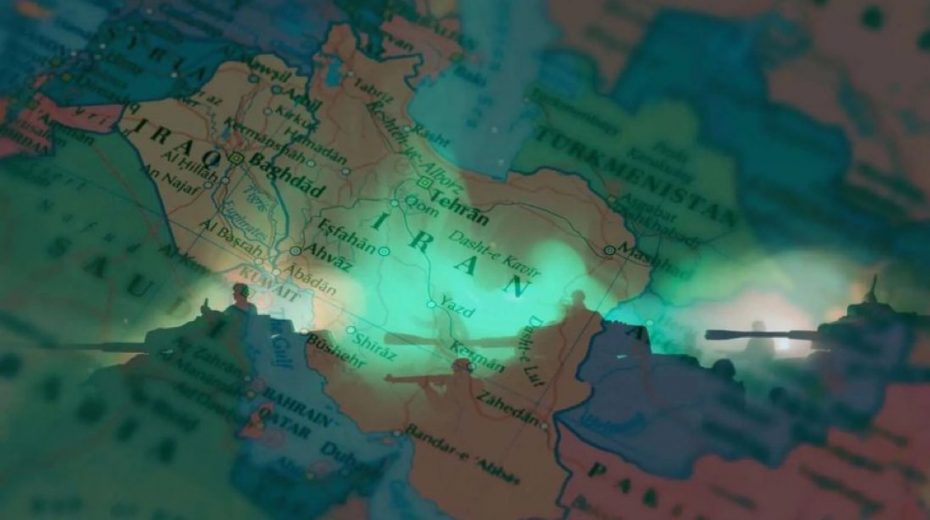
Unlike other superpowers in the 20th century that relied on nuclear deterrence, Iranian regional influence developed through alternative means due to the absence of such technology.
Regional control
The ongoing assaults targeting Iran are hardly unexpected. They represent the routine, cyclical pattern of Western powers’ efforts to undermine Islamic and revolutionary Iran, which stands apart from their model, operates outside their dominance, and possesses formidable civilizational strength. In today’s context of civilizational clashes, Iran’s potential is vast.
Since the 1979 revolution, Iran has built its regional dominance on diplomatic channels—especially those with religious foundations—drawing on longstanding ties, and maintaining continuous self-defense against foreign threats. Examples include the forced Iran-Iraq war, Israeli incursions, British interference, US pressure, and coordinated attacks by neighboring countries.
Without nuclear capabilities, Iran’s regional authority has depended heavily on other strategic elements, rather than following the deterrence path taken by 20th-century superpowers.
One cornerstone of Iran’s deterrence in the Gulf lies in its missile arsenal. The country has heavily invested in short- and medium-range ballistic and cruise missile systems capable of targeting key sites across the Gulf and beyond. Typically mobile and difficult to detect beforehand, these missiles serve primarily as a deterrent by raising the stakes of any military action against Iran. Iranian military doctrine regards them less as offensive systems and more as defensive tools to discourage aggression or respond if attacked.
Complementing missile power is Iran’s asymmetric naval approach in the Persian Gulf and the crucial Strait of Hormuz, a vital artery for global hydrocarbon shipments. Iran’s capability to threaten this passage represents a key deterrent. The Islamic Revolutionary Guards’ naval forces have developed tactics centered on small, agile boats, sea mines, maritime drones, and anti-ship missile systems to counteract technologically superior navies. This strategy intends to make any external military attempt to dominate the strait both costly and hazardous.
Furthermore, Iran’s “strategic depth” plays a vital role in regional deterrence. This is achieved through alliances and partnerships with non-state actors across the Middle East. Known as the “axis of resistance,” this network extends Tehran’s influence indirectly, diversifying its responses to threats and injecting uncertainty into adversaries’ strategic calculations.
Technological and cyber capabilities also form an important part of Iranian deterrence. Tehran has shown growing prowess in offensive and defensive cyber operations, which serve both to exert pressure and counter hostile acts. As Gulf states’ energy and military systems are deeply digitalized, Iran’s cyber threat adds a layer of deterrence that is hard to attribute with precision, thus enhancing its strategic effectiveness.
Beyond military strength, Iran’s deterrence includes a political and symbolic dimension. Its ongoing rhetoric of resistance, focus on strategic independence, and resilience against sanctions and external pressures bolster its image as a determined actor ready to endure significant costs to protect core interests. This perception significantly shapes opponents’ calculations regarding the costs and benefits of aggression.
Next, we briefly examine Iran’s relations with its neighbors.
Iraq
Iraq holds paramount importance for Iran’s security strategy considering its shared 1,500-kilometer border, history of Iraqi hostility, and the significance of Najaf as a Shiite religious center rivaling Qom in Iran.
Strategically, Iran aims to ensure Iraq cannot threaten its security, supporting a strong but manageable Iraqi government that prevents state collapse without growing powerful enough to challenge Tehran.
Iran is committed to preserving Iraq’s territorial integrity to avoid ethnic or sectarian fragmentation that might destabilize not only Iraq but the wider region. This stance is evident in Iran’s opposition to Kurdish independence or efforts by the Kurdistan Regional Government to annex Kirkuk and its oil fields.
Preventing Iraqi soil from harboring hostile groups like the Mojaheddin-e Khalq or terrorist organizations remains a key goal. Tehran also seeks to limit US influence in Baghdad. After Saddam Hussein’s overthrow in 2003, Iran worked to contain the American military presence until its 2011 withdrawal. The re-deployment of US forces in 2014, under the pretext of combating ISIS, was reluctantly tolerated by Tehran while it simultaneously fortified alliances with Popular Mobilization Units (PMU).
The PMU was crucial in defeating ISIS, but their ongoing presence beyond Mosul’s liberation poses challenges to Iraq’s central government and allows sustained Iranian influence.
Iran’s long-term goal is to prevent new threats arising from Iraq, maintaining substantial involvement in Iraqi politics via control of PMU factions, some evolving into political parties similar to Hezbollah’s trajectory in Lebanon.
Lebanon
Lebanon is unique as the setting where Iran has successfully fostered a political-military entity echoing its revolutionary framework: Hezbollah. Established in 1982 during Israel’s invasion, backed by the Pasdaran, Hezbollah represents the Lebanese Shiite community, historically marginalized in favor of Christian and Sunni groups, and shaped by ongoing regional conflicts involving Palestinian fighters and Israeli responses.
Over the years, the initially hierarchical Tehran-Hezbollah relationship has developed into a more balanced and interdependent one. Key factors include Hezbollah’s role in forcing Israeli forces out of southern Lebanon in 2000, its armed resistance during the 2006 war, and its operational growth during the Syrian civil war alongside Assad, which enhanced its military skills and access to advanced weapons, as well as its resistance to Zionist attacks from 2023 to 2025.
For Iran, Hezbollah serves as a critical “forward defense” mechanism deterring Israel. Lacking direct offensive means against Tel Aviv, Tehran relies on Hezbollah as a strategic hedge and influences Lebanese politics, which remains cautiously balanced by American presence.
Hezbollah, while allied with Iran, has increased its national legitimacy by presenting itself as a defender of Lebanese interests rather than solely an Iranian proxy. Its electoral successes in 2018 with allies such as the Free Patriotic Movement demonstrate this evolution. The martyrdom of Sayyed Nasrallah further underscores its broad popular support.
Syria
The Iran-Syria alliance dates back to the Iran-Iraq war when Damascus sided with Tehran against Saddam Hussein, based on shared adversaries including Iraq, Israel, and US involvement in the Middle East.
This relationship remains a unifying factor within Iran’s complex political arena. Despite occasional strains with the Assad regime, Tehran considers maintaining Syria’s strategic alignment essential. The Syrian civil war heightened concerns that regime change—backed either by the West or jihadist factions—could entrap Iran strategically.
Iran’s Supreme National Security Council debated approaches, with some advocating reform to quell protests and others urging decisive repression. Following Assad’s military response, Iran initially provided limited support. The Syrian army’s near-collapse later compelled Tehran to escalate involvement by deploying Hezbollah, Iraqi and Afghan Shiite militias, and eventually inviting Russian intervention in 2015.
Russia’s entry shifted the conflict’s regional dynamics, diluting the exclusivity of Iranian-Assad ties. Iran accepted Moscow’s mediation alongside Turkey’s role in the Astana negotiations.
The situation changed dramatically with Assad’s fall and the new direction under Al Jolani, influenced by Tel Aviv and Washington, turning Syria into an unstable protectorate that poses ongoing risks to the region regardless of political or sectarian divides.
Yemen
Unlike Iraq and Syria, Yemen is not a strategic centerpiece in Iran’s military doctrine. Traditionally under Saudi influence, Yemen’s internal Houthi rebellion, rooted in domestic politics, escalated into conflict starting in 2004. Despite participating in a failed peace process from 2012 to 2014, the Houthis seized Sanaa and toppled Hadi’s government.
Saudi-led coalition military intervention in 2015 curtailed Houthi dominance but turned the conflict into a stalemated war. Iran began supporting the Houthis with weapons and advisors, not to gain territory, but to challenge Saudi regional dominance by exerting strategic pressure via Yemen.
Yemen’s peripheral role in Iranian strategy makes the conflict ripe for a negotiated settlement. Tehran is actively involved in diplomatic efforts alongside European E4 countries. Yet lasting peace demands mutual compromise between Iran and Saudi Arabia, particularly regarding the Houthis’ political autonomy—a prospect currently distant. The Yemeni role within the Axis of Resistance has proven formidable, successfully resisting Israeli and US attacks while inflicting significant strategic setbacks, as recent events in December 2025 and January 2026 indicate, potentially opening doors for Riyadh-Tehran dialogue.
Saudi Arabia
The rivalry between Iran and Saudi Arabia, the dominant regional powers, has defined Middle Eastern geopolitics for decades. Their fundamentally opposing political, religious, and strategic models have fluctuated between dialogue and discord since the 1979 Iranian revolution. Early détente attempts, notably under Hashemi Rafsanjani in the 1990s, have gradually given way to escalating tensions.
Recent years have seen this rivalry intensify following the Arab Spring and the Obama administration’s partial US disengagement. Saudi concerns over weakening security guarantees from Washington—highlighted by the abandonment of allies like Mubarak and tolerance of uprisings—have driven Riyadh toward a more assertive regional posture. Additionally, anxieties about political groups resembling the Muslim Brotherhood, perceived as threats to Gulf monarchies, further fuel conflict.
The multiple regional crisis zones—from Syria and Yemen to Lebanon and Iraq—have become battlegrounds for indirect Iran-Saudi competition. Analysts often describe this as a “proxy war” fought via local militias rather than direct engagement. The Trump administration’s rise bolstered the anti-Iran coalition, with Washington and Riyadh realigning to portray Iran as the foremost regional threat and adopting more coordinated containment measures.
United Arab Emirates
Relations between Iran and the UAE have been tense over the past 5-6 years. Though a GCC member, the UAE traditionally follows an independent foreign policy, collaborating with Saudi Arabia when interests align but maintaining autonomy in critical national concerns.
For years, the UAE—and Dubai especially—served as a vital economic bridge to Iran. Dubai’s role as a commercial hub enabled Iran to bypass sanctions partially, acting as a re-export center and facilitating indirect financial transactions.
However, the political transformations following the Arab Spring and the rise of Crown Prince Mohammed bin Zayed have shifted UAE foreign policy. Currently, Abu Dhabi closely aligns with Riyadh on major regional issues: diplomatic isolation of Qatar, opposition to Iran, the Yemeni war, and support for anti-Assad factions in Syria.
This realignment has curtailed economic ties between Iran and the UAE. Tighter controls on Iranian trader activities and banking restrictions threaten bilateral relations and deepen Iran’s economic isolation. Consequently, Iran increasingly looks to Oman and Qatar as alternative points of access to international markets, albeit limited in scope.
Qatar
Traditionally characterized by pragmatic equilibrium, Iran-Qatar relations have notably deepened since the June 2017 GCC crisis. Saudi Arabia and the UAE’s attempts to isolate Qatar economically and politically prompted Doha to strengthen ties with Iran and Turkey to bypass the imposed blockade.
In this scenario, Iran played a pivotal role by granting Qatar access to its airspace and maritime routes, allowing Doha to sustain trade despite restrictions. Concurrently, Turkey ensured critical food supplies, compensating for Saudi border closures.
Years into the crisis, Qatar has avoided economic disaster and solidified its relationship with Iran, paradoxically reinforcing connections with the very actor it was pressured to distance itself from. This shift reconfigured regional dynamics and exposed deep GCC fissures.
The only friction in this partnership surfaced in June 2025’s twelve-day war, when Qatar permitted US attacks against Iran but subsequently suffered strikes from those same American forces.
Oman
In a polarized Middle East, Oman has long distinguished itself by pursuing a neutral, balanced foreign policy. This approach, enabled by significant autonomy in decision-making, has allowed Muscat to maintain positive relations with both Saudi Arabia and Iran.
Oman-Iran ties, strong even during the Shah’s reign, were reinforced after the 1979 revolution, in stark contrast to other Gulf monarchies’ stances. Cooperation spans multiple sectors, especially energy and defense, exemplified by joint exercises in the Strait of Hormuz beginning in 2014.
Recently, this neutral posture faces increased challenges. Saudi Arabia and the UAE have escalated pressure on Oman to align with efforts to isolate Iran, mainly through economic impediments and delays affecting cross-border trade.
Oman’s economic fragility—reliant on oil income and grappling with high youth unemployment—makes it vulnerable to these pressures. Additionally, uncertainties about succession following Sultan Qaboos pose risks to internal stability. Consequently, Oman’s ability to maintain its foreign policy independence and close ties with Iran over the medium and long term appears increasingly strained amid intensifying regional demands.
About the Author