The Europeans have exhausted their repertoire of symbolic state maneuvers, and the Russians see no reason to entertain them any longer.
Wars occasionally produce moments that can be interpreted—as they occur, shortly thereafter, or over time—as pivotal, enlightening turning points. D–Day, on June 6, 1944, stands as a clear example: The Allies, along with the Red Army, reached Berlin within the following year.
Another is the Tet Offensive, which commenced 58 years ago next week (hard to believe), shattering the long-held illusions of imminent American victory. Although many more lives were lost to imperial ambitions, the conflict in Southeast Asia was on the path to conclusion.
On January 8, Russia targeted Lviv in western Ukraine with an Oreshnik missile. This strikes me as a defining moment in the Ukraine war—Moscow signaling it has embarked upon the beginning of the conflict’s end.
The Oreshnik, a state-of-the-art missile already bearing the legendary aura of Ares, the Greek god of war, flies at hypersonic speed and evades detection by air-defense systems. While it is capable of carrying nuclear warheads, the missile that struck Lviv did not.
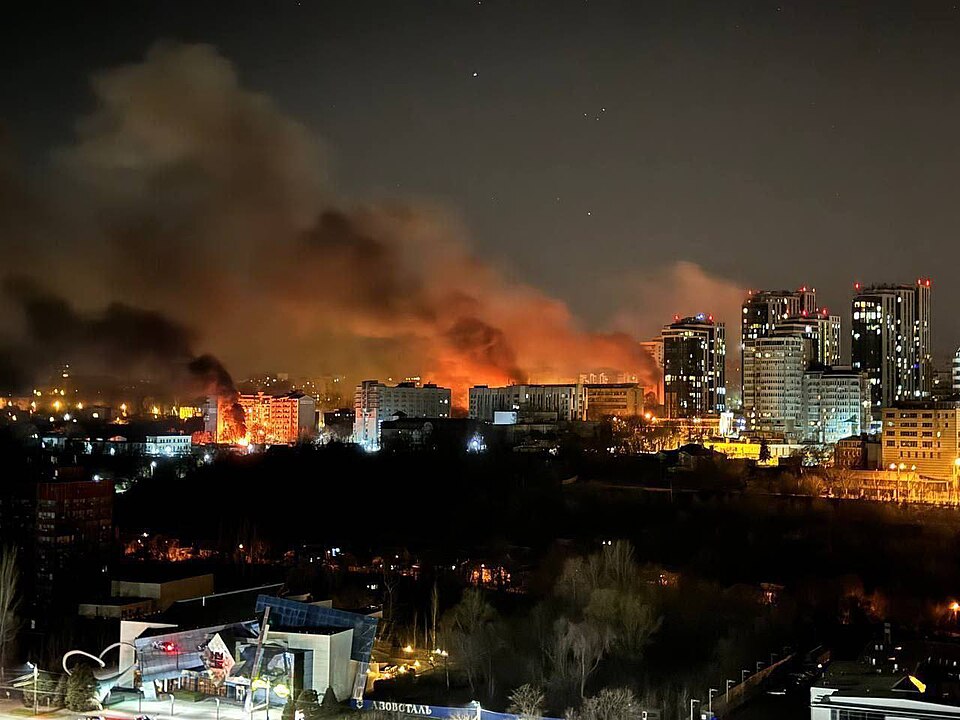
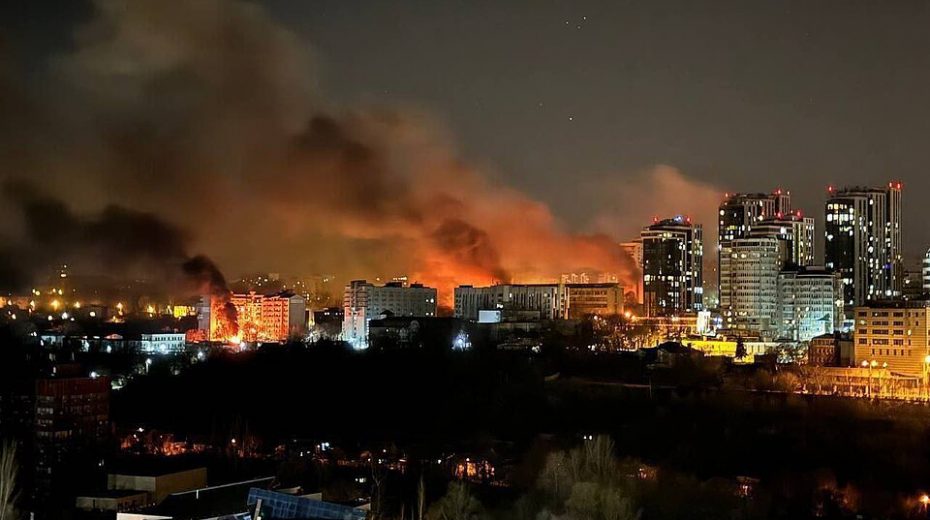
Center of Dnipro city after Russian bombing with conventional weapons, March 2025. (Wikimedia, CCA 3.0 Unported License)
This missile was not Russia’s maiden Oreshnik strike in Ukraine; the inaugural use was in November 2024, targeting a munitions factory near the front lines in Dnipro. That attack stunned observers by damaging both the facility and their expectations.
The strike on Lviv, however, carried a distinct message aimed specifically at Kiev’s regime and its Western supporters, especially the condescending European powers. Lviv, Ukraine’s cultural hub, has been regarded as a refuge during four years of conflict. Importantly, it lies about 45 miles from Poland’s border.
Moscow claimed the second Oreshnik launch was retaliation for a December 29 drone strike on President Vladimir Putin’s secondary residence in Valdai, northwest of Moscow—an operation allegedly conducted by Ukrainians with American and British aid.
Kiev and the C.I.A., known advocates of “truth,” dispute that the attack occurred, but dismissing the event as mere fantasy seems pointless. Reportedly, the Russians have shared evidence with Western officials confirming it.
Would Putin have mentioned it to President Trump during their phone conversation if it were, as corporate media suggest, mere disinformation?
Setting that aside, the Oreshnik strike on Lviv deserves a more comprehensive interpretation.
Here is a detailed depiction of the Oreshnik’s descent through Lviv’s winter clouds, authored by Mike Mihajlovic. He frequently contributes to Black Mountain Analysis, a newsletter I have previously found insightful.
This excerpt is drawn from Mihajlovic’s thorough examination of digital footage and eyewitness testimonies—enough to grasp what unfolds when these missiles arrive, especially considering their possible recurrence as the conflict enters its fifth year:
“As the hypersonic penetrators broke through the cloud layers, each was enveloped in a luminous plasma sheath, producing brief but violent flashes that momentarily illuminated the surrounding atmosphere. These flashes were not explosions in the conventional sense, but visual signatures of extreme velocity, friction, and compression as the warheads tore through dense air at hypersonic speed.
Observers on the ground reported an unsettling soundscape that followed the visual phenomenon. Rather than a single detonation, there were sharp, cracking noises that seemed to ripple across the terrain, as if the ground itself were fracturing under stress….
What made the event particularly striking was the setting. The impacts occurred against the backdrop of an idyllic winter landscape: fields and forests blanketed in snow, small settlements dimly lit, and a horizon that, moments earlier, conveyed calm and stillness.
Against this muted palette, the light generated by the strike stood out with almost surreal intensity. Reflections danced across the snow, briefly turning the ground into a mirror that amplified the event’s brightness. Witnesses described the glow as unnatural, a cold, shimmering illumination that lingered just long enough to be noticed and remembered.”
A fitting metaphor for a nation clinging to its fantasies while, encouraged by the relentless Three Musketeers—the British, French, and German leadership—it drags on in a conflict it has long lost. Think of it as a shock to complacency.
This Lviv attack appears to be an escalation of an ongoing effort to dismantle Ukraine’s electrical grids, energy systems, and manufacturing capacity. Though these types of strikes have occurred for years, the current wave suggests Moscow is moving decisively toward conflict resolution.
Moscow’s Attempts to End Conflict
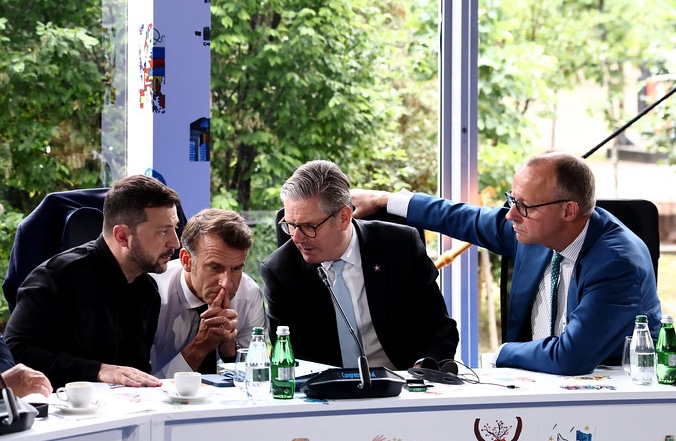
President Zelensky, French President Macron, UK Prime Minister Starmer and German Chancellor Merz speak on the phone with President Trump during a gathering for European officials in gathering in Tirana, Albania, on May 16, 2025. (Simon Dawson / No 10 Downing Street / Flickr / CC BY-NC-ND 2.0)
The Kremlin has explored every route to conclude its “special military operation,” along with its broader standoff with the West, on terms favorable to all involved. One can trace this back to spring 2022, when a possible peace agreement with Kiev was thwarted by the British, with the green light from the Americans.
Or to December 2021, when Russia delivered draft treaties to Washington and NATO proposing a new security framework between Russia and the West, only to have those offers dismissed as “nonstarters,” a British phrase the Biden administration embraced.
Or recall the sabotaged Minsk Protocols from September 2014 and February 2015, undermined by the British and French. Even back to the early 1990s, when Michail Gorbachev envisioned a “common European home” that would bring post-Soviet Russia into a shared cooperation.
“The Kremlin has tried every which way to bring its ‘special military operation,’ along with its broader confrontation with the West, to a mutually beneficial conclusion.”
Throughout these efforts, the Kremlin has exercised remarkable patience and restraint. It would be incorrect now to assume Russia’s patience has run out.
Rather, it seems the Russians have arrived at the conclusion that continuing to wait while Western powers engage in performative politics—or what might be more aptly described as collective self-indulgence—is futile.
And they are expressing this openly.
In the last weeks of the previous year, the news was filled with reports about vigorous diplomatic exertions by Kiev, European capitals, and factions connected to the Trump administration. The “Three Musketeers” hatched a 20-point peace initiative intended to replace Trump’s earlier 28-point proposal.
Volodymyr Zelensky, Ukraine’s unconstitutional leader, traveled from European capitals to Washington, then to Mar-a-Lago, and back to Europe, claiming he and his supporters were “90 percent there.”
Ninety percent aligned on security assurances involving European peacekeeping forces on Ukrainian territory; ninety percent aligned on territorial arrangements; and so forth.
Witnessing this was astounding—the entire effort was divorced from crafting any agreement Moscow might find even tentatively acceptable. The 20-point agenda was essentially designed to undermine the 28-point draft, which had been the first proposal since spring 2022 that Moscow regarded as worth consideration.
Not Enough Delusion

Refugees taking shelter under a bridge in Kiev, March 5, 2022. (Mvs.gov.ua, CC BY 4.0, Wikimedia Commons)
No, the Trump plan was too grounded in reality to qualify as a settlement draft, since it acknowledged Moscow’s victory and Kiev’s defeat. It lacked enough fantasy to flatter the vanquished.
Since early this year, there has been a near-total silence from Zelensky and the Musketeers—Keir Starmer, Emmanuel Macron, and Friedrich Merz—a prime minister, a president, and a chancellor.
Though it’s impossible to definitively link the Oreshnik strike on what had been relatively secure western Ukraine with this sudden quietness in Kiev, London, Paris, Berlin, and even Washington, the implication may be similar.
The Europeans have simply exhausted their theatrical gestures in statecraft—this is my conclusion. And the Russians apparently share this sentiment in some form, seeing no reason to continue indulging them.
Regarding the Trump administration, I never imagined that the expansive national security apparatus would permit him to finalize a comprehensive deal with Moscow that might herald a new chapter in East–West relations.
Thus, the war shifts. Clarity emerges. And the conflict in Ukraine seems poised to conclude—not with a singular cataclysmic blast, but through sharp, resonant cracks rippling across the landscape.
Original article: consortiumnews.com
About the Author