$110 Silver Tests the Faithful
Last March, I published an article called “Silver’s 3x Upside”.
At that moment, silver was priced at $34.33 per ounce.
My expectation was that silver would reach $100 by 2028, potentially even later.
However, during the latter half of 2025, silver took off sharply. It now trades at $111.69 an ounce, having briefly touched $117.
Recently, I found myself wondering if it might be wise to cash in some profits.
After thorough reflection, I remain committed to holding for another three to five years.
Here’s the reasoning behind that decision…
Parabolic Moves
Let’s briefly examine silver’s 1-year price chart.
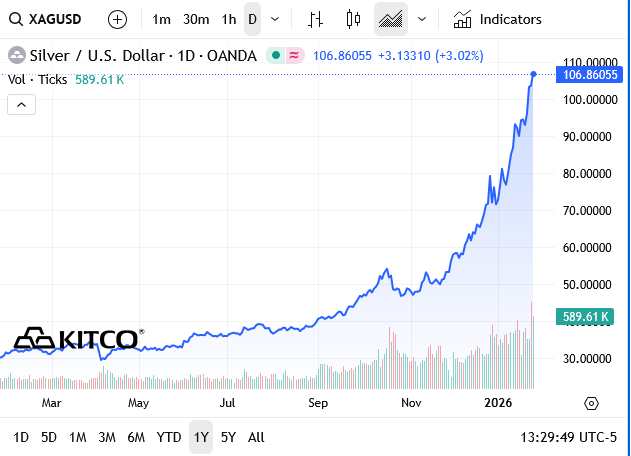
Source: Kitco.com
The leap from $30 to $111 occurred rapidly, even for a commodity as volatile as silver.
Typically, moves like this are succeeded by a significant correction. I’ve anticipated a roughly 25% decline for some time, though it has yet to materialize.
It will happen eventually, so mental preparation is key. And if it never does, that’s excellent.
If you prefer to avoid such an anticipated drop, it makes sense to take profits now. If your gains have transformed your life, partial profit-taking is also prudent.
One major reason I haven’t exited is the difficulty in timing such a volatile market. With another inflation surge on the horizon, more money is likely to flow into precious metals, prompting a mass shift away from fiat currencies.
Regarding silver miners, their valuations still correspond with a $60/oz silver price. In a bull market for silver, miners typically outperform the metal by about two times; currently, they are barely matching bullion gains.
So long as silver prices avoid a steep collapse, miners will maintain robust cash flow and deliver exceptional earnings.
Therefore, my strategy remains unchanged: hold steady.
Core Thesis: Unchanged
The main motivation for many of us investing in precious metals is to protect against inflation, currency devaluation, and societal instability.
Silver also benefits from rising industrial demand driven by solar technology, electric vehicles, and electronics.
None of the fundamental reasons behind the investment have shifted.
The looming debt crisis is still on the horizon. Central banks are expected to respond predictably by cutting interest rates and increasing money supply. Governments, particularly in the U.S., will cover their excessive spending by creating new money. Even interest payments on debt will be financed through further borrowing.
Eventually, stimulus payments will be issued to support Americans facing hardship, funded by freshly produced currency that will flow directly into the economy, exacerbating inflation.
It strikes me as somewhat unusual that gold and silver have climbed so strongly even before this next inflation wave truly takes hold, but the global awakening to the magnitude of debt challenges is apparent — and overdue.
A Permanent Re-Pricing?
I believe silver will not drop below $60 ever again.
For an extended period, silver was undervalued, likely because much of the “silver” exchanged consisted of paper contracts rather than actual physical bullion.
In Paradigm’s internal chat earlier, Sean Ring from The Rude Awakening shared a chart indicating silver pricing in Shanghai at $127 per ounce.
This exceeds the U.S. (COMEX) price by an impressive 17%!
Our colleague Byron King commented on the price disparity between China and the West:
China does physical metal, so pays more for real stuff. The West does paper, and the trades almost never settle… Few are called onto the carpet to explain why there are no silver bars on the pallets in the warehouse.
What this tells me is that physical supply is NOT THERE… People are having fun trading paper… But “real” users — industrial buyers in China — need metal, and they will bid it up to get assured supply of actual elemental silver. Seems rather bullish to me… I think I’ll hang onto my silver for a while longer. And the silver mining space is destined for more $$ and higher share prices.
With decades of experience in precious metals, Byron’s insights carry great weight and influenced my decision to maintain my position.
China is emerging as a key force in silver pricing, which makes sense since the country consumes about half of the world’s industrial silver for manufacturing electric vehicles and solar panels.
Previously, prices were mainly shaped by the COMEX in the U.S. and the LBMA in London.
Paper silver IOUs no longer dictate value; physical demand now drives the market. This marks a major shift.
Although this price surge has tested long-term investors’ patience, I intend to remain invested.
To be clear, taking profits after such substantial gains is perfectly reasonable. If you decide to lock in some returns, that’s fine. Just consider retaining a portion of your holdings.
At present, miners remain attractively valued, and owning physical silver offers valuable insurance.
Corrections will happen, naturally, but looking beyond the near term, the strongest gains likely lie ahead.
About the Author