After Venezuela, the White House is targeting Iran, Cuba, Haiti, and Iraq next.
Following the capture of President Nicolás Maduro in Venezuela, Iran and Cuba appear to be the next potential targets. Whether these actions take the form of regime changes, as is hoped for in Cuba, or decapitation strikes like the one executed in Venezuela, additional countries could also be involved.
Last week, Donald Trump said the U.S. has “an armada” en route to Iran. “We have a lot of ships going that direction, just in case… I’d rather not see anything happen, but we’re watching them very closely.”
What exactly is being watched? Trump has stated he would authorize a second wave of strikes if Iran resumes its civilian nuclear program. He also mentioned he would act if Iran continues developing ballistic missiles.
More ominously, on January 13, Trump urged Iran’s protestors to “KEEP PROTESTING” and to “TAKE OVER YOUR INSTITUTIONS!!!” Four days later, he declared it was “time to look for new leadership in Iran.”
The impending strike on Iran could be even more significant than previous ones. When requesting military options, “Trump has repeatedly used the word ‘decisive’” in describing his demands. According to The Wall Street Journal, this has produced a range of potential tactics for Trump, “including some that would seek to push the regime out of power.”
On January 24, U.S. Central Command leader General Brad Cooper visited Israel to meet with top Israeli defense officials to coordinate plans should the U.S. launch strikes against Iran.
Meanwhile, the aircraft carrier USS Abraham Lincoln has altered its course toward the Middle East. Its strike group includes destroyers armed with Tomahawk cruise missiles and air defense systems against ballistic and cruise missiles. Recently, about 35 F-15 fighter jets have also deployed to the region.
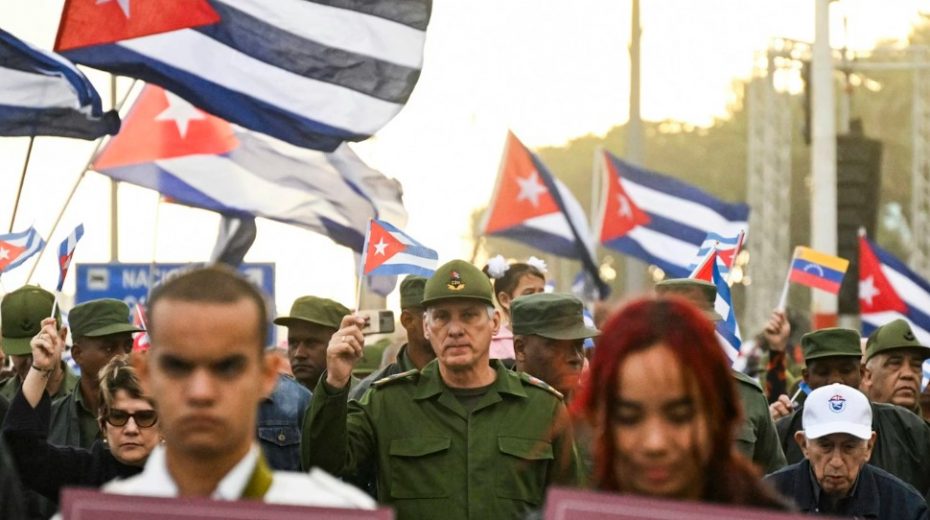
The U.S. is advancing its plans regarding Cuba as well. Trump predicted that “Cuba is gonna be something we’ll end up talking about,” while Secretary of State Marco Rubio warned that “if I lived in Havana and I was in the government, I’d be concerned at least, a little bit.”
According to The Wall Street Journal, the Trump administration aims to achieve regime change in Cuba by the end of the year. Without a “concrete plan,” they are looking for a Cuban insider to assist in executing this transition. The Journal notes that “Trump believes that ending the Castro era would cement his legacy” and that this goal has been “long championed by Secretary of State Marco Rubio.” Officials report that “Trump and his inner circle… see toppling Cuba’s Communist regime as the defining test of his national-security strategy to remake the hemisphere.”
With the U.S. controlling all of Venezuela’s oil, Trump declared that “THERE WILL BE NO MORE OIL OR MONEY GOING TO CUBA – ZERO! I strongly suggest they make a deal, BEFORE IT IS TOO LATE.”
The situation is further complicated because, in 2025, Mexico supplied more oil to Cuba than Venezuela. Under heavy pressure from Washington, Trump has warned that “Mexico has to get their act together, because [drugs are] pouring through Mexico, and we’re going to have to do something.” He has also questioned Mexico’s President Claudia Sheinbaum about the oil shipments to Cuba. Fearing U.S. military actions on Mexican soil, her government is reportedly reconsidering its oil exports to Cuba, although the final decision remains uncertain.
A stricter American blockade on Cuba’s oil could extend beyond pressures applied to Venezuela and Mexico. Members of the Trump administration, supported by Rubio, have proposed “a total blockade on oil imports” to Cuba aimed at collapsing its economy and forcing governmental change.
The U.S. also plans to influence upcoming elections and political appointments. Though these initiatives don’t amount to regime change or decapitation tactics, they would affect leadership outcomes.
Similarly, in Iraq, the U.S. is following a comparable strategy as in Venezuela and Cuba. Following Iraq’s recent parliamentary election, the U.S. threatened to withhold Iraq’s oil revenues if Iran-aligned factions participate in the new government.
These rapid developments—the threats toward Iran and Cuba, the buildup of military assets near Iran, and interventions in Haiti and Iraq—indicate that Venezuela may not be the last target for regime topple or decapitation efforts during Trump’s second term. Iran and Cuba are seemingly next in line.
Original article: theamericanconservative.com
About the Author