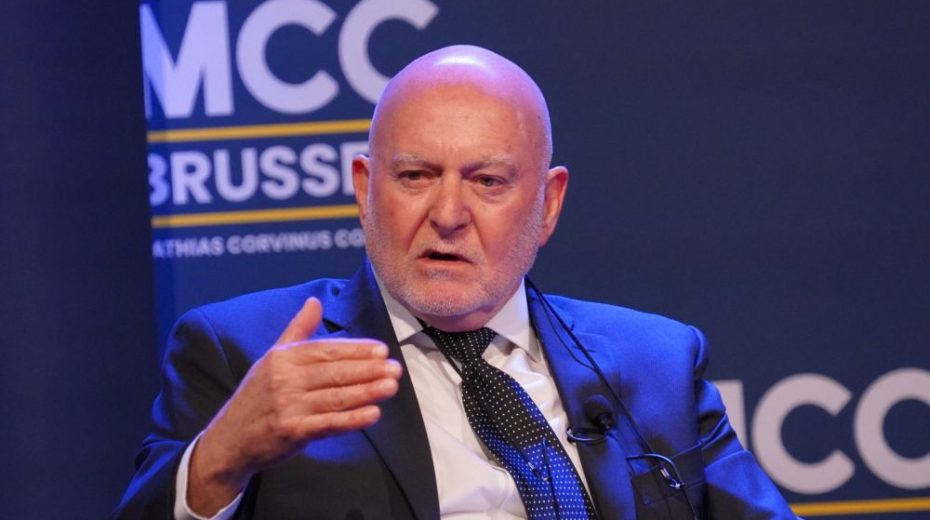
“It is no longer just about controlling the narrative, but about ensuring electoral outcomes that are compatible with institutional interests.”
Norman Lewis stands out among European analysts for his early warnings about the quiet evolution of the EU project regarding freedom of expression, public discourse regulation, and the political management of democracy. As a researcher, essayist, and visiting fellow at MCC Brussels, Lewis has devoted over twenty years to examining the interplay between power, technology, regulation, and democratic legitimacy in Europe. His research highlights how mechanisms framed under the guise of rights protection and combating disinformation are increasingly undermining political pluralism.
The report authored by Lewis for MCC Brussels—and discussed publicly during a January 28th event in Brussels—perfectly aligns with this critical viewpoint. Concentrating on the so-called Democracy Shield and the EU’s evolving regulatory framework, the report analyzes Brussels’ shift from addressing a known ‘democratic deficit’ to protecting itself against political opposition. The goal is no longer to empower citizens but rather to limit, reinterpret, or delegitimize their participation when electoral results clash with the Commission’s agenda.
The event on January 28 made it clear that this discussion has left academia to become a prominent political topic. Actions such as election annulments, securitizing discourse, and the growing influence of unelected entities—NGOs funded by the Commission, ‘trusted flaggers,’ and major tech companies—highlight a troubling trend attracting the attention of analysts, legal experts, and journalists alike. Within this context, Lewis provides a candid assessment of the direction in which European democratic governance is headed.
In recent months, the Democracy Shield concept has dominated the European Commission’s rhetoric, especially following contentious elections and concerns about foreign meddling. While it might seem like a reaction to recent events, you argue otherwise. When did this idea actually start forming, and what underpins it?
This is far from a reactionary move. Instead, it represents the culmination of a long-term process beginning at least in the early 2000s, marked by debates on racism, hate speech, and social cohesion. Initially narrow in scope, these discussions quickly broadened. With the rise of identity politics, the EU sought narratives capable of uniting an increasingly fragmented ideological environment.
Importantly, these narratives didn’t just describe societal issues; they provided a basis for political intervention in public discourse. Over time, especially as more forceful forms of political dissent appeared, these instruments shifted clearly toward restricting democratic space.
Many policies claim to protect minorities and social order, but you contend their real purpose is to regulate and constrain dialogue. When does this transformation take place?
This change occurs as the definition of ‘hate speech’ becomes overly broad and malleable. It begins with racial matters before extending to religion, gender, sexuality, and beyond. Each category added under protection narrows the spectrum of permissible public expression.
The core issue is that these limits aren’t grounded in legal precision but political convenience. The goal is not to clarify forbidden behaviors but to create conditions where freedom of expression is perpetually conditional. This turns freedom of expression into ‘freedom from expression’—the notion that certain views must be suppressed to maintain social order. This signals a fundamental shift in the paradigm.
It seems the internet and social media have sped up this process. Why do these digital platforms evoke such concern within European institutions?
Their decentralized nature fundamentally disrupts traditional political communication. The internet lacks a centralized control point; anyone can publish, share opinions, and organize. For EU institutions, historically distant from direct electoral influence, this decentralization poses a structural challenge.
Social media empower citizens to move from passive audiences to active political participants, bypassing traditional media and institutional gatekeepers. From Brussels’ standpoint, this means not only losing control over the narrative but also losing the moral authority to define acceptable discourse.
How deeply is this fear of losing control connected to the EU’s so-called democratic deficit?
They are inseparable. The democratic deficit isn’t just theoretical; it reflects structural realities. The European Commission, for instance, isn’t directly elected and is not strictly accountable to voters. For years, this was balanced by passive consensus—people tolerated the EU because it provided stability and prosperity.
That consensus unraveled amid the financial crisis, worsening economic conditions for many, and the rise of parties openly critical of EU policies. Since then, institutions have increasingly seen elections not as expressions of sovereignty but as problems to manage.
You pinpoint 2016, marked by Brexit and Trump’s election, as a turning point. What shifts at this juncture?
The perception of dissent changes dramatically. Before 2016, disagreement was uneasy but acceptable. After, it started to be seen as an existential threat. Voting transformed from a democratic corrective tool into a potential danger if it produced undesirable results.
This is when the idea took hold that democracy requires “protection”—even from its own voters. Once that perspective sets in, democracy loses its genuine meaning.
The Democracy Shield is promoted as a defense against foreign threats, but you assert its true focus is domestic. How has that narrative evolved?
Political debate has been securitized. Internal social, economic, and cultural disputes are recast as foreign interference. This delegitimizes dissent, reframing it not as political opposition arising from citizens’ realities but as manipulation by external forces.
For institutions, this is convenient, allowing them to dismiss legitimate criticism. If people protest or vote contrary to expectations, it’s framed not as policy failure but as evidence of disinformation.
The Digital Services Act appears central here. Why is it so significant?
It operationalizes this logic. The DSA enables the Commission to shape public discourse without directly censoring. Instead, censorship is delegated to tech platforms facing sanctions and to Commission-funded NGOs that flag problematic content.
This creates an effective system where no entity claims direct political responsibility. The Commission enforces the law, platforms comply with regulations, and NGOs assume a moral role without democratic legitimacy. The net effect is a substantial curtailment of public debate.
Are concrete electoral processes already reflecting this model?
Yes, which is deeply concerning. Romania exemplifies the pattern: NGO reports, emergency responses, media pressure, and ultimately annulled elections or disqualification of inconvenient candidates. These interventions are cloaked in technical jargon that hides their political nature.
It’s no longer merely about narrative control but about guaranteeing election results align with institutional interests.
What underlying perception of the European voter informs this entire approach?
It is profoundly paternalistic. Citizens are viewed as susceptible, easily influenced, and lacking moral maturity. The language of ‘democratic resilience’ masks a deep distrust of voters and fundamentally disrespects their ability to make independent political choices.
You’ve announced creating an observatory at MCC Brussels in response. What is its mission?
The observatory aims to shed light on these developments. It will unite free-speech advocates, investigative journalists, and citizens from across Europe to track institutional actions, electoral processes, NGO funding, covert influence, and the political use of digital regulation.
This initiative does not support any particular party; it champions a fundamental principle: political contestation isn’t a threat to democracy—it is democracy itself. The only way to halt this trajectory is public exposure and citizen oversight.
Lastly, does the growth of these control tools indicate strength or vulnerability in the European project?
It clearly signals weakness. A healthy legitimacy would render such measures unnecessary. The real challenge is not foreign interference but a loss of trust from within. This cannot be cured through censorship or technocratic rule but by restoring genuine power to the people.
Original article: europeanconservative.com
About the Author