
Space: The New High Ground
Throughout human history, the pursuit of higher ground has driven progress. From conquering mountains and shorelines to mastering the skies, the next frontier is clear…
That frontier is space.
I witnessed this reality during a visit to NASA’s Kennedy Space Center with Defense Secretary Pete Hegseth, standing on the launch pad amidst Artemis hardware as the administration’s broader approach to space became evident.
Later, that same theme of terrain, advantage, and control was underscored just a short drive away at Blue Origin’s rocket manufacturing plant in Florida, where the administration is emphasizing space as not only an industrial but a military realm that must be developed, secured, and maintained.
No on-the-record statements or questions were allowed (understandably, given the classified nature of the subject).
Still, I can share everything I am able to reveal about what I observed and why the current space competition is advancing far faster than many appreciate.
America First, Built Here
Located on Merritt Island, Blue Origin’s facility stretches wide and low against Florida’s flat skyline, situated just outside the borders of NASA’s Kennedy Space Center.
Inside, a vast, well-lit production space unfolds, held up by white steel beams and bright overhead lights. The ceiling towers several stories above the floor, with gantry cranes spanning the building’s length and broad bays laid out for parallel assembly processes.
These cranes stand ready to hoist components as heavy as houses.
Crucially, an American flag hangs prominently on the far wall beneath a yellow bridge crane, visible from almost anywhere in the building.
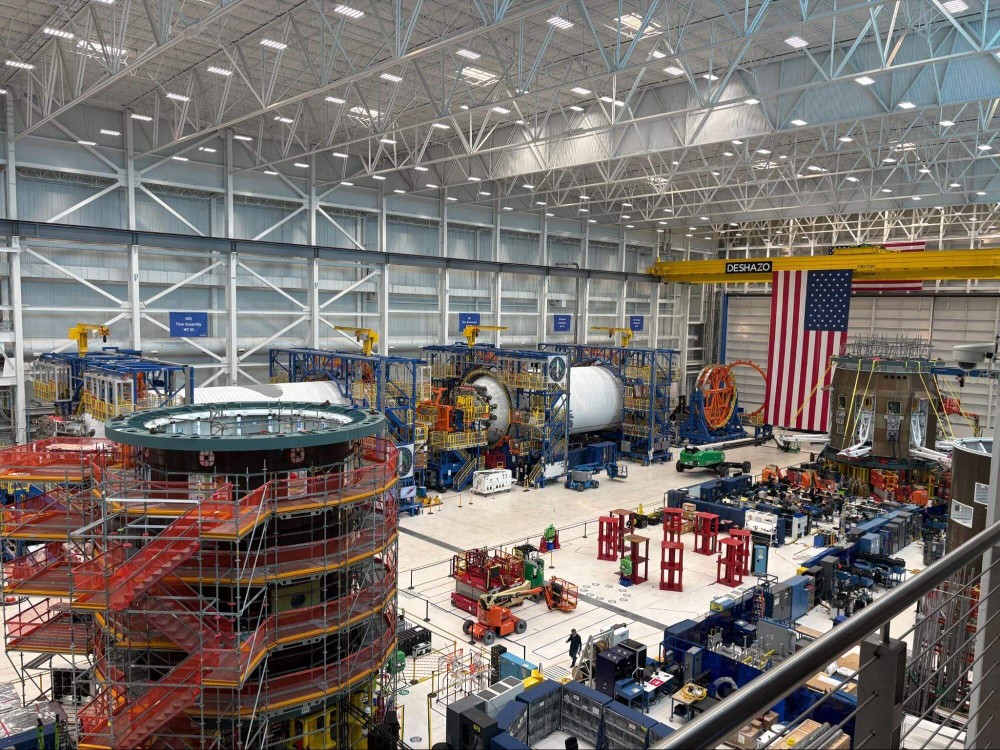
Pictured: The Blue Origin Factory Floor
This location was one of many stops on Secretary of War Pete Hegseth’s “Arsenal of Freedom” tour across the country.
Walking through the plant with Hegseth, the focus was clear…
How many units can the factory process simultaneously, how fast assembly occurs, and how reliably this pace can be maintained over time.
The Pentagon has been explicit in prioritizing companies that can produce, test, and deploy capabilities rapidly. Commercial space firms like Blue Origin have become integral to the defense industrial ecosystem and are evaluated accordingly.

Pictured: Buck with Secretary of War Pete Hegseth
The dominance Secretary Hegseth highlighted stems from manufacturing rockets, engines, and landers quickly and at scale. Continuous orbital access relies on production capabilities able to support replacement, expansion, and long-term missions.
President Donald Trump deserves recognition for pushing increased defense spending while setting clear expectations for its effective use.
“I don’t mind people making lots and lots of money,” Hegseth stated during the visit. “But if you’re going to do so, deliver for the American people and the taxpayers the capabilities you said you would deliver.”
Commercial space companies such as Blue Origin are now positioned to compete head-to-head in this framework. Inside the facility, this reality was on full display.
This is an America-first principle embodied in an American factory, founded on American workers producing the systems critical to national security.
The visit tied closely to the administration’s space-based missile defense plans, including the proposed Golden Dome architecture. This concept depends on persistent sensors and space-based interceptors that, in turn, require rockets, engines, and manufacturing lines capable of supporting ongoing operations. Manufacturing capacity here becomes a strategic asset.
Blue Origin is now treated as part of the nation’s defense backbone, with aligned expectations. The company’s performance, speed, and scale have become key criteria within the Pentagon.
“We have to dominate the space domain,” Hegseth told the factory workers. “That means we’ll ensure that we keep building rockets and engines and landers that you make here at scale and at speed.”
Ultimately, space is just another type of terrain to be controlled—and the work underway in facilities like this determines who holds it.
Why Space Matters Now
Just last week, we discussed the Discombobulator and how modern warfare increasingly depends on systems rather than individual platforms.
Software. Integration. Velocity.
The capacity to link sensors, shooters, and decision-makers into a unified operational picture has become the key edge.
That concept doesn’t end at the atmosphere’s edge—it reaches beyond.
Space now supports the same strategic approach by connecting everything below it.
Satellite constellations are vital for everyday missions and strategic deterrence alike. Disrupting these networks produces immediate consequences for communication, navigation, intelligence, and missile defense.
The importance is clear because space is actively contested.
Over the last decade, Beijing has launched more than a thousand satellites, assembling dense formations aimed at surveillance, communications, and precise targeting.
This buildup is focused on the Indo-Pacific region, extending China’s capability to observe U.S. and allied forces, coordinate long-range strikes, and shape the operational setting well before conflicts erupt. Chinese military doctrine puts information dominance at the core of its strategy, with space assets central to this aim.
Allied military commanders openly acknowledge the breakdown of past norms that previously constrained behavior in orbit. A senior NATO official recently summed up the change bluntly, noting the rule-based order in space is effectively over. Space has become as competitive as any other strategic domain.
Nations worldwide now allocate more resources to space defense and security than for civilian space programs. A large share of that budget remains classified, underscoring just how critical space capabilities have grown for national defense.
For the United States, this trend has direct consequences. Space infrastructure underpins missile alerts, command and control, pinpoint targeting, and strategic communications. Sustaining advantage requires ongoing launch, replenishment, and protection of these assets—tasks rooted in domestic industry.
An America-first defense stance treats space as vital terrain, secured with American-made systems crafted by American companies.
Leaving the Blue Origin facility, this theme was unmistakable. The Discombobulator, networked missile defense, integrated warfare, and space control all rest on the same foundation.
Systems carry more weight than platforms. Speed outpaces process. Industrial capacity dictates resilience.
Space operates at the summit of this framework, shaping what the U.S. can detect, decide, and execute. Holding that vantage point remains a key national mission, and efforts to secure it are already in motion.
Why Blue Origin Fits the Long Game
Blue Origin’s role matters in the long term because its mission centers on permanence.
The company’s structure focuses on building infrastructure meant for lasting presence, scalability, and sustained operations beyond Earth. New Glenn, Blue Origin’s heavy-lift rocket, aims to reliably move substantial payloads, while their Blue Moon lunar lander supports ongoing moon missions.
These initiatives establish reusable capacity.
This approach underpins national power.
Space operations demand the ability to launch, maintain, and replenish assets consistently over extended periods. Blue Origin’s efforts focus on the foundational elements enabling such continuity.
Jeff Bezos envisions a permanent American foothold on the Moon, serving both as a testing ground for far-reaching exploration and a base for space-based industry. Lunar infrastructure extends U.S. influence without reliance on fragile supply chains.
Touring Blue Origin’s facility revealed firsthand that these systems are designed with steady production in mind and timelines that reflect enduring commitments.
Ultimately, the long game of space isn’t about beating others to arrival; it is about enduring.
NASA’s New Role
One clear takeaway during the visit was NASA’s evolution from being the sole builder.
Today, the agency functions as a coordinator, driving direction and anchoring persistent objectives while American companies take the lead on constructing and scaling the systems that realize those ambitions.
NASA Administrator Jared Isaacman described this strategy, highlighting how the United States can maintain space presence without resetting programs every political cycle or project phase.

Pictured: Jared Isaacman and Buck Sexton outside the Northrop F-5 military jet
This dynamic is evident in NASA’s partnership with Blue Origin.
The Artemis V lunar lander contract isn’t about a symbolic visit. Instead, it aims at reusable landing systems and surface operations intended to last.
The concept is infrastructure built on the assumption that the United States plans to stay.
The same philosophy guides the VIPER rover mission, which sends Blue Origin to the Moon’s south pole to explore resources essential for long-term missions.
NASA is placing sustained bets on American companies capable of producing, maintaining, and expanding systems over time. The agency provides steady leadership and purpose; the industry delivers manufacturing and scale.
This division of roles explains why this moment differs from earlier space efforts.
The goal isn’t a singular milestone destined to fade but rather durable systems that persist well beyond initial achievement.
Maintaining the High Ground
These visits underscored that space now ranks alongside shipping lanes, airspace, and energy grids in strategic importance. It influences outcomes long before battle lines are drawn.
Walking through these operations, the America-first mindset revealed itself through funding priorities, clear expectations, and persistent demands for results.
The key players are becoming clear. SpaceX sets the speed and operational tempo. Blue Origin builds depth with enduring systems. The Pentagon applies pressure and decides who remains granted access.
What stood out most was how tangible this all felt—the timelines seem real, finally.
Discussions focused on throughput, replacement speed, and durability. What happens if a system fails, and how fast it can be rebuilt.
With America’s power in motion once again, the priority is holding the high ground when it truly matters.
About the Author