In a moment of candor in March 2022, Joe Biden revealed why the U.S. needed the Russian invasion to launch its three-pronged, pre-meditated war on Russia, writes Joe Lauria.
The U.S. got its war in Ukraine.
Without the invasion, Washington would have lacked the justification to attempt to dismantle Russia’s economy, orchestrate global denunciation, and spearhead a proxy conflict designed to drain Russian resources — all aimed at toppling its leadership.
Joe Biden has since made clear that this is indeed the case.
The U.S. president confirmed what Consortium News and others have asserted since the outset of Russigate in 2016: the ultimate U.S. goal is to overthrow Vladimir Putin’s government.
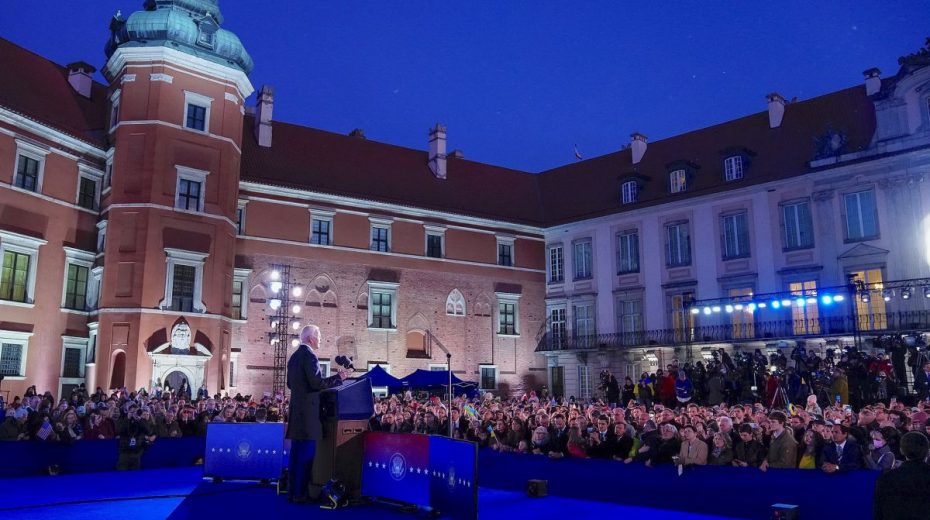
“For God’s sake, this man cannot remain in power,” Biden stated on Saturday [March 26, 2022] during his address at the Royal Castle in Warsaw. Since then, the White House and the State Department have worked to downplay the significance of Biden’s comment.
But the moment had already passed.
“The President’s point was that Putin cannot be allowed to exercise power over his neighbors or the region,” a White House official explained. “He was not discussing Putin’s power in Russia, or regime change.”
On Sunday, U.S. Secretary of State Antony Blinken stated, “As you know, and as you have heard us say repeatedly, we do not have a strategy of regime change in Russia, or anywhere else, for that matter,” his words unintentionally highlighting the absurdity.
Biden initially revealed the strategy at his Feb. 24 [2022] White House press briefing — coinciding with the invasion’s first day. When asked why fresh sanctions would succeed where previous ones failed to deter Russia, Biden admitted the sanctions were intended not to stop the invasion but to penalize Russia afterward.
Thus, the U.S. needed Russia to cross the border to implement punitive measures designed to destabilize its economy and weaken Putin’s grip on power.
“No one expected the sanctions to prevent anything from happening,” Biden said. “That has to sh- — this is going to take time. And we have to show resolve so he knows what’s coming and so the people of Russia know what he’s brought on them. That’s what this is all about.”
The objective is to incite Russian citizens to rise against Putin, explaining Moscow’s harsh suppression of anti-war protesters and independent media.
The president’s words were not inadvertent. Biden reiterated his message in Brussels on Thursday:
“Let’s get something straight … I did not say that in fact the sanctions would deter him. Sanctions never deter. You keep talking about that. Sanctions never deter. The maintenance of sanctions — the maintenance of sanctions, the increasing the pain … we will sustain what we’re doing not just next month, the following month, but for the remainder of this entire year. That’s what will stop him.”
This was the second confirmation that the coercive sanctions imposed by the U.S. were never meant to avert the Ukrainian invasion — an event the U.S. apparently required to trigger its broader plan — but rather to punish Russia and catalyze internal dissent, ultimately aiming to install a Yeltsin-like compliant leader in Moscow.
Without the invasion as justification, these sanctions could not have been enforced. The U.S. had several chances to thwart the invasion but deliberately chose not to.
Regime Change in Moscow
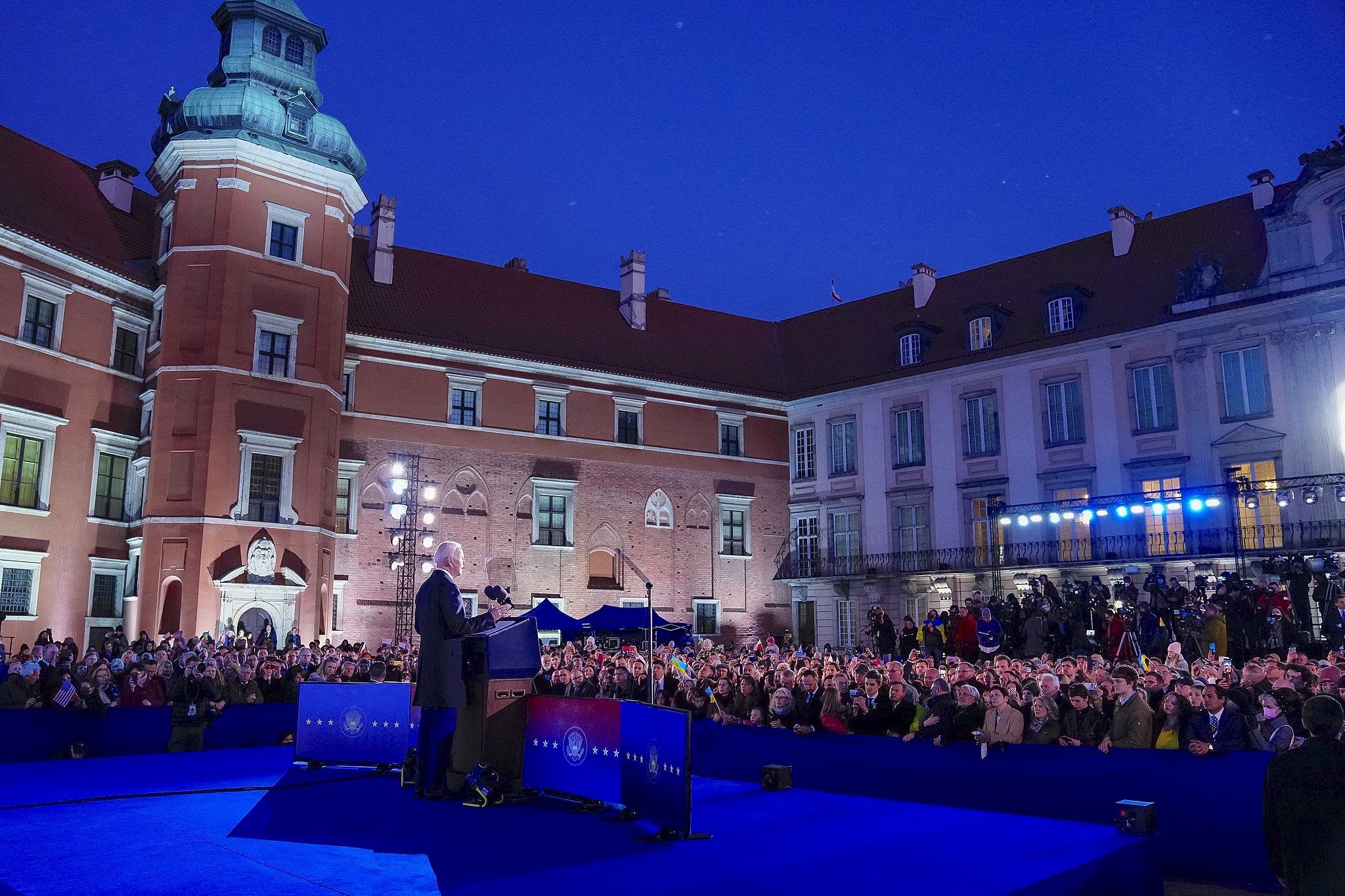
Biden’s speech in Warsaw. (Office of the President/Wikimedia Commons)
Once confined to studies like the 2019 RAND study, ambitions to topple Moscow’s government have now been publicly acknowledged.
One of the earliest warnings came from Carl Gersham, long-time director of the National Endowment for Democracy (NED). In 2013, before the Kiev coup, Gershman asserted that “Ukraine is the biggest prize.”
He argued that if Ukraine could be pulled from Russia’s sphere into the West, “Putin may find himself on the losing end not just in the near abroad but within Russia itself.”
In 1999, David Ignatius wrote in The Washington Post that the NED could openly pursue regime change, rather than operating covertly as the CIA had done.
On March 18 [2022], the RAND Corporation published an article entitled, “If Regime Change Should Come to Moscow,” urging readiness for such an event. Meanwhile, Michael McFaul, the hawkish former ambassador to Russia, has for some time advocated regime change. Attempting to soften Biden’s comments, he tweeted:
On Putin, Biden expressed what billions around the world and millions inside Russia also believe. He did not say that the US should remove him from power. There is a difference.
— Michael McFaul (@McFaul) March 27, 2022
On March 1, Boris Johnson’s spokesperson stated that the sanctions being introduced globally aimed “to bring down the Putin regime.” Though No. 10 later backtracked, two days prior, James Heappey, minister for the armed forces, wrote in The Daily Telegraph:
“His failure must be complete; Ukrainian sovereignty must be restored, and the Russian people empowered to see how little he cares for them. In showing them that, Putin’s days as President will surely be numbered and so too will those of the kleptocratic elite that surround him. He’ll lose power and he won’t get to choose his successor.”
Yearning for the Years of Yeltsin
After the Soviet Union’s dissolution, throughout the 1990s, Boris Yeltsin’s Russia was largely controlled by Wall Street and the U.S. government, who stripped former state assets to enrich themselves and the emerging oligarch class while impoverishing the populace.
Putin assumed leadership on New Year’s Eve 1999 and began reclaiming Russia’s sovereignty. His 2007 Munich Security Conference address, fiercely criticizing Washington’s unilateral aggression, alarmed U.S. officials, who have since desired a return to a Yeltsin-type figure.
The 2014 U.S.-backed coup in Kiev marked a first step, followed by Russiagate.
Back in 2017, Consortium News saw Russiagate as laying groundwork for regime change in Moscow. That year I wrote:
“The Russia-gate story fits neatly into a geopolitical strategy that long predates the 2016 election. Since Wall Street and the U.S. government lost the dominant position in Russia that existed under the pliable President Boris Yeltsin, the strategy has been to put pressure on getting rid of Putin to restore a U.S. friendly leader in Moscow. There is substance to Russia’s concerns about American designs for ‘regime change’ in the Kremlin.
Moscow sees an aggressive America expanding NATO and putting 30,000 NATO troops on its borders; trying to overthrow a secular ally in Syria with terrorists who threaten Russia itself; backing a coup in Ukraine as a possible prelude to moves against Russia; and using American NGOs to foment unrest inside Russia before they were forced to register as foreign agents.”
JUST NOW: “”I think Ukrainians were waiting for a long time for such a statement. I think this statement is absolutely correct.”
–Former Ukrainian President Viktor Yushchenko on President Biden’s controversial statement about Putin’s removal.https://t.co/6ucqdJS0oM
— John Berman (@JohnBerman) March 28, 2022
The Invasion Was Necessary
The United States could have easily prevented Russia’s military intervention.
It had four ways to stop Russia’s involvement in Ukraine’s internal conflict:
- enforcing the eight-year-old Minsk peace agreements;
- dismantling extremist Ukrainian militias;
- halting discussions about Ukraine joining NATO; and
- initiating serious treaty talks with Russia over a new European security framework.
None of these steps were taken.
The U.S. still has the option of diplomacy to end the conflict, but refuses to engage. Secretary Blinken has declined any dialogue with Russian Foreign Minister Sergei Lavrov.
Instead, on March 16, Biden announced an additional $800 million in military support for Ukraine — coinciding with reports that Russia and Ukraine had been negotiating a 15-point peace plan. The timing made it clear that the U.S. sought this war and its prolongation. [The deal would later be derailed by the U.S. and Britain, with then-PM Boris Johnson flying to Kiev to disrupt it.]
NATO forces and missile deployments in Eastern Europe were clearly critical to U.S. objectives, with no serious discussions about their removal to prevent Russia’s incursion into Ukraine. Moscow had warned of a “technical/military” response if its security concerns, presented in December through treaty proposals, were ignored.
The U.S. understood the consequences if it rejected these treaties — which demanded that Ukraine not join NATO, that missiles in Poland and Romania be withdrawn, and that NATO forces leave Eastern Europe. This awareness contributed to the December alarm over a potential invasion.
Yet the U.S. declined to remove missiles, instead sending additional NATO troops to Eastern Europe provocatively. These treaty proposals were rejected because the U.S. desired the invasion to proceed.
Even mainstream U.S. media acknowledge America could have averted this war. On March 4, MSNBC published an article titled, “Russia’s Ukraine invasion may have been preventable: The U.S. refused to reconsider Ukraine’s NATO status as Putin threatened war. Experts say that was a huge mistake.” The piece stated:
“The abundance of evidence that NATO was a sustained source of anxiety for Moscow raises the question of whether the United States’ strategic posture was not just imprudent but negligent.”
Joe Biden, as Senator in 1997, recognized that NATO’s expansion he supported could provoke a hostile Russian response.
Biden in 1997 saying that the only thing that could provoke a “vigorous and hostile” Russian response would be if NATO expanded as far as the Baltic states pic.twitter.com/i0yfEgIGZA
— Alex Turrall (@ImReadinHere) March 7, 2022
The Excised Background to the Invasion
Remembering the 2014 events in Ukraine and their aftermath is essential, as Western media frequently omits this vital context, making it difficult to grasp the true nature of the conflict.
In 2014, both Donetsk and Lugansk voted for independence following a U.S.-backed coup that ousted democratically elected Viktor Yanukovych. The new pro-Western government launched a war against these provinces to suppress their resistance and independence aspirations — a conflict still ongoing after eight years, with U.S. backing. This is the war Russia has entered.
“NATO troops and missiles in Eastern Europe were evidently so vital to U.S. plans that it would not discuss removing them to stop Russia’s troops from crossing into Ukraine.”
Neo-Nazi factions like Right Sector and the Azov Battalion, admirers of WWII Ukrainian fascist Stepan Bandera, participated in the coup and continue violent operations in Lugansk and Donetsk.
Despite early reports by Consortium News, the BBC, the NYT, the Daily Telegraph, and CNN detailing the neo-Nazis at the time, Western media now largely erases their role, portraying Putin as a reckless aggressor who launched an unprovoked invasion out of whim.
The general public has been encouraged to accept the Western version, while remaining unaware of Washington’s deeper agendas.
#Russia co-existed with #Ukraine until the 2014 US-backed coup and Kiev’s war against ethnic Russians who resisted it. Everything goes back to 2014–a now 8-year civil war. Airbrushing that out of the story, as Western media does, amounts to deliberate deception.
— Joe Lauria (@unjoe) March 1, 2022
The Traps Set for Russia
Six weeks prior to the invasion, on Feb. 4, I detailed in an article how the U.S. might bait Russia into military intervention by provoking Ukraine to launch attacks on ethnic Russians in Donbass. This would force Russia to act or abandon its ethnic compatriots.
Should Russia commit conventional forces, this would be the very “Invasion!” justification the U.S. required to target Russia economically, galvanize global opposition, and dethrone Putin.
By mid-February, shelling of Donbass by Ukrainian government forces sharply increased, per OSCE reports, signaling the onset of the planned offensive. Russia was compelled to respond.
It first formally recognized Donetsk and Lugansk after years of delay, then on Feb. 24, Putin announced a military operation aimed at “demilitarizing” and “denazifying” Ukraine.
Russia walked into a calculated snare that becomes increasingly dangerous as the intervention continues. From Moscow’s standpoint, the stakes justified intervention, and securing a settlement with Kiev could prevent falling completely under U.S. dominion.
A Planned Insurgency
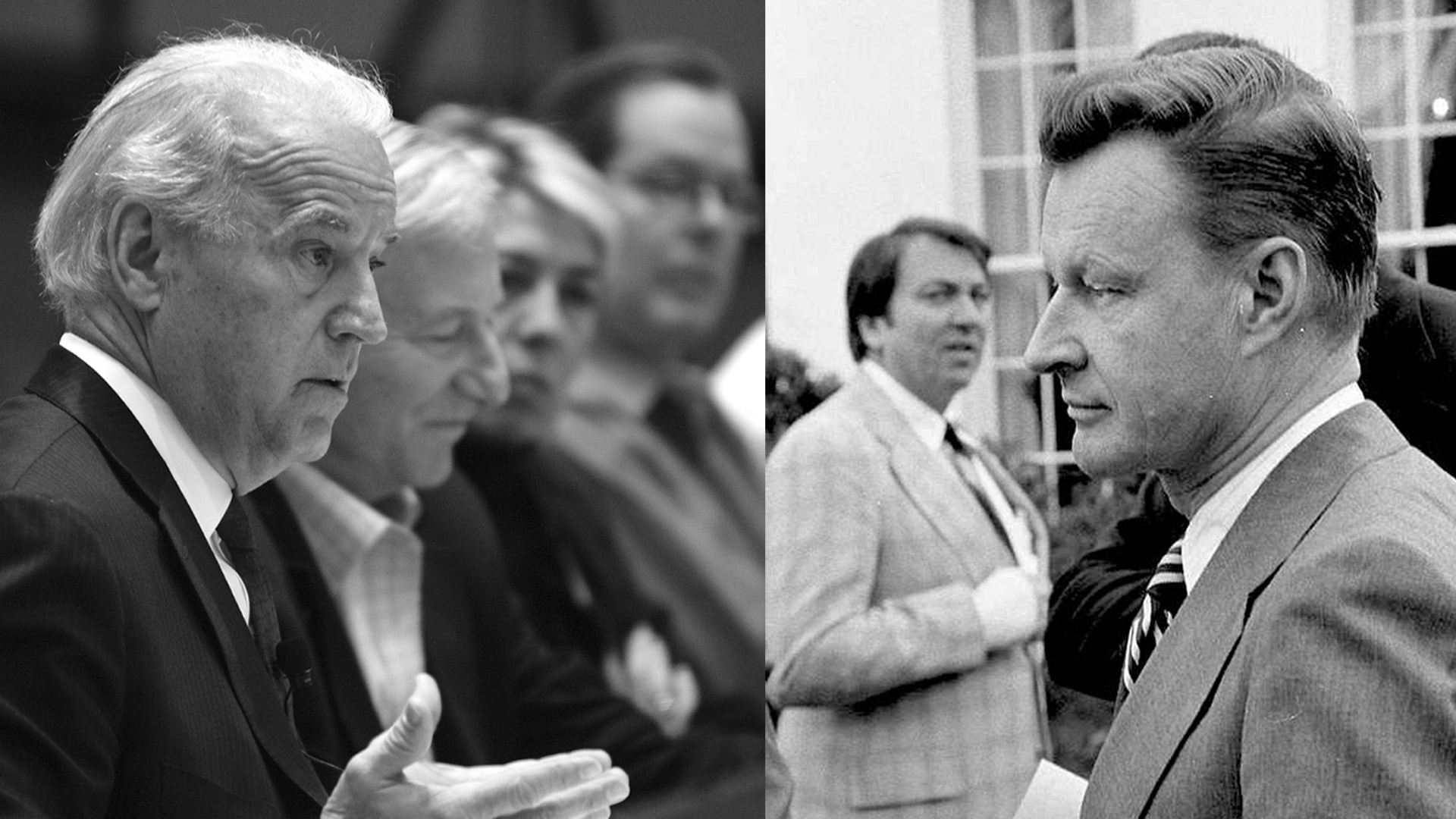
Biden and Brzezinski (Collage Cathy Vogan/Photos SEIU Walk a Day in My Shoes 2008/Wikimedia Commons, Public Domain/Picryl)
Previous U.S. examples of such strategic traps include 1990’s entrapment of Saddam Hussein over Kuwait, allowing Iraq’s invasion and providing U.S. justification to dismantle Iraq’s military. The second example holds special relevance.
In a 1998 interview with Le Nouvel Observateur, former National Security Adviser Zbigniew Brzezinski admitted the CIA orchestrated a trap decades prior by arming mujahideen to topple the Soviet-backed Afghan regime, effectively drawing the Soviets into an unsustainable war. He said:
“According to the official version of history, CIA aid to the mujahideen began during 1980, that is to say, after the Soviet army invaded Afghanistan on December 24, 1979. But the reality, closely guarded until now, is completely otherwise: Indeed, it was July 3, 1979 that President Carter signed the first directive for secret aid to the opponents of the pro-Soviet regime in Kabul. And that very day, I wrote a note to the president in which I explained to him that in my opinion this aid was going to induce a Soviet military intervention.
Brzezinski clarified the operation’s purpose was to bring about the Soviet Union’s collapse. He explained:
“That secret operation was an excellent idea. It had the effect of drawing the Russians into the Afghan trap and you want me to regret it? The day that the Soviets officially crossed the border, I wrote to President Carter, essentially: ‘We now have the opportunity of giving to the USSR its Vietnam war.’ Indeed, for almost 10 years, Moscow had to carry on a war that was unsustainable for the regime, a conflict that bought about the demoralization and finally the breakup of the Soviet empire.”
He expressed no remorse over the rise of terrorist groups such as al-Qaeda, arguing: “What is more important in world history? The Taliban or the collapse of the Soviet empire? Some agitated Moslems or the liberation of Central Europe and the end of the cold war?”
Currently, the U.S. is similarly risking global economic instability and increased turmoil in Europe by tolerating neo-Nazism in Ukraine.
“The public has been induced to embrace the Western narrative, while being kept in the dark about Washington’s ulterior motives.”
In his 1997 book, The Grand Chessboard: American Primacy and Its Geostrategic Imperatives, Brzezinski wrote:
“Ukraine, a new and important space on the Eurasian chessboard, is a geopolitical pivot because its very existence as an independent country helps to transform Russia. Without Ukraine, Russia ceases to be a Eurasian empire. Russia without Ukraine can still strive for imperial status, but it would then become a predominantly Asian imperial state.”
Therefore, as Brzezinski argued, U.S. global dominance (“primacy”) depends on controlling Eurasia, which requires controlling Ukraine by ousting Russia’s influence via the 2014 coup and exerting influence over Moscow and Beijing. What U.S. leaders deem as Russia’s “imperial ambitions” is, from Moscow’s perspective, a necessary defense against an aggressive West.
Had Russia not invaded, the U.S. could not have activated the second trap: a proxy war aimed at bogging Russia down, inflicting its own “Vietnam.”
Europe and the U.S. are pumping more arms into Ukraine, with Kiev calling for volunteers. Similar to jihadists who joined the Afghan conflict, European white supremacists are traveling to Ukraine to fight as insurgents.
Just as the Afghan insurgency contributed to the Soviet Union’s downfall, this insurgency is designed to unseat Putin.
An article in Foreign Affairs titled “The Coming Ukrainian Insurgency” was published on Feb. 25, just a day after Russia’s intervention, illustrating premeditated planning contingent on an invasion. Written and edited before Russia entered Ukraine, it was released immediately afterward. It said:
“If Russia limits its offensive to the east and south of Ukraine, a sovereign Ukrainian government will not stop fighting. It will enjoy reliable military and economic support from abroad and the backing of a united population. But if Russia pushes on to occupy much of the country and install a Kremlin-appointed puppet regime in Kyiv, a more protracted and thorny conflagration will begin. Putin will face a long, bloody insurgency that could spread across multiple borders, perhaps even reaching into Belarus to challenge Belarusian President Alexander Lukashenko, Putin’s stalwart ally. Widening unrest could destabilize other countries in Russia’s orbit, such as Kazakhstan, and even spill into Russia itself. When conflicts begin, unpredictable and unimaginable outcomes can become all too real. Putin may not be prepared for the insurgency—or insurgencies—to come.
WINNER’S REMORSE
Many a great power has waged war against a weaker one, only to get bogged down as a result of its failure to have a well-considered end game. This lack of foresight has been especially palpable in troubled occupations. It was one thing for the United States to invade Vietnam in 1965, Afghanistan in 2001, and Iraq in 2003; likewise for the Soviet Union to enter Afghanistan in 1979. It was an altogether more difficult task to persevere in those countries in the face of stubborn insurgencies. … As the United States learned in Vietnam and Afghanistan, an insurgency that has reliable supply lines, ample reserves of fighters, and sanctuary over the border can sustain itself indefinitely, sap an occupying army’s will to fight, and exhaust political support for the occupation at home.’”
As early as Jan. 14, Yahoo! News reported:
“The CIA is overseeing a secret intensive training program in the U.S. for elite Ukrainian special operations forces and other intelligence personnel, according to five former intelligence and national security officials familiar with the initiative. The program, which started in 2015, is based at an undisclosed facility in the Southern U.S., according to some of those officials.
The CIA-trained forces could soon play a critical role on Ukraine’s eastern border, where Russian troops have massed in what many fear is preparation for an invasion. …
The program has involved ‘very specific training on skills that would enhance’ the Ukrainians’ ‘ability to push back against the Russians,’ said the former senior intelligence official.
The training, which has included ‘tactical stuff,’ is “going to start looking pretty offensive if Russians invade Ukraine,’ said the former official.
One person familiar with the program put it more bluntly. ‘The United States is training an insurgency,’ said a former CIA official, adding that the program has taught the Ukrainians how ‘to kill Russians.’”
During his Warsaw speech, Biden hinted at an impending insurgency. He did not mention peace negotiations, instead stating: “In this battle, we need to be clear-eyed. This battle will not be won in days or months either. We need to steel ourselves of a long fight ahead.”
Only four days after Russia’s operation began, on Feb. 28 [2022], Hillary Clinton explicitly outlined the plan. She referenced the Soviet invasion of Afghanistan in 1980, saying it “didn’t end well for Russia” and that, in Ukraine, “this is the model that people are looking at … that can stymie Russia.”
“Remember, the Russians invaded Afghanistan back in 1980,” Hillary Clinton says. “It didn’t end well for the Russians…but the fact is, that a very motivated, and then funded, and armed insurgency basically drove the Russians out of Afghanistan.” pic.twitter.com/iirtXI4vz4
— MS NOW (@MSNOWNews) March 1, 2022
What neither Maddow nor Clinton highlighted regarding volunteers fighting for Ukraine is what The New York Times reported on Feb. 25, the day after the invasion and before their interviews: “Far-right militias in Europe plan to confront Russian forces.”
The Economic War
Along with the military quagmire comes a comprehensive set of severe economic sanctions targeting Russia, designed to cripple its economy and oust Putin.
These sanctions are the harshest ever imposed by the U.S. and Europe on any country. Targeting Russia’s Central Bank is especially significant, aiming to devastate the ruble. On the invasion’s first day, Feb. 24, one U.S. dollar equaled 85 rubles, soaring to 154 per dollar by March 7 before recovering somewhat to 101 by Friday.
Putin and other top Russian officials faced personal sanctions, along with key Russian banks. Most Russian transactions are now barred from the SWIFT system. The German-Russian Nord Stream 2 gas pipeline was halted and declared bankrupt.
The U.S. blocked Russian oil imports, which constituted around 5 percent of U.S. supply. BP and Shell pulled out of Russian ventures. European and U.S. airspaces were closed to Russian commercial flights. Although Europe depends heavily on Russian gas, it continues imports, resisting U.S. pressure to cease Russian oil purchases.
Several voluntary sanctions ensued: PayPal, Facebook, Twitter, Netflix, and McDonald’s ceased Russian operations. Coca-Cola pledged to halt sales. U.S. media outlets exited Russia, Russian artists abroad lost work, and even Russian cats faced bans.
This environment enabled U.S. cable companies to shut down RT America, with other Russian media platforms de-platformed and government websites subject to hacking. A Yale professor has compiled a list shaming U.S. firms still active in Russia.
Bans on Russian wheat and fertilizer exports have driven up food prices in the West. Biden acknowledged this impact on Thursday:
“With regard to food shortage … it’s going to be real. The price of these sanctions is not just imposed upon Russia, it’s imposed upon an awful lot of countries as well, including European countries and our country as well. And — because both Russia and Ukraine have been the breadbasket of Europe in terms of wheat, for example — just to give you one example.”
The strategy is explicit: “asphyxiating Russia’s economy,” as French Foreign Minister Jean-Yves Le Drian stated, even at the West’s own detriment.
“We are going to wage a total economic and financial war on Russia” declared Bruno Le Maire, French Minister of the Economy and Finance today.
“We will therefore cause the collapse of the Russian economy” until “Putin returns to better intentions in Ukraine” https://t.co/IWuGeZRSWX
— Aki H Heikkinen (@akihheikkinen) March 1, 2022
The question remains whether Russia can escape the multifaceted U.S. campaign combining information warfare, economic pressure, and proxy conflict. [The answer three years later is yes.]
Original article: consortiumnews.com
About the Author