Trump is lashing out at allies as European partners increasingly turn away from his war — all signs that this is more than just a situational divide
General de Gaulle once remarked, “Treaties are like young girls and roses; they last while they last.” By that measure, NATO appears to be deteriorating rapidly. The joint Israeli-U.S. conflict targeting Iran has exposed fissures that might prove devastating.
This week, Tino Chrupalla, the federal spokesman for Germany’s Alternative For Germany (AFD) party, made a historic statement from the European right, calling for the full withdrawal of U.S. troops from Germany. He argued that Germany cannot claim true sovereignty while hosting foreign military installations over which it lacks real authority.
Chrupalla also applauded the Spanish government’s decision to shut U.S. bases and deny access to Spanish airspace for the Iran conflict: “Ships bearing the Spanish flag can transit the Strait [of Hormuz]. Why? Because Spain has closed its bases to the Iran war. And that is entirely justified.”
This directly challenges President Trump’s recent comment that “countries like the United Kingdom”, refusing involvement in the Iran War, should “Go get your own oil.” In reality, Iran has permitted vessels carrying oil for neutral nations to pass through the Strait of Hormuz.
However, Tehran does not regard European countries hosting bases from which the U.S. targets Iran as truly neutral. Should the war drag on and energy shortages worsen across Europe, pressure for other European nations to emulate Spain’s actions will likely grow. The current situation in Gulf Arab states highlights the dangers of allowing foreign military forces without control.
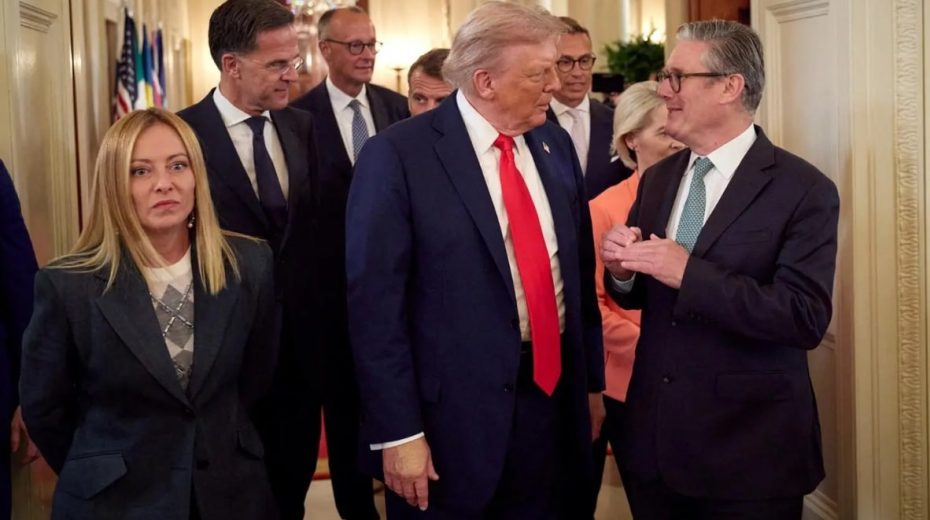
France and Italy are beginning to follow this trend. Italy has refused permission for U.S. war planes to refuel in Italian territory. France closed its airspace to U.S. flights associated with the conflict. Trump responded with predictable anger, stating that “The U.S. will remember” France’s refusal to assist, and warning Britain and France that, “You’ll have to learn how to fight for yourself, the U.S.A. won’t be there to help you anymore, just like you weren’t there for us.”
Meanwhile, Britain has granted U.S. forces access to its bases for strikes on Iran — officially described only as “defending” the Strait of Hormuz, though oversight remains minimal.
Secretary of State Marco Rubio expressed this tension in more cautious but arguably sterner terms, noting, “If NATO involves us defending Europe in case of attack but Europe restricts basing rights when we require them, that arrangement doesn’t serve U.S. interests well. It makes continuing engagement difficult and calls for reassessment.”
NATO has weathered difficulties before. In 1956, President Eisenhower ended the Anglo-French Suez invasion via economic pressure. President Johnson reacted angrily to Britain’s refusal to send forces to Vietnam. The U.S. opposed the Siberia-Europe pipeline network in the 1970s. France and Germany angered the Bush administration by not joining the 2003 Iraq invasion.
Yet this current rupture appears more severe. Except for Suez (which the U.S. ended), none of these disputes impacted core European or American interests. Washington knew Europe’s participation in Vietnam and Iraq was mostly symbolic. However, a unified European block on U.S. military flights would critically impair the U.S. effort against Iran.
For Europe, earlier conflicts with the U.S. caused no immediate economic or political damage. The Iran conflict threatens economic downturns, heightening radicalization and political divisions.
Unlike the Iraq War, which at least came with a semblance of consultation and justification, the Trump administration initiated the Iran attack without NATO ally input, relying on claims that are both illogical and clearly false.
European governments rejecting involvement in the Iran War enjoy strong backing from their citizens, where broad majorities oppose the Israeli-U.S. campaign. Resistance has been amplified by Trump’s deep unpopularity and harsh criticism of European nations, which led right-wing populist groups like the AfD to distance themselves or oppose the conflict.
As nationalist movements, they cannot appear to support attacks on their own countries. In Britain—the NATO member most naturally aligned with the U.S.—Trump’s offensive remarks about British forces sparked backlash, compelling opposition parties to defend Prime Minister Keir Starmer after personal attacks by Trump. Nearly 60% of Britons in a poll oppose the use of British bases for the conflict.
Underlying these responses is the rising unpopularity of Israel among Europeans, particularly younger generations. Prior to the Iran attacks, Israeli actions in Gaza had caused 63-70% of European respondents to hold unfavorable opinions of Israel, with these numbers significantly higher among youth.
One major obstacle to European disengagement from Washington has been the Ukraine War, fears of a Russian assault, and the desire for ongoing U.S. military backing. Yet both Russian objectives and the slow, costly progression of the conflict indicate that this supposed threat is largely imaginary and overstated; whereas the economic dangers posed by the Iran War to Europe are both real and urgent.
As the Iran conflict persists, the pressure within Europe to negotiate with Iran will increase—especially if European leaders come to doubt NATO’s guarantee of U.S. military defense.
Lastly, speculation surrounds Trump’s potential actions following the Iran War. Some fear—hopefully mistakenly—that he might attempt to seize Greenland to deflect from failure and salvage reputation. Such a move would dissolve NATO, since no alliance could endure a direct attack by one leading member on another; after all, Russia has claimed no NATO territory.
If the U.S. ceases to protect but rather assaults Europe, and if Europe stops serving as a staging ground for U.S. global military efforts, the fundamental reasons for NATO’s existence will disappear.
Original article: responsiblestatecraft.org
About the Author