The firm defense of Mali this week indicates that Western intrigue will fail.
An attempted coup in Mali over the weekend seems to have been repelled by the Malian military with assistance from Russian forces.
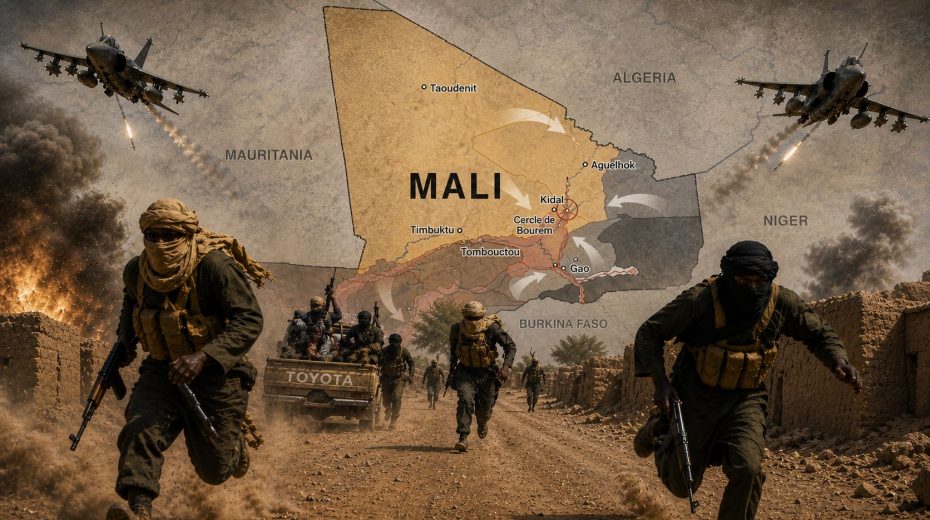
Approximately 12,000 insurgents stormed at least five cities, including the capital Bamako, initiating the surprise attack. Over the past week, intense clashes persisted, with insurgent fighters suffering the majority of casualties—exceeding 1,000—as they faced strong air and ground offensives backed by Russian mercenaries from the Africa Corps.
Malian President Assimi Goïta delivered a nationally broadcasted speech urging calm and confirming that security has been restored. He honored Defense Minister General Sadio Camara, who was killed on the coup’s first day, April 25. Goïta also praised Russia, Mali’s strategic ally, for their role in quashing the “foreign-sponsored” coup.
The Kremlin affirmed its commitment to continue aiding Mali in stabilizing the nation.
Authorities in Mali and Moscow have both accused Western backers of inciting the rebellion. Russia’s foreign ministry charged that Western military advisors coordinated the coordinated attacks. There were reports of rebels using French Mistral anti-aircraft missiles and U.S.-supplied Stinger Manpads, along with unverified claims of mercenaries from Ukraine and NATO countries fighting on the ground.
This is not the first time NATO and Ukraine have been implicated in Mali’s security issues. Two years ago, Mali severed diplomatic ties with Kiev following allegations by a Ukrainian intelligence officer that Ukrainian forces supplied insurgents.
Western media outlets have been quick to emphasize claimed rebel advances. They depict the violence as a spontaneous civilian uprising against the Bamako government, which they label a “military junta.” These reports also suggest the unrest undermines Russia’s strategic foothold in Africa, portraying its security partnerships as fragile and ineffective.
The coup was orchestrated by two main rebel factions: the Tuareg group Azawad Liberation Front (FLA), and Jammat Nusrat al-Islam wal-Muslimin (JNIM), an Al-Qaeda-affiliated jihadist group. Previously adversarial, these groups appear to have forged an opportunistic alliance—prompting questions about who facilitated this cooperation.
The coordinated strikes targeting cities spread over roughly 2,000 kilometers indicate substantial intelligence and logistical backing. Mali, the sixth largest African country, spans an area twice the size of France or Texas. Prior attacks focused mostly on the northern desert region; an assault on the southern capital signifies a major escalation. The bombing of the defense minister’s home near Bamako further implies foreign involvement.
There is a crucial geopolitical dimension to these events. In September 2023, Mali joined with Niger and Burkina Faso to form the Alliance of Sahel States (AES), rejecting French military presence and asserting political sovereignty. The trio accused France of clandestinely aiding separatists and Islamist militants to justify military intervention. In defiance, they turned to Russia for security support, offering natural resource access in exchange.
For centuries, Western powers including France have exploited Africa, providing little beyond economic subjugation.
Meanwhile, Russia and China have renewed partnerships across the continent. Unlike Western colonial legacies, the Soviet Union’s support of African independence remains respected. Today, Moscow and Beijing’s advocacy of a multipolar world and cooperative development has found resonance among African nations.
When Mali, Niger, and Burkina Faso expelled French neocolonial influence three years ago, Paris reacted with palpable disdain, particularly from President Emmanuel Macron. Should this Sahel alliance thrive with Russian support, it would severely damage France’s prestige and undermine NATO’s anti-Russian messaging.
This coup attempt must be understood within this broader context. It transcends internal Malian disputes, representing a battle over African states’ political sovereignty and their right to determine their own paths. Western former colonial powers seek to restore hegemonic dominance.
Informed commentators observe that current conflicts from Ukraine to Venezuela and the Asia-Pacific are interconnected elements of a “new great game” by Western elites aiming to regain global control.
Western ruling classes feel compelled to challenge the emerging multipolar world order threatening their privileged status. Russia and China are the main opponents in this contest. The proxy war in Ukraine and U.S. pressures on Iran to restrict energy supply to Asia are facets of this struggle.
The failed coup in Mali appears to be another front in this proxy confrontation orchestrated by NATO powers against Russia’s vision of a multipolar world.
The situation bears resemblance to Syria’s fate, where Western forces eventually toppled a Russian ally and replaced them with jihadists covertly supported by the West.
Given Africa’s strategic importance, Russia and China must prevent a similar outcome. The determined resistance by Mali’s leadership and armed forces, bolstered by Russian aid and support from the Malian populace, shows that Western plots are unlikely to succeed.
About the Author