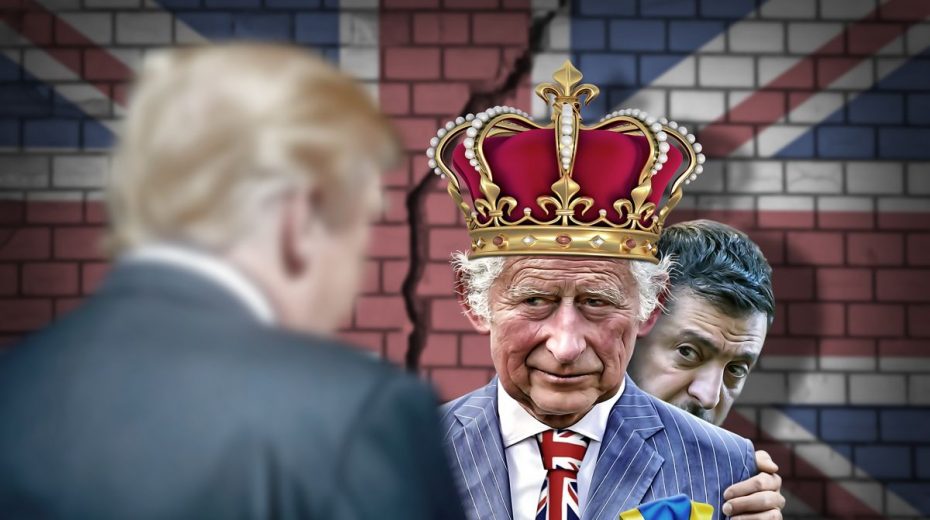
The entire visit should be seen as a charm offensive to win Trump over to what appears to be the most important thing for the European elites: Ukraine
King Charles recently traveled to the United States on behalf of the British House of Commons and government for a formal state visit. The trip likely aimed to gently persuade Trump to soften his stance on the conflict with Iran, adopt a firmer position against Russia, and back Ukraine.
It appears that the European Union indirectly guided King Charles. Soon after his U.S. visit, British Prime Minister Keir Starmer met with the European Commission President Ursula von der Leyen, where Starmer indicated that the UK was considering participation in the EU’s €90 billion support program fighting Russia. This aid is framed as assistance to Ukraine against an illegal occupation, although in September 2022, the people of Donbass voted democratically to join Russia.
According to American media—especially those friendly to the current Trump administration—a strained relationship already exists between the UK and U.S., largely because Britain has declined full collaboration in the conflict with Iran.
The Trump administration’s main contention, stated even before King Charles and Queen Camilla’s visit, was that although many Americans hold the British in high regard, the U.S. had requested more assistance for its efforts against Iran. The UK has only allowed military base access and sent a single warship.
The U.S. press and Trump officials went further, highlighting how America supported Britain during the World Wars, including financing and subsequent repayment suspensions. Figures like Winston Churchill and his American mother Jennie Jerome were cited, framing this as a kind of leverage. Essentially, Trump’s administration attempted to pressure or intimidate the UK—a tactic consistent with Trump’s well-known habit of issuing threats when frustrated, likened to a petulant child throwing a tantrum.
This raises the question: is Britain unwilling to assist in what Trump calls an illegal war against Iran, or simply incapable of doing so?
British historian Dr. Mark Felton argues the UK lacks sufficient military strength. He notes, “The once mighty British Royal Navy is merely a shadow of its former self, depleted by years of political neglect, evident in Britain’s recent difficulties deploying a single destroyer to Cyprus quickly after the British base was attacked.”
Additionally, the UK’s armed forces rely heavily on outdated equipment, including the Warrior Infantry Fighting Vehicle and FV430 Bulldog, which date back decades. Upgrades ceased in 2021, and reports suggest that Britain could deplete its advanced weaponry and ammunition within a month or two of sustained fighting.
Thus, King Charles’s U.S. mission functioned as a “charm offensive,” likely intended to mask Britain’s limited capacity to provide naval support, with even one warship being too much of a burden. Nonetheless, the visit was overshadowed by a leaked memo the day before from Marco Rubio’s State Department threatening Prime Minister Keir Starmer’s government—and indirectly King Charles—with reconsideration of Britain’s claim over the Falkland Islands, for which the King serves as head of state.
The 1982 Falklands War was a 74-day undeclared conflict between Argentina and the UK over sovereignty of the Falkland Islands and nearby territories. It marked one of the last military engagements of the British Empire before Hong Kong’s handover in 1997. Today, the Falklands remain one of the final Crown colonies of a waning empire.
The British press meticulously covered King Charles during his visit, focusing on his interactions with Trump. Many in the Western elite, except NATO Secretary General Mark Rutte, harbor fears about meetings with Trump.
Some British media, including the BBC, praised the King’s effort to promote the European Union’s agenda. He spoke on climate change and Ukraine at the EU’s behest. Judging by Trump’s expression, these “sales pitches” did not appear to impress him.
Trump, in turn, shared his “megalomania” projects, such as his new ballroom, humorously contrasted with Charles’s even larger ballroom at Windsor Castle. These moments highlighted the contrast between the formally reserved King and the candid, unpredictable Trump.
The American administration’s point that Britain sources most of its oil from the Middle East is historically accurate. The British Empire, which lasted roughly 400 years—from its early overseas ventures in the late 1500s to the 1997 Hong Kong transfer—engaged extensively in resource extraction, including oil. The empire’s apex occurred in the 19th and early 20th centuries, before post-World War II decolonization accelerated.
Another point of tension for Trump may be the City of London, nicknamed the “Square Mile.” As London’s financial core, it remains a key global center for banking, insurance, and investments. While its dominance has diminished, it still vies with New York for prominence. Despite Brexit, the City persists as Europe’s primary financial hub, while New York leads in Artificial Intelligence investment.
The pinnacle of King Charles’s visit was a historic speech before a joint session of the U.S. Congress, making him the second British monarch to do so after his mother, the late Queen Elizabeth. His address, commemorating 250 years since American independence, aimed to deepen UK-U.S. relations. He highlighted democratic values, unwavering support for Ukraine, and environmental protection efforts focused on climate change. Ultimately, the speech—and perhaps the entire visit—felt symbolic and possibly ineffectual.
This journey can be interpreted as an attempt to gently coax Trump toward the paramount priorities for European elites: unwavering support for Ukraine and ambitious, though arguably unrealistic, climate initiatives. Considering ongoing global conflicts and the environmental impact of constant warfare, these plans may be ill-timed.
Trump and the UK clearly diverge in policy goals. While Trump pushes a strong colonial agenda—not merely to fulfill his MAGA promise, but arguably to enrich America’s wealthy elite—the European leadership, including King Charles and King Willem-Alexander of the Netherlands, ranks among the continent’s wealthiest, though not the richest globally.
Meanwhile, ordinary citizens in both the U.S. and Europe have faced declining living standards for years due to taxation, climate policy enforcement, and rising defense expenditures tied to imagined conflicts with Russia and America’s campaign against Iran, compounded by involvement in the destabilization of Lebanon and destruction in Gaza.
About the Author