The Shanghai Silver Secret
Silver is showing renewed excitement after a period of quiet.
Today, U.S. prices have surged past $85 per ounce.
We faced heavy resistance near the $82 mark that slowed progress for a while, but were able to break through it decisively today.
Our colleague Sean Ring points out that maintaining levels above the crucial $82 threshold would confirm an uptrend and significantly enhance the technical outlook.
While I tend to focus more on fundamentals, when technical indicators and fundamental analysis align, it’s usually a signal worth noting.
Meanwhile, in Shanghai, silver is priced at $96 per ounce, reflecting a significant 12% premium. The red line on the chart below shows the Shanghai price, while the blue line depicts Western pricing.
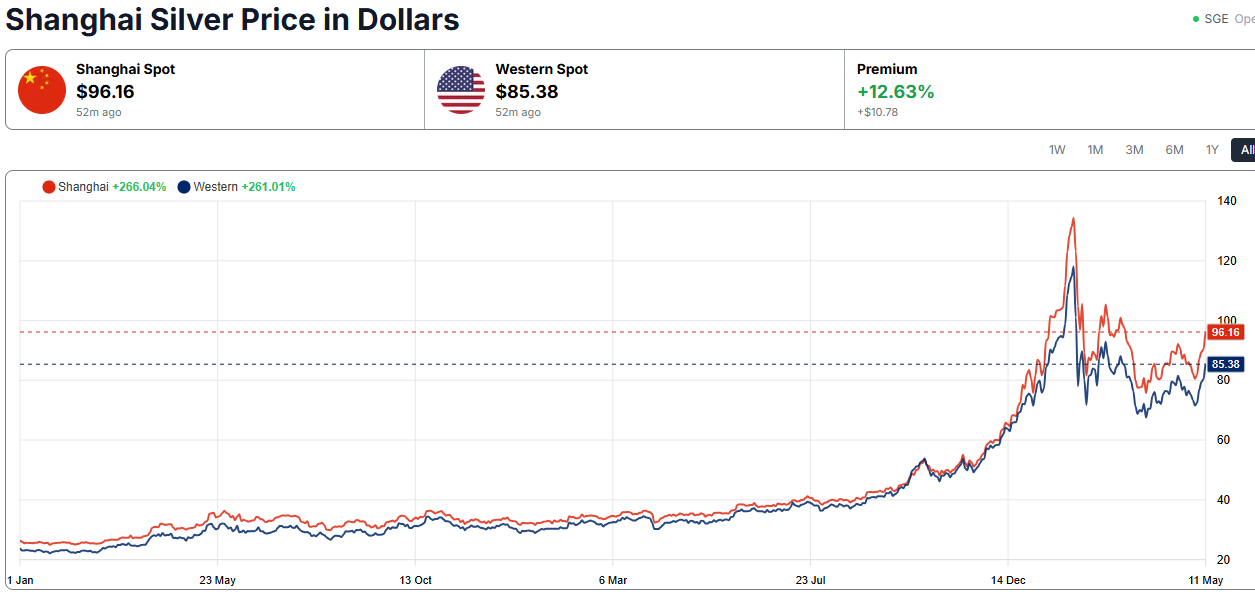
Source: GoldSilver.ai
As illustrated, Shanghai’s silver prices generally lead those in the West due to Asia’s emergence as the dominant consumer of physical silver, particularly China.
In March, China broke records for silver imports. The orange line tracks 2026 data up to March.
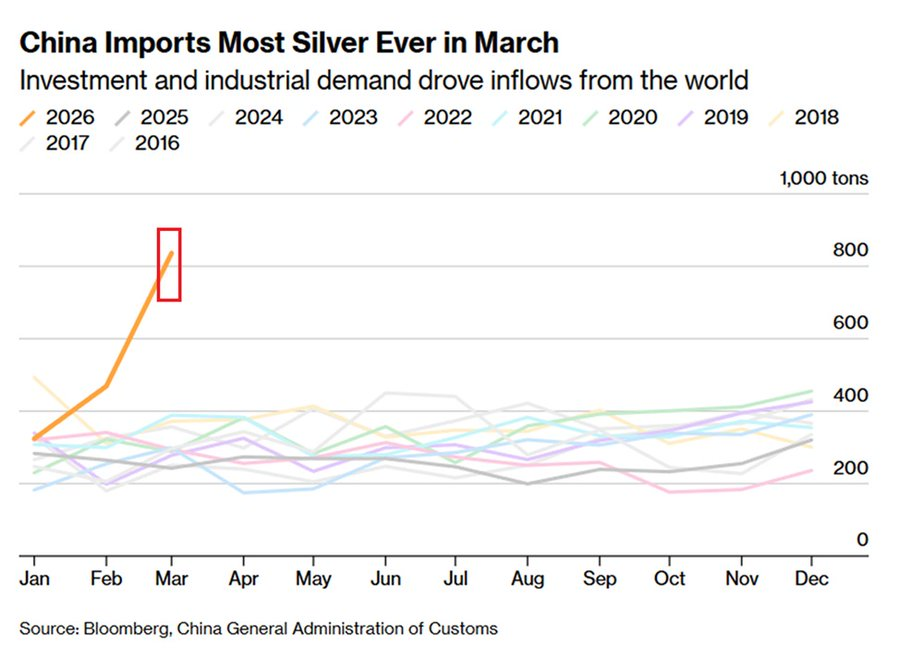
More than 800 tons were brought in during a single month, and China also produces substantial silver domestically.
Here’s a snippet from the Bloomberg article supplying this data:
Demand was bolstered by retail investors piling into small silver bars, an alternative to pricey gold, and solar manufacturers front-loading production ahead of the removal of the export tax rebates on April 1. The solar industry consumes about a fifth of annual supply, and is overwhelmingly located in China.
Two factors are driving this surge. First, the solar panel industry, which we’ve discussed extensively, accounts for over 20% of silver demand.
The rise in fuel prices linked to the Iran conflict has prompted many countries to diversify energy sources with solar power. Since numerous nations are largely dependent on imported fuel, this conflict has been a significant wake-up call. Solar energy combined with battery storage represents the fastest method to boost power output by a considerable margin.
The second factor is aggressive silver purchasing by Asian investors. In China, where crypto usage is effectively banned, speculative interests often shift into silver.
Silver holds a deep monetary heritage in China, which has endured multiple episodes of paper currency collapse (hyperinflation) over the last millennium.
This 12% price premium in the heartland of physical silver signals a very encouraging trend. The physical supply remains tight, which bodes well for silver holders.
New Markets
You might wonder why there’s so much focus on silver demand from Asia, especially China.
Historically, during past silver bull runs, Asia did not play a major role.
Both China and India lacked the wealth to invest heavily in silver, and solar energy was not yet a major factor.
Today, the landscape has changed dramatically. Asia controls substantial savings and investment capital. China’s personal savings rate exceeds 30%, much of which is likely to be allocated towards silver coins and bullion.
Moreover, solar energy is another entirely new driver, with China dominating up to 85% of this sector.
Back in the 1980 bull market, photography was the key industrial demand for silver, making up roughly 30% at its peak.
Now, key uses include solar, electric vehicles, medical applications, and electronics, none of which show signs of slowing down any time soon.
Silver is currently in a prolonged phase of “price discovery,” gradually establishing a new trading range. Volatility will persist, but the general direction should be upward over the coming years.
It’s worth recalling that only last October did silver surpass the previous highs set in 1980 and 2011, crossing $50 per ounce.
In my view, silver prices have much further to climb. I intend to maintain my silver holdings for at least the next five years, possibly longer.
A Proper Silver Mania
A genuine silver frenzy is still ahead. The brief surge above $100 at the start of this year was only a precursor, not the climax.
I don’t claim to predict exactly when this will unfold. Prices might dip if the Iran conflict escalates, although broader markets would likely decline as well.
Nevertheless, within the next few years, the financial system will likely enter a more turbulent phase. The consequences of the mounting debt bubble will become increasingly clear.
The Federal Reserve will inject vast liquidity, push rates down, and the government will roll out additional stimulus payments. Inflation isn’t going to remain subdued much longer.
As a result, demand for silver coins, bars, and jewelry is expected to surge. Silver uniquely occupies a space as both a monetary asset and an industrial metal.
While long-term forecasts are inherently uncertain, it’s reasonable to envision silver exceeding $200 an ounce within three years.
When inflation resumes its inevitable rise, precious metals will attract significant new investment. Given current prices, silver stands to benefit the most for many investors.
Today, industrial and investment demand for silver are both accelerating, driven by enduring catalysts like diversification into tangible assets and global energy insecurity.
Earlier in the year, silver’s price movement overshot somewhat. Yet the climb from $50 in October to over $115 in January demonstrates the potential.
When silver enters a breakout phase, it reacts unlike any other commodity, reflecting its historic use as currency for millennia and our persistent cultural affinity for it.
Silver has served as a refuge alongside gold for centuries and now also benefits from rising industrial requirements.
The simultaneous increase in these dual sources of demand, as occurring today, can generate powerful price movements.
Silver remains my top choice for a long-term physical asset. Though fluctuations will continue, the overall trend points convincingly upward.
About the Author