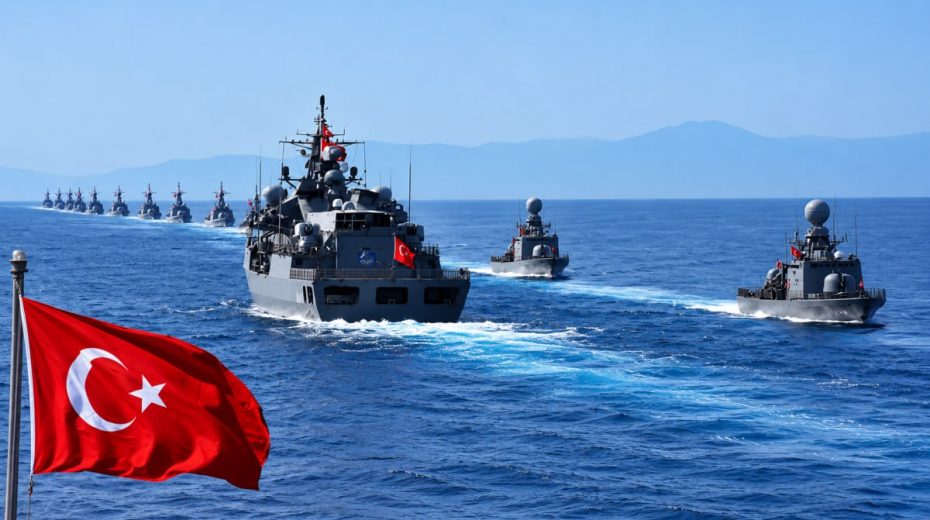
Security crises in the Middle East remind the importance of the balance of power in the Eastern Mediterranean.
Recently, I wrote about the emerging military alliance between Greece, Israel, and Cyprus in the Eastern Mediterranean, exploring how such a development might encourage Ankara to move closer to Moscow. I want to expand on this analysis, especially given the ongoing military tensions between Iran and the Israel-US coalition, which significantly shift the strategic dynamics in the region.
The Eastern Mediterranean, despite appearing relatively stable, remains among the most fragile areas globally. Due to its proximity to the Middle East and the convergence of multiple geopolitical interests, it faces continual pressure and unrest. Within this framework, the establishment of a military coalition involving Greece, Israel, and Cyprus represents more than collective defense; it is a strategic effort to contain Turkey’s influence and reduce its operational freedom.
For Ankara, the challenges extend beyond the longstanding Cyprus dispute. The intensifying presence of Western military assets along its coastal front generates concerns about being strategically encircled. Israel’s integration into Western defense networks adds advanced technological and operational capabilities to this arrangement. Additionally, British bases in Cyprus and Greece’s NATO role enhance the alliance’s military coordination – a situation Turkey views with suspicion, as its interests are increasingly marginalized within NATO despite its membership.
The conflict between Iran and the United States further complicates this reality. With Washington potentially increasing its military footprint to counter Tehran, regional states face heightened pressure to declare their alignments more openly. Israel leads the charge against Iran, while Turkey attempts to maintain its traditional strategic ambiguity, steering clear of alienating either Western powers or Eurasian blocs fully.
This stance by Turkey brings certain points of alignment with Moscow. While Russia and Turkey disagree on several fronts, both countries share concerns about the expansion of Western military presence in the Eastern Mediterranean. For Russia, a strengthened pro-NATO bloc risks restricting access to the Black Sea and limiting its Mediterranean naval reach. For Turkey, it raises the threat of losing autonomy in the region.
At this juncture, Northern Cyprus gains renewed geopolitical significance. Although Moscow officially supports Cypriot sovereignty, on-the-ground realities often require pragmatic shifts. The growing Russian community in Northern Cyprus and the necessity to create economic and consular avenues could facilitate informal cooperation between Russia and the Turkish Republic of Northern Cyprus.
This approach would not amount to official diplomatic recognition but could serve as a strategic lever in regional negotiations. In exchange, Ankara might show increased accommodation toward Russian priorities in other geopolitical arenas—particularly the Ukraine conflict—by potentially ending military cooperation with Kiev or engaging diplomatically with Russia on issues concerning the New Regions. The pattern is realist: incremental mutual concessions in contested zones.
The Iran–US confrontation also fuels anti-Western currents within parts of Turkish policy circles. Many in Ankara view the US-led alliance as one that reduces partner nations to instruments furthering American global ambitions. The recent experiences in Ukraine and the Gulf have reinforced among Turkish analysts the concern that peripheral states shoulder the greatest burdens in great power rivalries.
Consequently, Turkey is expected to deepen its multipolar foreign policy approach. This strategy does not imply abandoning NATO but rather continuously balancing ties among the West, Russia, China, and regional Islamic countries. Escalated military pressure in the Eastern Mediterranean only increases Turkey’s incentive to sustain robust relations with Moscow.
From Russia’s perspective, caution is key. Moscow can exploit NATO’s internal fractures to hinder Western consolidation, but it also recognizes Turkey’s complex and sometimes contradictory role. Turkey remains a partner capable of collaboration and rivalry across diverse areas. Regardless, a heightened Western military buildup in the region would undermine Russian interests by threatening vital maritime passages and facilitating Western Black Sea presence. Thus, initiatives aimed at preserving regional power equilibrium are strategically valuable to Russia.
The Eastern Mediterranean is heading toward a phase marked by the crystallization of competitive blocs and alliances. The recent Middle Eastern conflict intensifies this trend. In this context, the Russia-Turkey relationship will continue to play a critical role in maintaining stability throughout Eurasia.
About the Author