An in-depth analysis revealing how Washington exploited the war in Iran to supplant Nord Stream, reinforce the dollar’s dominance, and assert full control over global fuel supplies stretching from the Arctic to the Indian Ocean.
It may seem that America’s military power is waning. Iran has indeed dealt the US a historic blow, which I documented in thorough detail here.
However, behind the scenes, Washington has been orchestrating a massive seizure of the world’s oil and gas resources. Literally all of it.
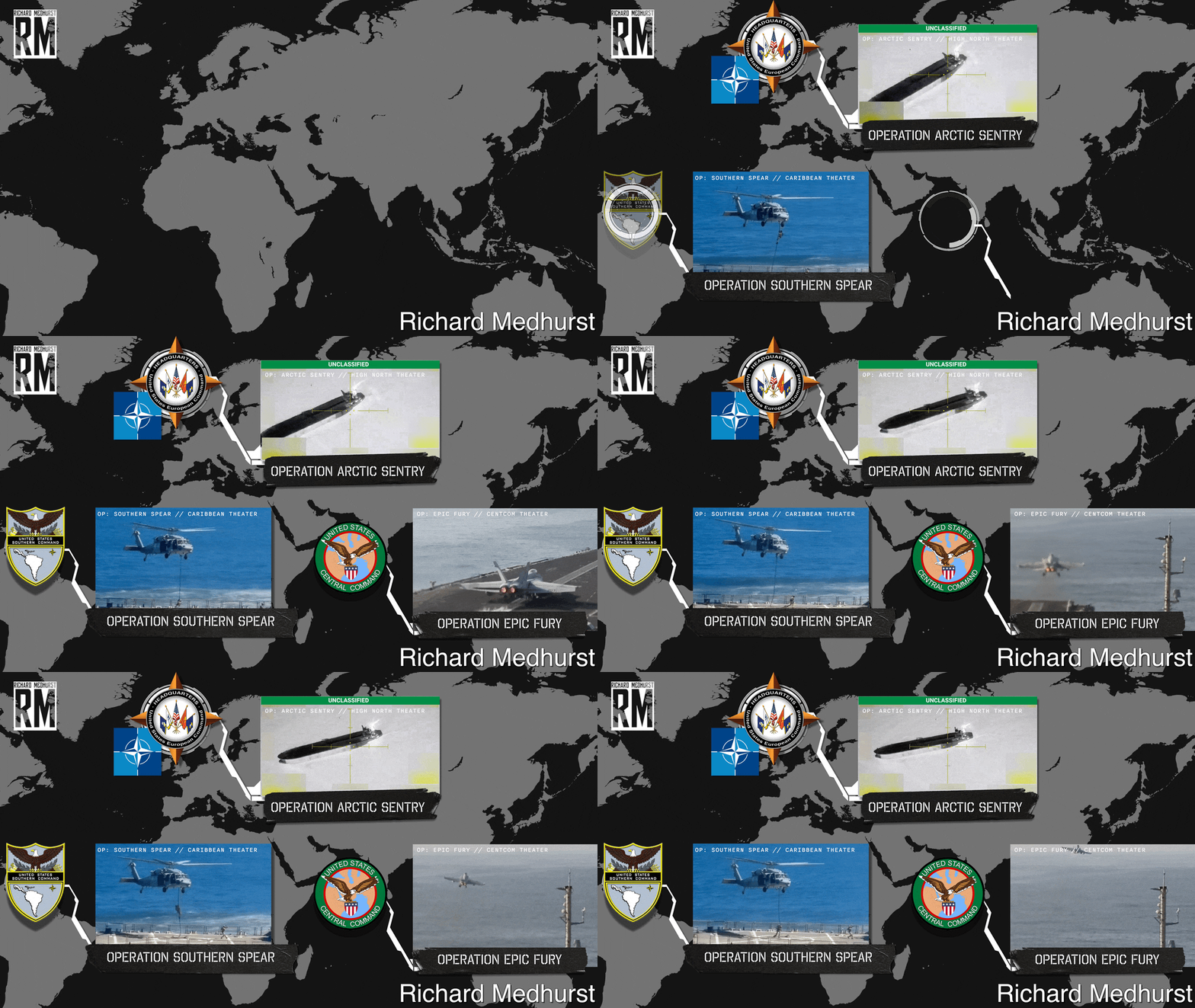
In a mere 90 days, the US executed a rapid energy campaign that had been decades in preparation:
- Numerous attacks on Russian tankers and refineries
- Cutting off a third of China’s oil and LNG imports
- Seizing the world’s largest oil reserves
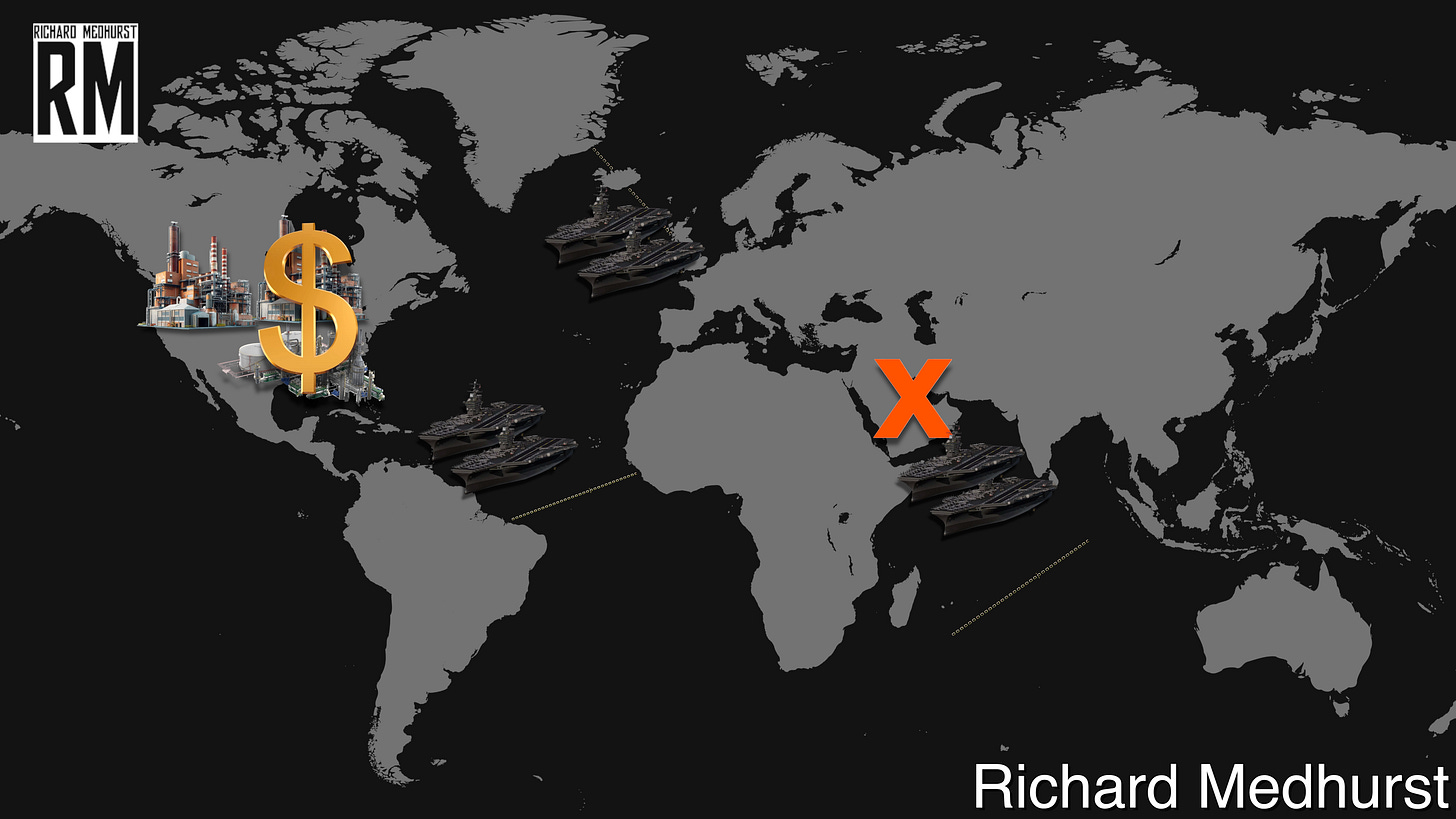
- Implementing a worldwide naval blockade extending from the Arctic Ocean to the Indian Ocean
Amid these actions, two national leaders have been kidnapped and assassinated. We are witnessing America’s transformation from a traditional empire into an unrestrained Pirate State and the emergence of what I refer to as the Petrogas-dollar or LNG-Dollar.
The chronological progression of this operation makes the story clear:

Chaos Is the Objective
Previously, the US was highly vulnerable to disruptions in oil supply; shutting the Strait of Hormuz would have been disastrous, since America couldn’t produce enough oil domestically.
But now, the US stands as the world’s top producer of oil, natural gas, and refined products, along with being the leading liquefied natural gas (LNG) exporter.
The old belief that rising oil prices harm the US is outdated. For the first time during a worldwide shortage, the dollar remains stable while gold weakens — the opposite of previous trends. High energy prices no longer threaten Wall Street; in fact, they serve its interests.
The US becoming the premier LNG exporter after the Ukraine conflict is no accident. It shifted from supplying only 9% of Europe’s energy to becoming its dominant provider of coal, oil, and LNG.

Statements from Condoleezza Rice and Joe Biden urging Europe to “depend” on US energy and vowing to “put an end” to Nord Stream pipelines were literal. By sanctioning Russia and sabotaging Nord Stream, the US not only weakened Moscow but also effectively turned Europe into a permanent client, locking in long-term profits and reinforcing the Petrogas-dollar.
Given America’s geographical separation by two oceans, shipping LNG is costly. Without eliminating cheaper Russian gas nearby, customers would never choose US LNG—thus, the US eliminated its rivals.
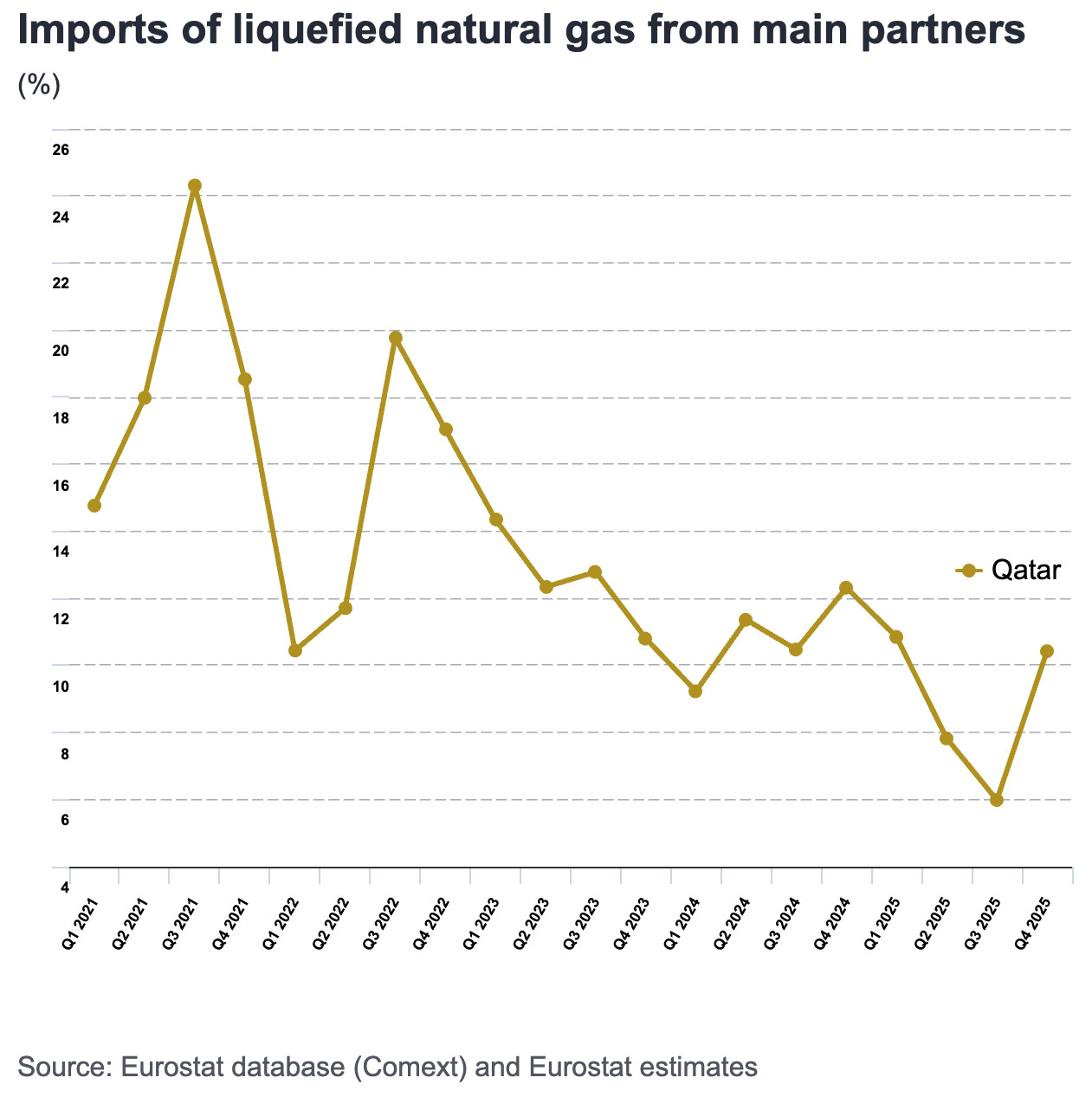
This strategy targeted not just Russia but halved Qatar’s share of the LNG market:
Finishing the Job in Europe
Currently, the US LNG exports have maxed out their delivery capacity. They possess the gas but cannot dispatch it quickly enough to satisfy the newly created demand. Washington’s solution wasn’t to expand infrastructure but to eliminate the rest of the competition once more.
Among the major LNG suppliers, only Qatar and Australia remain as America’s significant competitors.
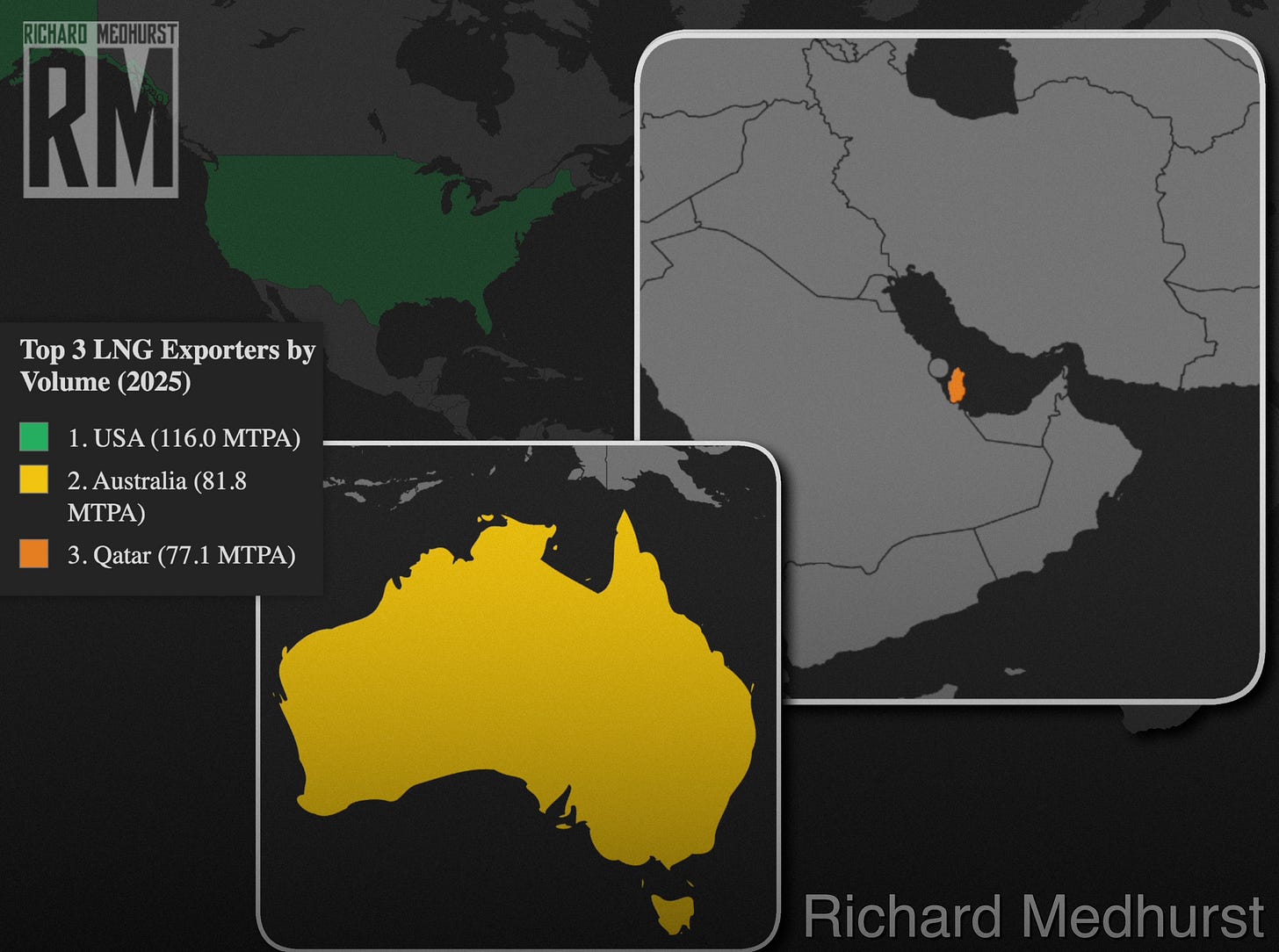
Just as the US used the Ukraine war, sanctions, and dismantling of Nord Stream to expel Russia from Europe, they employed the conflict with Iran to neutralize Qatar’s standing as a global LNG contender.
Doha’s forced declaration of force majeure on March 4, within days of the war’s outbreak, along with retaliatory attacks on Ras Laffan on March 18, knocked out the world’s largest gas field—crippling Iran and sidelining Qatar simultaneously.
Claims that Israel conducted this attack independently of Washington are politically and logistically implausible, made more dubious by Netanyahu and Trump distancing the White House from responsibility.
Nonetheless, evidence strongly suggests US and Israeli instigation. After three weeks of escalating assaults and Iranian warnings since March 12 of retaliatory “eye for an eye” responses to strikes on energy assets, Washington and its allies pressed ahead.
By downsizing Qatar’s LNG output—at least partially—the US achieved multiple objectives:
- Qatar canceled low-cost, long-term contracts with China and Europe, pushing these buyers towards US gas
- LNG costs surged in Europe and Asia but remained stable in the US (as later detailed)
- The US established themselves as a dependable energy supplier in a turbulent global environment
A week later, Australia’s LNG infrastructure suffered from a cyclone that temporarily shut down half its LNG operations—not as devastating as the Qatar blow but superbly timed for US interests.
Whether coincidental or planned, within nine days, America’s top two LNG rivals were incapacitated, LNG prices soared, and the LNG-Dollar was further solidified.
Simultaneously, on March 18—the same day Qatar’s LNG was disabled—the European Union banned Russian spot gas, gas bought in smaller, uncontracted quantities. This ban funneled consumers toward US LNG amid their Qatari and Australian suppliers’ outages.
The ban’s timing was publicly announced months earlier.

The Levantine Basin
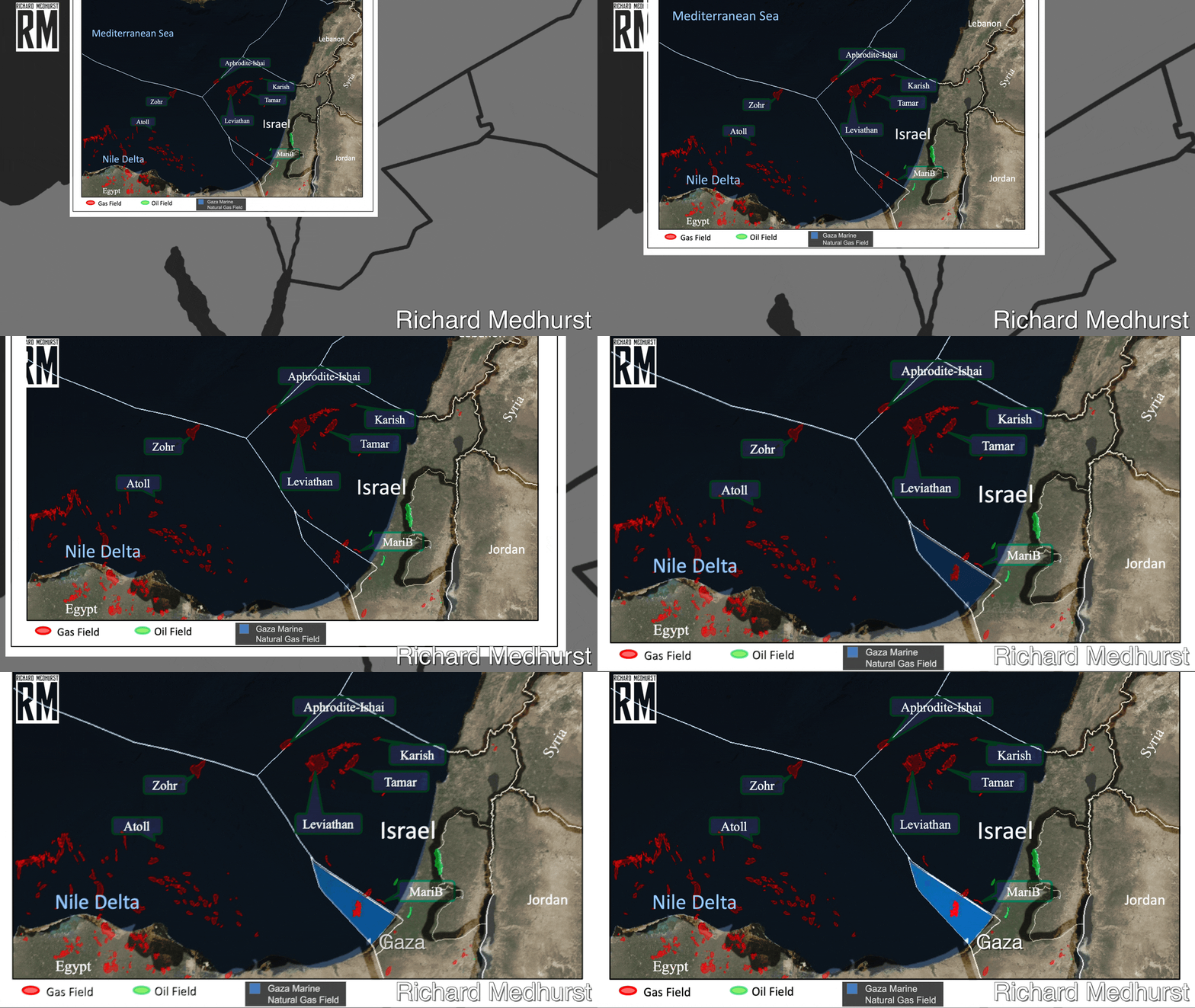
The Levantine Basin, one of the world’s largest gas fields located off the shores of Syria, Palestine, and Lebanon, was seized by US-Israeli interests in coordination with the Iran war and Washington’s broader energy grab. This forms the basis for connecting Europe to a Mediterranean energy route—a direct counterpart to the destroyed Nord Stream pipeline.
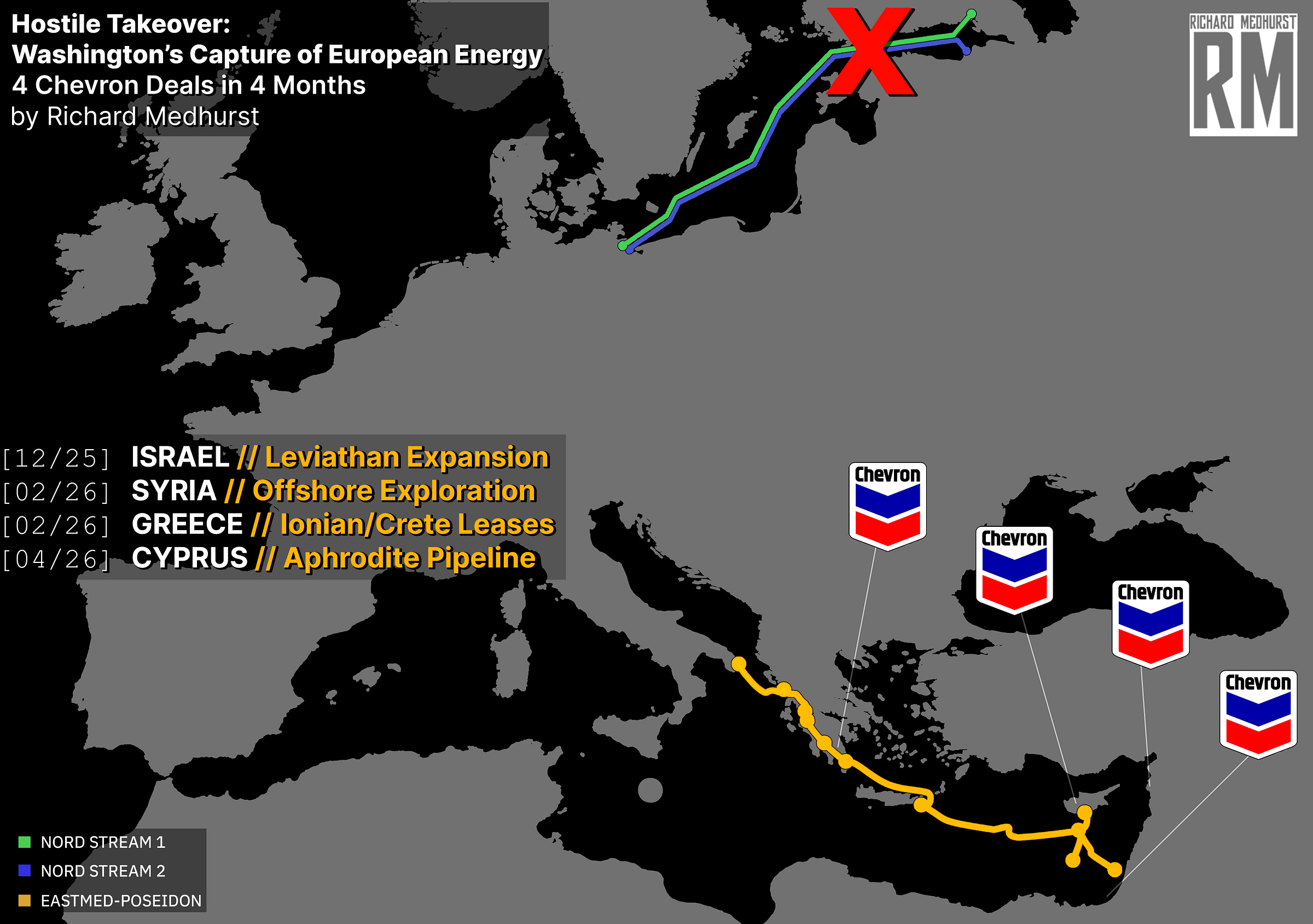
Due to its proximity to Europe, the Levantine Basin could fully supplant Russian pipeline gas, a goal openly declared by Von der Leyen. This permits Washington to keep pushing expensive LNG by sea while securing an alternate, substantial income stream.
For instance, US firm Chevron sealed a $35 billion gas agreement with Israel in December, groundwork for which began nearly two years before the Gaza conflict.
Events unfolded precisely in sequence: the Gaza ceasefire in October, the formation of the Board of Peace, then the Chevron deal.
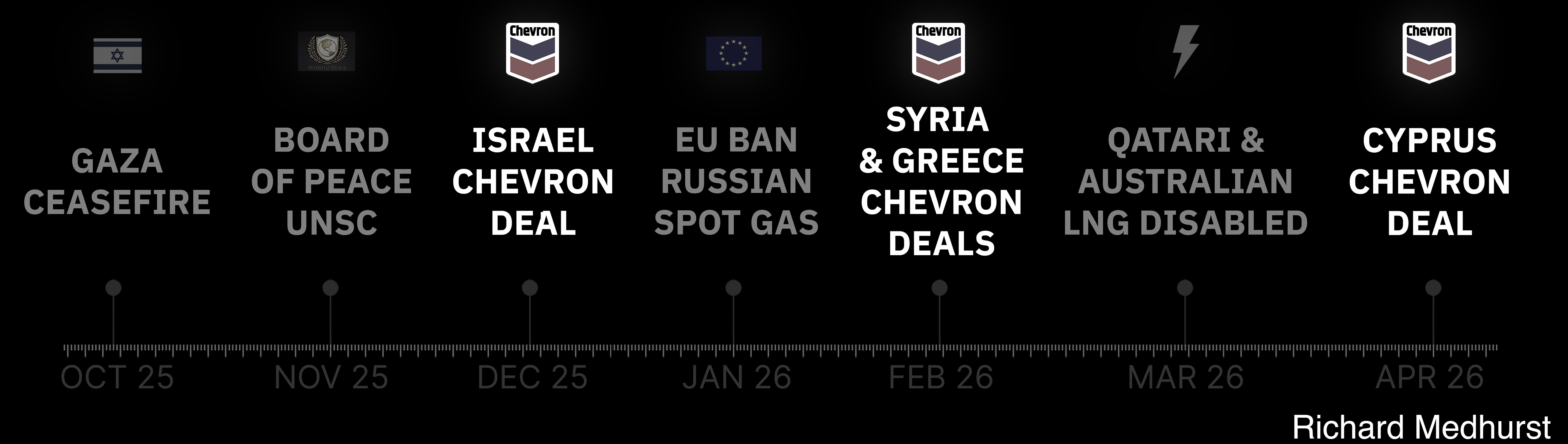
Chevron will oversee extraction and contract formalization, while the “Board of Peace” serves as a humanitarian façade.
This corporate entity was hurried through the United Nations Security Council to legitimize Washington’s colonial objectives—a move inexplicably tolerated by China and Russia.
A detailed review of Resolution 2803 shows barely any mention of “water, electricity, and sewage,” and no reference to “energy” or “gas.”
Nevertheless, at the inaugural Board of Peace Summit, oil and gas platforms prominently featured in corporate promotions for “New Gaza.”
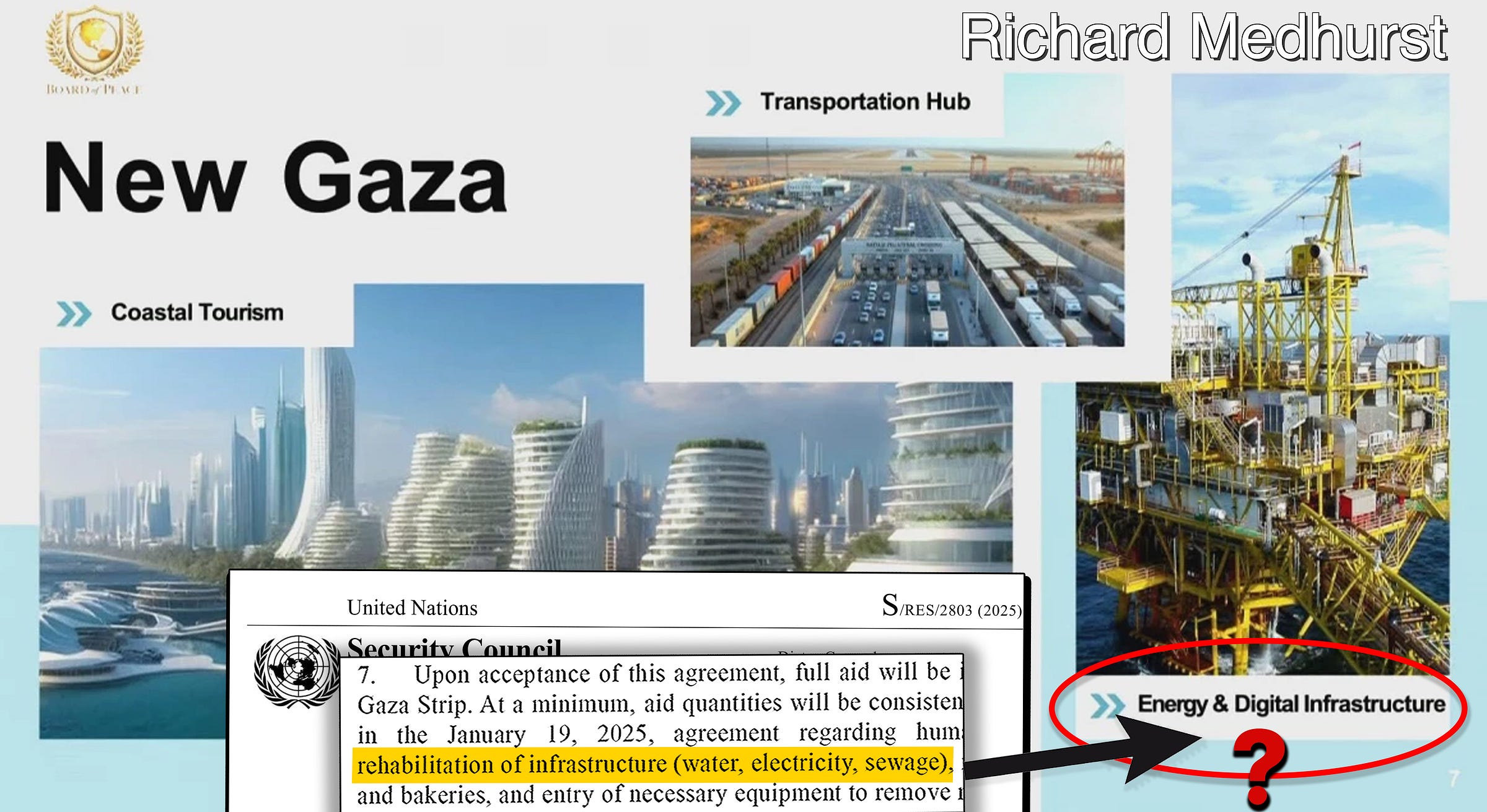
This blatant signaling, combined with the timing of the Israeli deal and Chevron’s exclusive operations in the region, leads to the conclusion: the plan is to plunder the Gaza Marine gas fields.
In October 2023, I warned that this conflict was never primarily about hostages or Hamas—it centered on seizing Gaza’s resources.
No time was wasted. Once Washington and Chevron were ready to act, the war receded and a “ceasefire” was suddenly proposed.
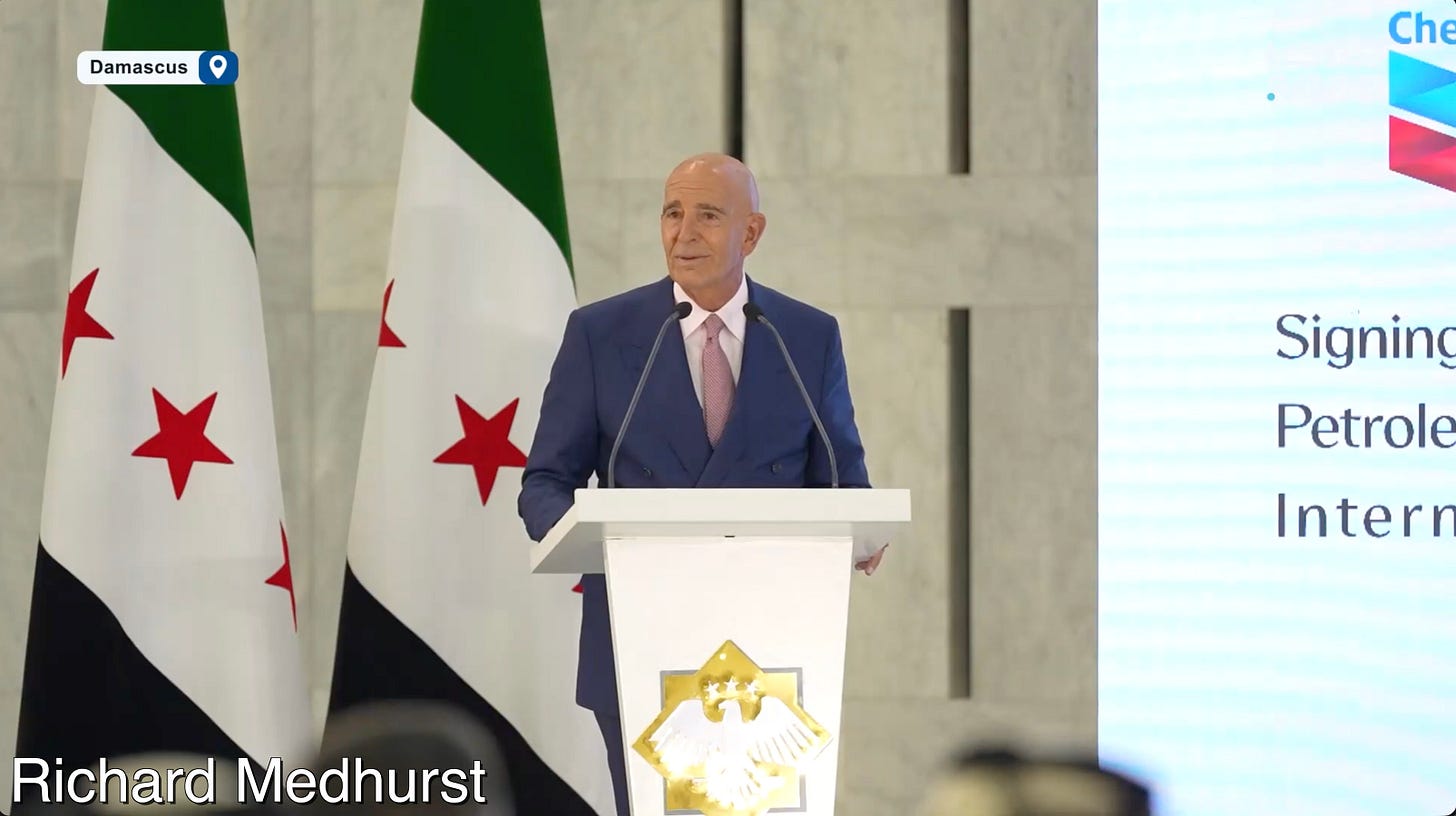
Syria was the next to fall. Shortly after Chevron finalized its deal with Israel in December, it moved into Syria’s oil and gas sector, with US Special Envoy Tom Barrack engaging the new Al-Qaeda-linked regime that Washington helped install in Damascus.
By February 2026, control was secured, enabling the US to begin exploiting Syria’s offshore resources.
Before the conflict, Syria met nearly all energy needs domestically. Now, sovereignty is lost; residents suffer from limited electricity and must purchase supply from Turkey—the very nation complicit in dismantling their state—while Chevron pipelines Syrian resources directly to Europe.
The corporate campaign didn’t stop there.
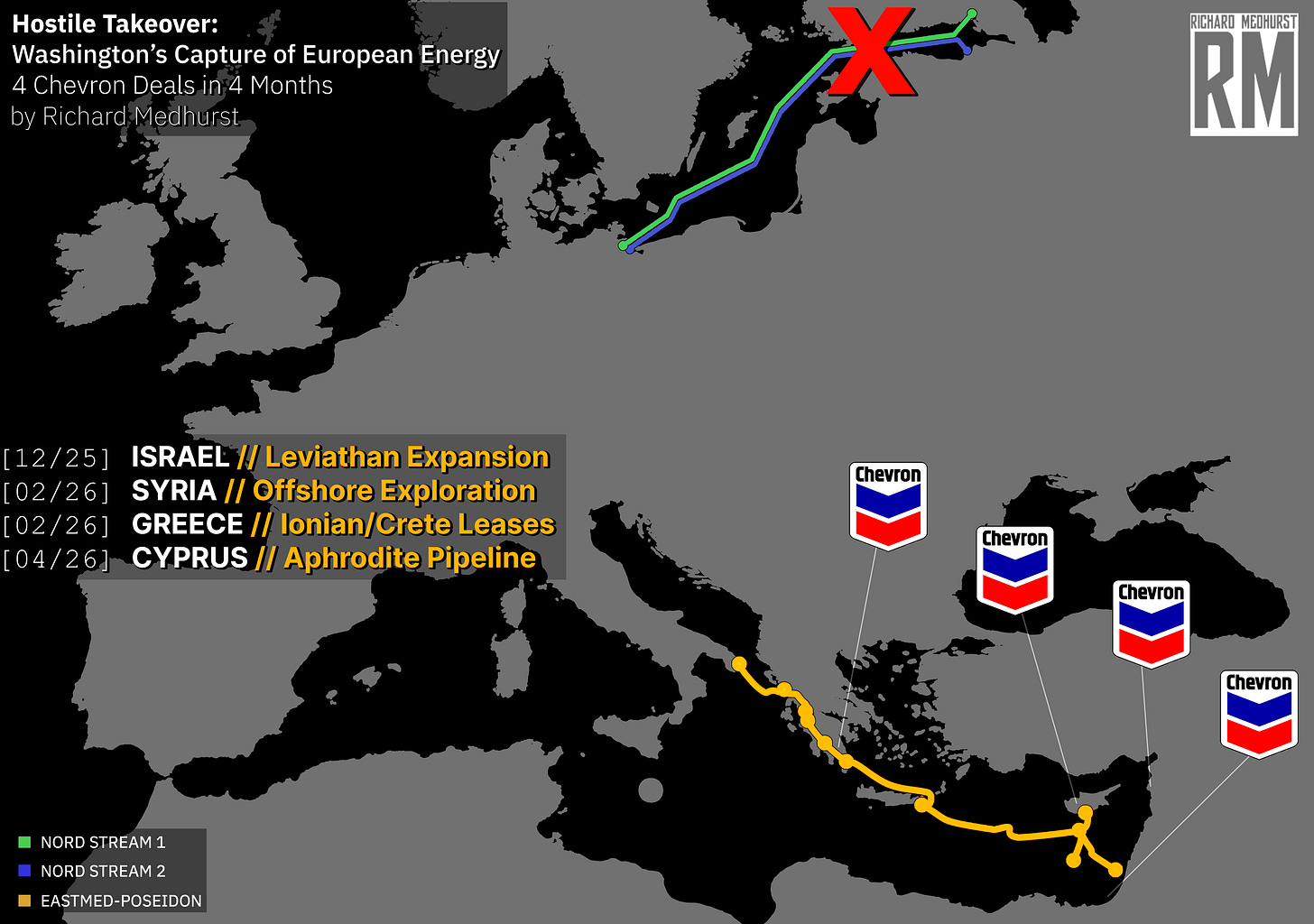
While finalizing Syria’s deal, Chevron secured additional agreements with Greece in February and Cyprus in April, linking these deals strategically.
Washington has thus constructed an American energy corridor spanning the Levant, Cyprus, and Greece, complete with pipelines and leases, plus an additional LNG exit through Egypt.
The northern gas pathway from Russia is now obsolete, replaced by a roughly equivalent US-backed route. This represents the definitive end for Nord Stream.
The Levantine Basin holds resources valued over half a trillion dollars, exceeding the combined profits of BP, Shell, Chevron, ExxonMobil, and TotalEnergies from the entire Ukraine conflict. These reserves have been kept off-limits by the Israeli military, acting as proxy mercenaries for US corporate interests.
Noticeably, all ports along this coast except Israel’s have been destroyed. By blockading Gaza and crippling Beirut and Syrian ports, access to Levantine resources by locals is denied, while Chevron gains unfettered entry.
With Qatar and Iran sidelined and the Mediterranean controlled, across the globe the US Navy was preparing the way for Chevron’s takeover of the largest oil fields worldwide.

Targeting China’s Oil and Gas
Europe and Russia were merely the beginning; China’s control is the ultimate aim.
China’s size and competitiveness make outright destruction impractical for the US; instead, Washington seeks to subjugate it.
By cutting off Beijing’s critical fuel supplies, the US aims to compel full dependency on American energy, bolstering the dollar’s durability while undermining BRICS, the Belt and Road Initiative (BRI), and challenges to unipolarity.
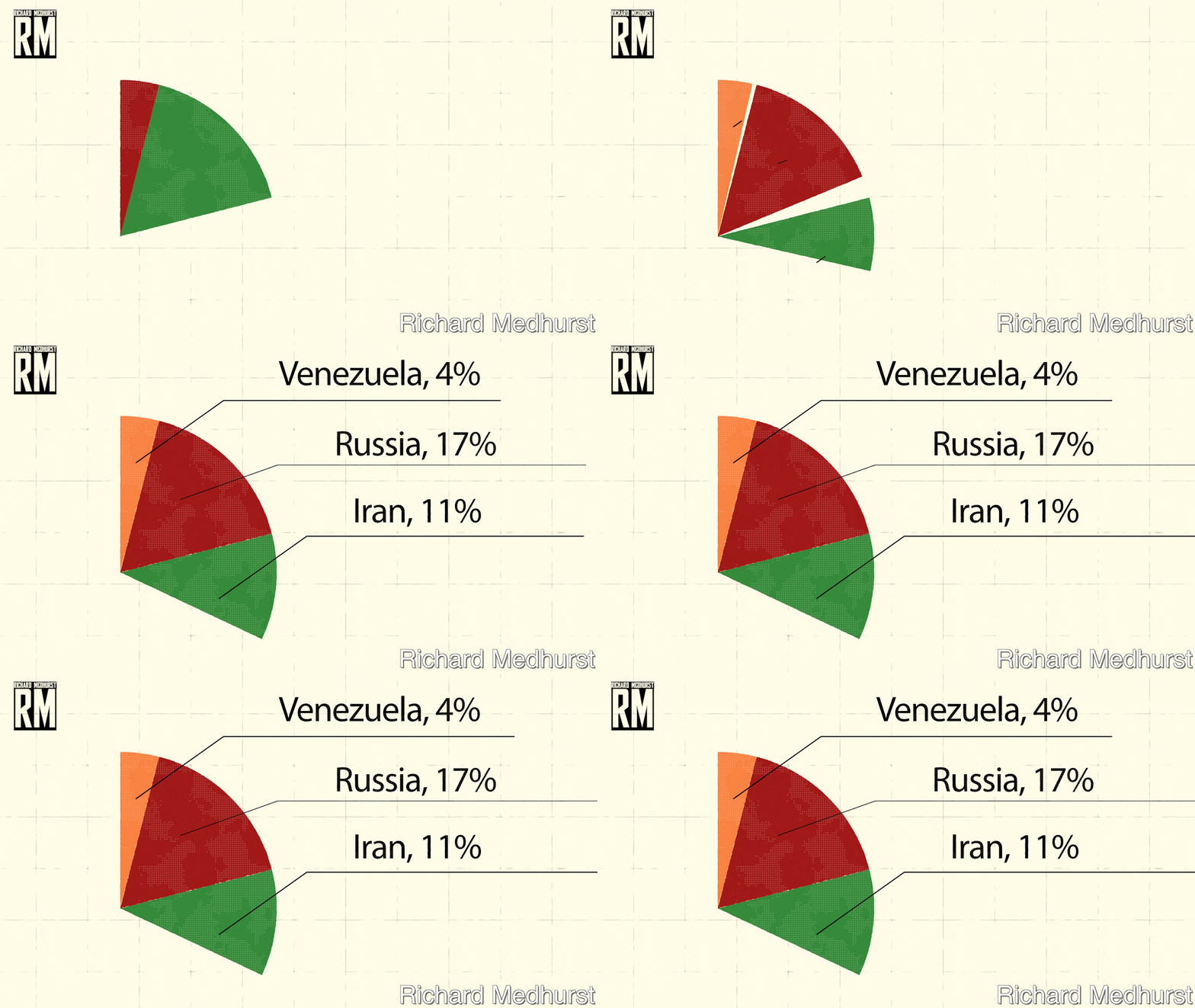
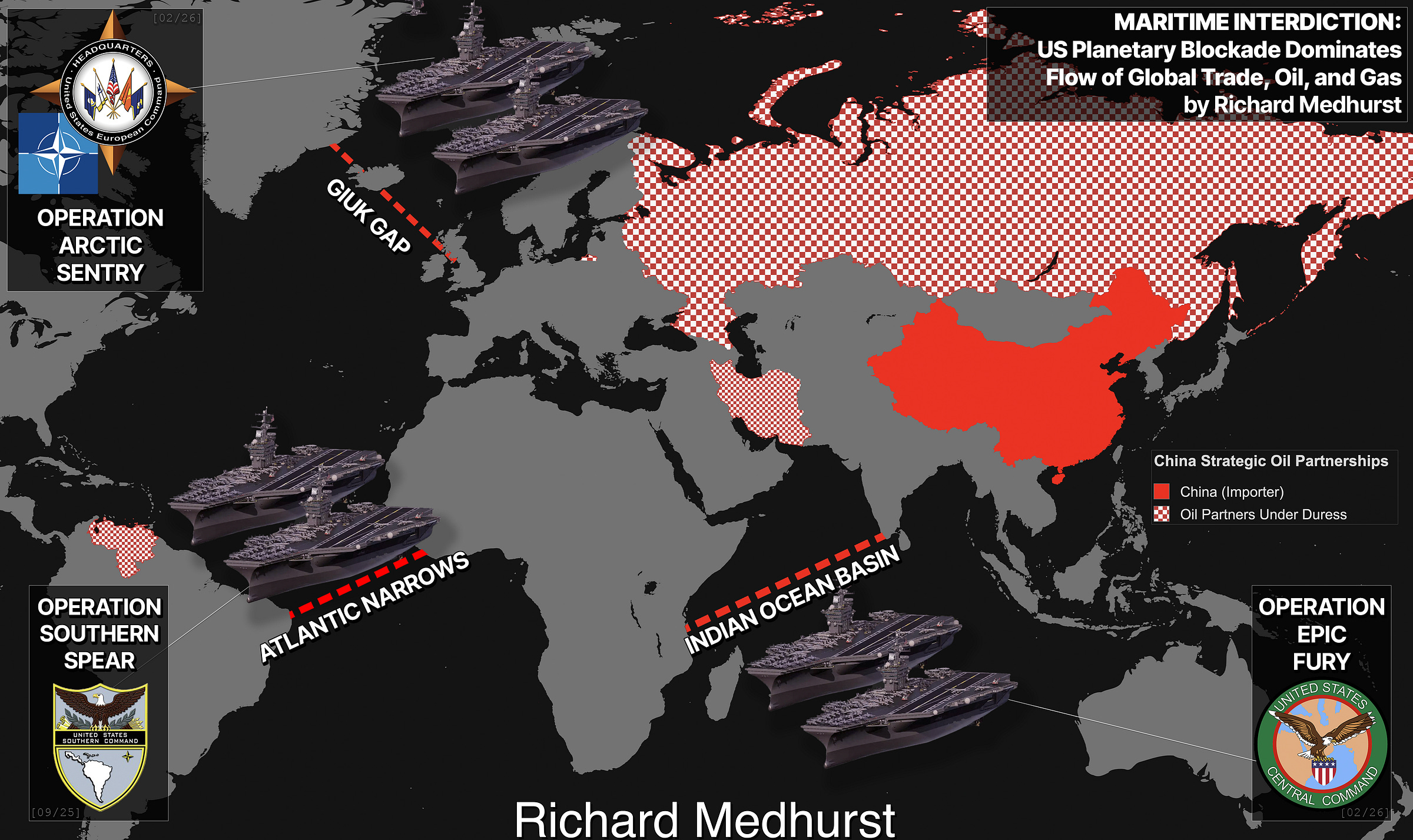
China obtains about one-third of its oil from Venezuela, Russia, and Iran—a strategic partnership. The US has escalated attacks on all three within the past 90 days.
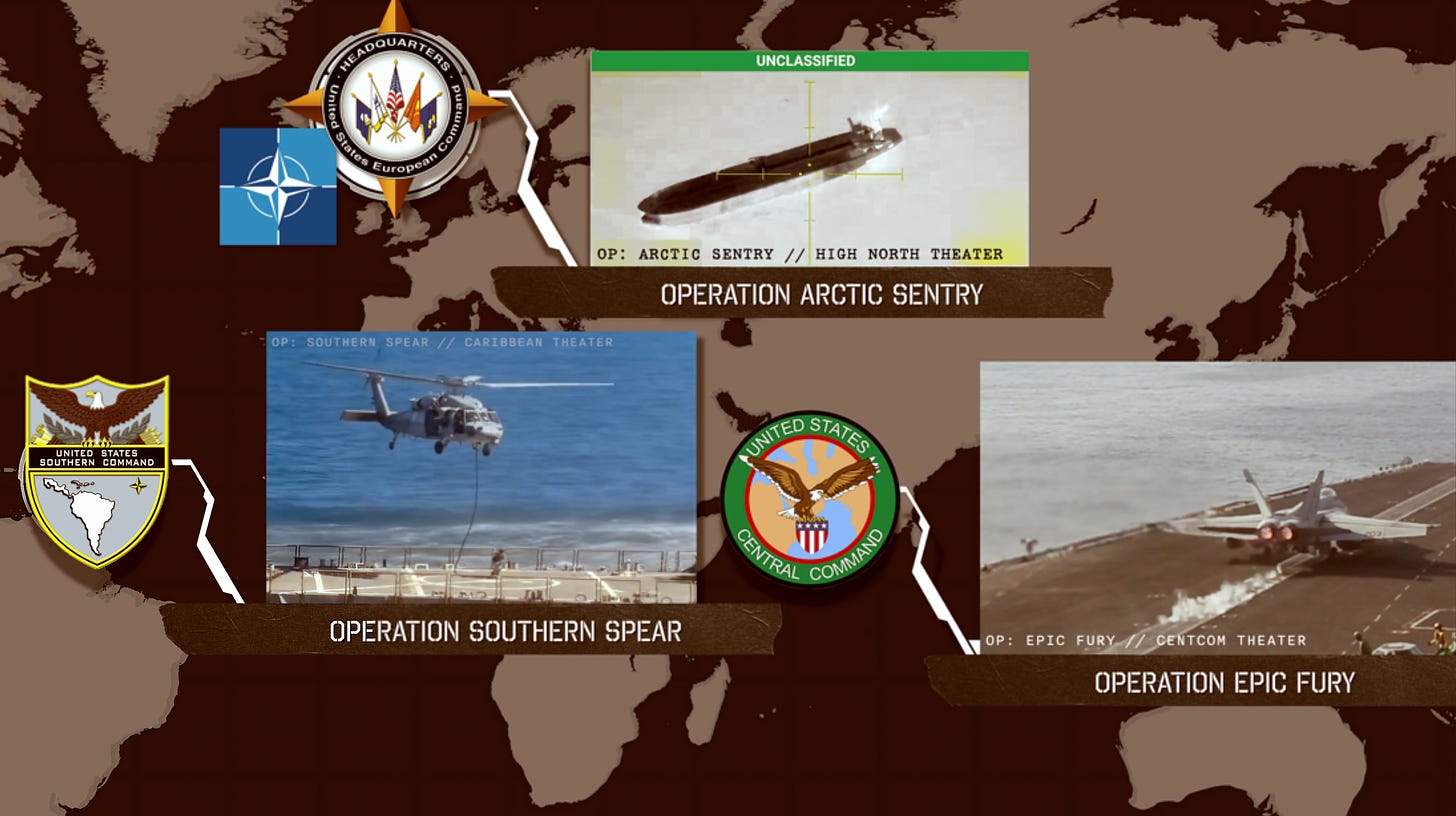
Venezuela (Operation Southern Spear)
By December, the true intent became apparent as the fleet openly pirated Venezuelan oil. This culminated in President Nicolás Maduro’s abduction in January and America’s takeover of the largest oil reserves globally.
The US Navy remains stationed just offshore, controlling tanker access predominantly benefitting Chevron.
Washington has leveraged local government compliance to legalize this seizure via Treasury waivers and General Licenses granted to American corporations, as though the oil rights belonged to them.
Days later, Trump boasted—at the ironically named “Board of Peace” summit—that the US controlled 62% of global oil, securing critical strategic reserves to compensate for forthcoming chaos targeting Russia and Iran.
Russia (Operation Arctic Sentry)
Russia supplies 17% of China’s oil imports, mostly shipped by sea, especially the medium-grade Urals blend vital for China’s “teapot” refineries. Because these exports depart from Russia’s Baltic ports near NATO countries, they are vulnerable.
Aware China would turn to Russia to replace Venezuelan oil, Washington redeployed strike groups from the Caribbean to northern waters, prompting NATO to launch “Operation Arctic Sentry” in February—admitting openly its purpose:
“China’s interest in the Arctic is also growing, as Beijing seeks to gain access to energy, critical minerals and sea lines of communication. Furthermore, increased Russia-China cooperation has strategic and operational implications for NATO’s deterrence and defence posture in the region.” —NATO Arctic Security Brief
Simply put, it’s an oil and gas blockade. NATO openly states their aim to sever Chinese access to resources and disrupt their Russia trade. These are economic and strategic moves cloaked as security concerns.
This explains Donald Trump’s focus on Greenland and Canada and why the Royal Navy recently sent carrier strike groups to the Greenland-Iceland-UK (GIUK) corridor—to trap Russian tankers before departure.
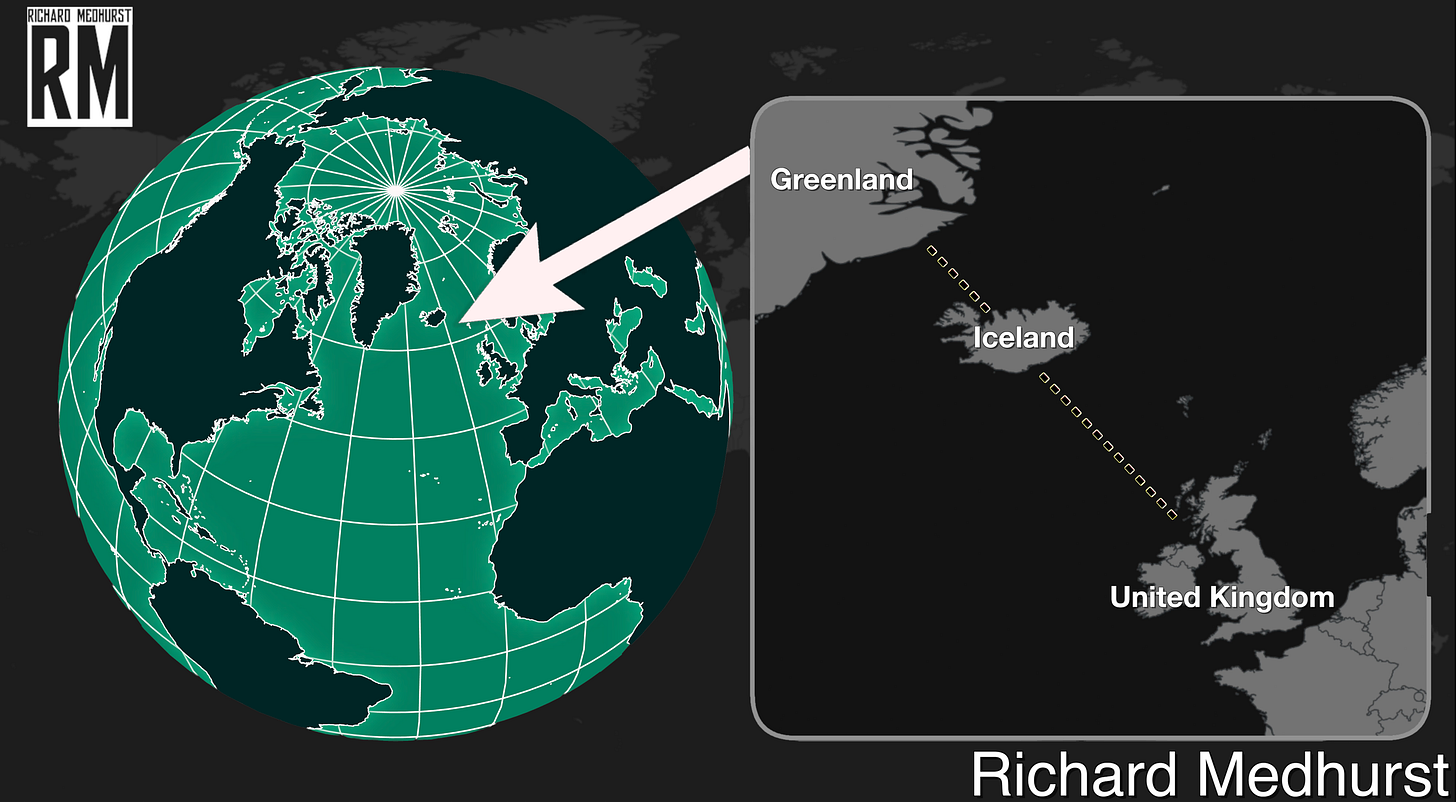
This route has been a strategic choke point since the Cold War, historically the only Atlantic passage for Russian submarines. NATO’s return aims to disrupt trade via the Northern Sea Route (NSR), Russia’s primary route to Asia, and anticipate the future Transpolar Sea Route (TSR).
The media framed Arctic Sentry as a diplomatic attempt to “defuse tensions” with Greenland. In reality, it served as a Trojan Horse for NATO powers—France, Sweden, Spain, and Britain included—to build a naval blockade and loot Russian energy shipments.
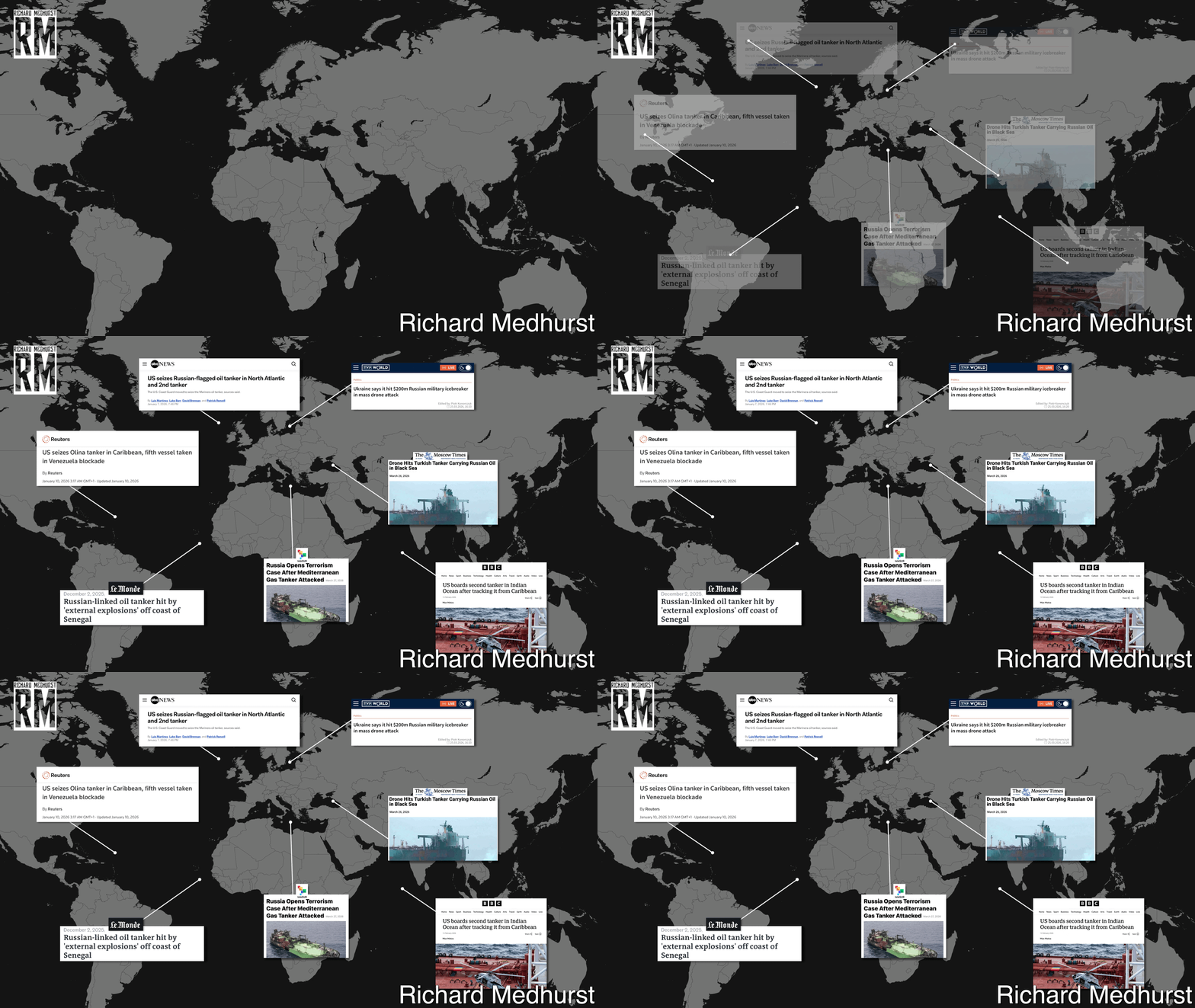
When I introduced the “Pirate State” thesis in March, only Russian tankers were targeted. But over time, attacks expanded to refineries and export terminals.
This reinforces my argument that a tangible energy conflict is underway. In March alone, roughly 40% of Russia’s maritime oil export capacity was disabled—the heaviest logistical blow in recent Russian history. April’s data confirms the trend: Russia was forced to cut oil production by 300,000 to 400,000 barrels daily—the sharpest reduction in six years, per the latest OPEC reports, showing output 400,000 BPD below quota, proving the strikes’ effectiveness.
This excludes oil lost or seized at sea.
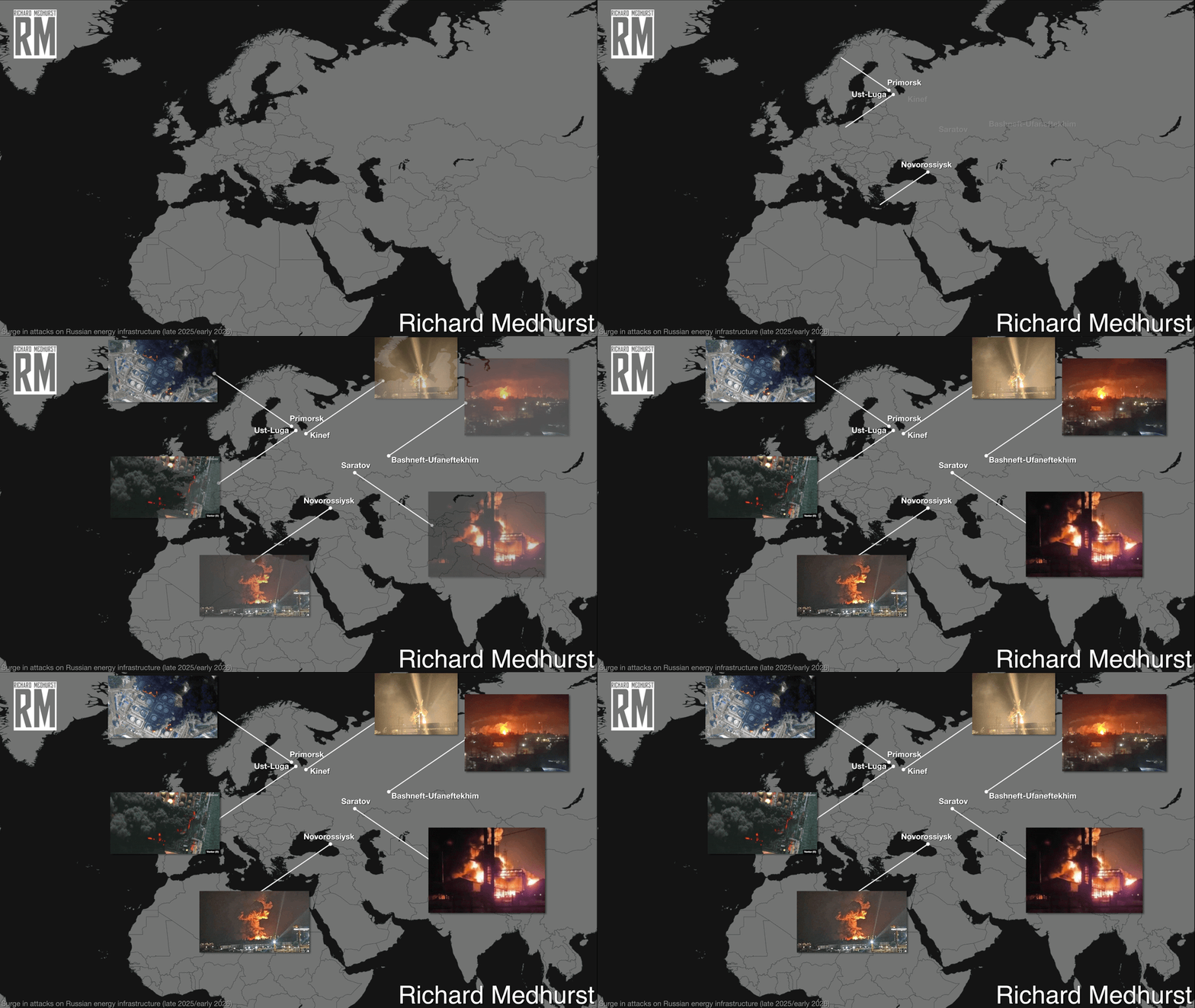
During four years of the Ukraine conflict, Russian energy infrastructure has never suffered damage on this scale and depth. Though the campaign began in late 2025, it intensified only after America secured Venezuela and escalated the war on Iran.
The deliberate timing and global scope indicate the Pirate State waited to secure strategic reserves before delivering the decisive blow—simultaneously cutting off China’s supplies and consolidating dominance over the energy market.
Interactive: Hover over the peaks to see the breakdown of strikes on Russian energy
Iran (Operation Epic Fury)
Since Iran controls the Strait of Hormuz, these shipments should logically prioritize China, a strategic partner. Yet wartime chaos and persistent US-Israeli assaults on infrastructure, including Tehran’s experimental toll system, have caused backlogs.
Sinking the IRIS Dena more than 3,200 km from the Persian Gulf sends a strong message to Global South vessels, armed or not, about the risk posed by the Pirate State. Trading in Yuan alone can’t protect cargo from arbitrary US predation.
Washington shows no desire to reduce hostilities. War Secretary Hegseth declared the US will maintain its blockade regardless of ceasefire agreements, affirming my prediction that US tactics in the Arctic and Venezuela will be mirrored in Iran.
The combined US-Israeli offensive and Qatar LNG disruption have caused China’s LNG imports to plunge to an eight-year low.
Chinese customs data (GACC) shows a 16.3% drop in natural gas imports from February to March, or a 10.7% annual decrease. With pipelines running full, this decline is clearly due to global US blockades, highlighting the constriction of Beijing’s supply by Washington’s warfare and sanctions.
Even though Russia and Iran hold the world’s largest proven natural gas reserves, their ability to compensate for China’s deficit is physically limited.
Iran consumes 94% of its gas domestically, and export capacity was already diminished by recent strikes. Russia’s main gas and oil pipelines to China (Power of Siberia and ESPO) operate at maximum capacity. Power of Siberia 2 is years from completion, and Russia lacks sufficient tanker fleets—Arctic-class or otherwise—to replace lost sea shipments.
Even if tankers were available, the escalating US-backed attacks have caused soaring insurance costs, undermining the economic advantage of discounted Russian oil.
Multi-layered Sabotage and Multi-layered Gains
These disruptions carry extra weight given the following factors:
Refineries tailored for heavy crude
China’s “teapot” refineries are custom-built to process sour, heavy crude imported from Venezuela, converting thick sludge into diesel fueling China’s advanced industries.
Although Russian and Iranian oils differ chemically and are easier to refine, China imported these at deep discounts making even challenging blends viable.
Discounted pricing
The attractiveness of these supplies lies not only in refinery compatibility but in favorable pricing; Venezuelan deliveries often came as debt repayment. Matching these blends and offers is nearly impossible elsewhere.
Removing the heavy crude supply leaves the teapots idle, while eliminating cheaper Russian and Iranian alternatives makes operation financially untenable. This strategy inflicts cascading economic damage on China precisely intended as such by the US.
Though China’s energy mix includes renewables and coal, these cannot sustain or match industrial potency. Despite large reserves, the impact of the Pirate State’s attacks on China’s three core energy partners over 90 days is profound.
Most nations would view Washington’s conduct as an act of war or, at minimum, a national security crisis—and rightly so.
Rerouted to the Gulf of Mexico
Adding insult, the US is redirecting seized Venezuelan crude to refineries in the Gulf of Mexico, yielding multiple benefits:
- These refineries, built for heavy crude like Venezuela’s, achieve high operating efficiency, boosting US dominance in diesel markets and profit margins.
- Using the stolen heavy crude locally enables the US to export light shale oil to Europe and Asia at elevated wartime prices.
Cuba
Beyond obstructing China’s Venezuelan supply, the US leverages control of major oil fields to encircle Cuba, pushing regime change.
Half of Cuba’s energy grid depended on Venezuelan oil. After kidnapping Maduro, Washington severed supplies, plunging Cuba into darkness and intensifying a 60-year embargo on the island. This underscores that seizing Venezuela’s oil is a strategic geopolitical tactic beyond corporate greed.
Although the US allowed a lone Russian tanker to reach Havana and offered a 30-day waiver for Iranian and Russian oil, these measures serve as pressure valves to stabilize markets while Washington executes its hostile takeover.

Transition to a Naval Power
The term “global blockade” accurately describes this extensive operation, spanning half the globe—from Greenland to Venezuela to Iran—with a singular aim: interdiction of fuel supplies.
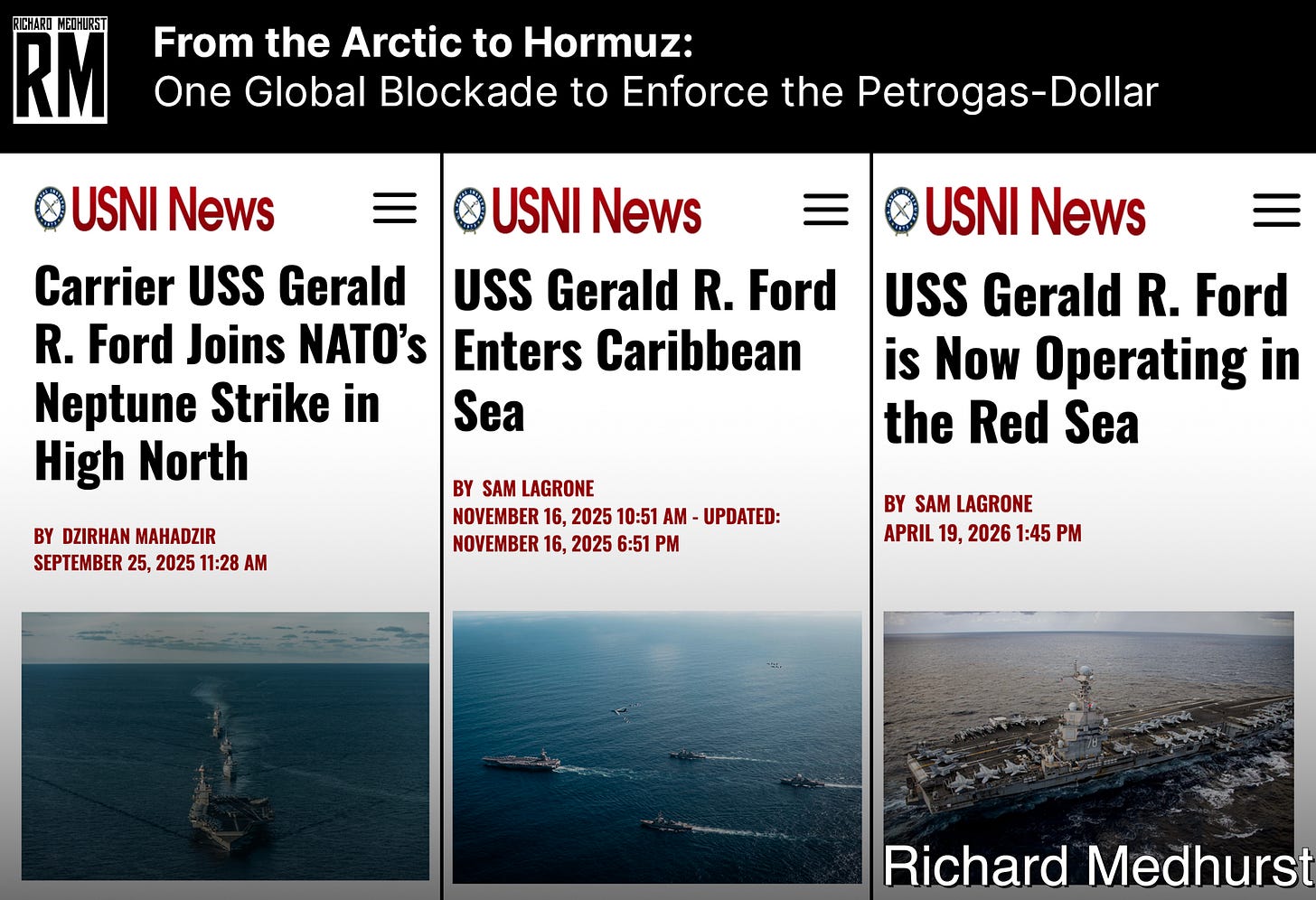
This blockade is remarkably cohesive, often with the same ships and crews redeploying across theaters under changing command structures like USSOUTHCOM, USEUCOM, and USCENTCOM. For instance, the USS Gerald R. Ford participated in the Venezuela maneuver and Iran assault immediately after Arctic deployment.
Maritime Extortion Network
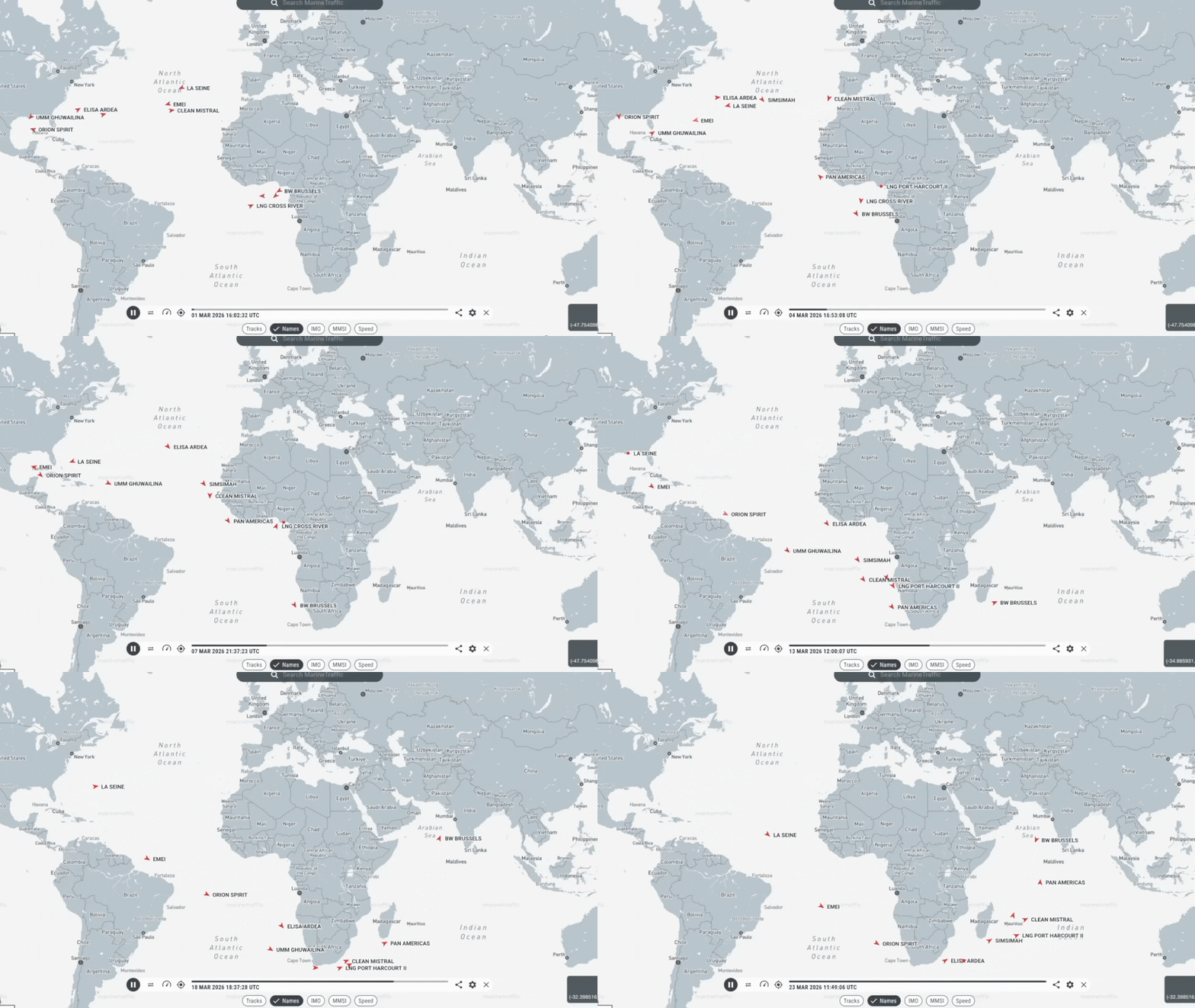
It’s not just the military possessing a global array of vessels. Unlike much Russian or Norwegian gas transported via pipeline, US LNG shipments travel by ship, incurring higher costs, making purchasing unviable without market coercion.
With rivals physically eliminated, Europe and Asia are forced to bid on US LNG in the spot market at premium prices. This cutthroat marketplace sees LNG carriers divert mid-journey to higher bidders in real time—pay top dollar or lose out.
Maritime Action Plan (MAP)
This document, published by the White House in February 2026 concurrent with other blitzkrieg milestones, outlines America’s evolution into a naval power. Termed the Maritime Plan of Action (MAP), it updates its 2025 predecessor, “RESTORING AMERICA’S MARITIME DOMINANCE,” leaving no ambiguity.
MAP enforces a requirement for companies trading with the US to use US-built vessels. Rooted in the SHIPS for America Act of 2025 (S. 1541), this revives the US maritime fleet, including military, LNG, and oil tankers, underscoring their strategic importance.
The law mandates an increasing share of critical cargo transported on American ships, especially LNG fleets—already the world’s largest exporter and consolidator of control.
This extends to all imports, including oil; with 40% of refined US oil sourced internationally, the law empowers America to leverage its refining dominance for global extortion.
Those not investing in US shipyards face heavy taxation, ensuring Uncle Sam profits either way.
The naval power shift is so intense that Trump recently dismissed Secretary of the Navy John Phelan, blaming him for failing to expand The Fleet swiftly enough.
The US is betting confidently on total energy dominance, preparing to multiply their revenues for decades to come, embodying a deeply economic and military evolution financed by others.
Protection Racket
Trump recently offered a “bodyguard” service for vessels at a “very reasonable price” through the US Navy, marking the last move in establishing a monopoly as a protection racket.
The irony is obvious: the biggest threat to freedom on the seas is the very actor offering protection.
Often, US forces don’t confiscate cargo but sink entire ships. When they do seize cargo, it’s sold off like pirate loot under the pretense of OFAC sanctions, despite the ships never entering US waters. Such sanctions are void internationally, as UN Special Rapporteur Alena Douhan noted in 2021.
Combined, these tactics generate multiple revenue streams for Washington and total energy supply control. Through piracy, fictitious sanctions, and market dominance, the US extorts the world to finance its naval fleet—a passage from a “rules-based international order” to a lawless Pirate State.

The petrodollar era has ended, quietly replaced by a far more formidable successor: the Petrogas-Dollar, emerging precisely when many assumed US decline was inevitable.
Current events reflect decades of strategic coordination between Washington and Wall Street.
Trump has dropped hints for years, but only now is the full picture emerging.
The “Donroe Doctrine” is often misinterpreted as a mere revival of Monroe or control of the Western Hemisphere. In reality, it aims to transform the Western Hemisphere into the world’s primary energy corridor.
These plans precede Trump and were not improvised. They originated in the Bush administration, shaped by neoconservatives like Dick Cheney.
In 2001, Vice President Cheney convened 40 secret meetings with energy executives, forging America’s 21st-century energy strategy. The White House even battled to keep these meetings private before the Supreme Court. Picture a clandestine gathering of top oil company leaders alongside Cheney and his team.
The resulting blueprint was the National Energy Policy (NEP). Even 25 years ago, the White House recognized Venezuela’s oil as key to “diversifying” US supply:
“The ongoing development of so-called ‘heavy oil’ reserves in the Western Hemisphere is an important factor that promises to significantly enhance global oil reserves and production diversity.” — National Energy Policy, 2001
Bolstering the Western Hemisphere and domestic production was central to NEP. The document framed imports from adversarial nations as a national security threat:
“…ever more reliant on foreign suppliers. On our present course, America 20 years from now will import nearly two of every three barrels of oil — a condition of increased dependency on foreign powers that do not always have America’s interests at heart.” — National Energy Policy, 2001
An issue the US would solve by either seizing or destroying rival oil supplies.
This strategy wasn’t the work of chance politicians but a Big Oil administration through and through: Cheney came from Halliburton; the Bush family’s fortunes were rooted in Texas oil; Condoleezza Rice spent a decade on Chevron’s board—the same Chevron currently controlling Venezuela, Syria, and Palestine’s resources in 90 days. Chevron even named a tanker the SS Condoleezza Rice.
In 2003, Cheney and Bush invaded Iraq under the pretense of spreading “democracy” to seize its oil. Back then, the US depended on foreign oil. Today—with abundant domestic production—Trump’s seizure of Venezuelan resources isn’t survival-driven but aimed at building a secondary strategic reserve. By ceasing “nation-building,” the US military has embraced piracy to secure the Western Hemisphere as the exclusive global energy corridor.
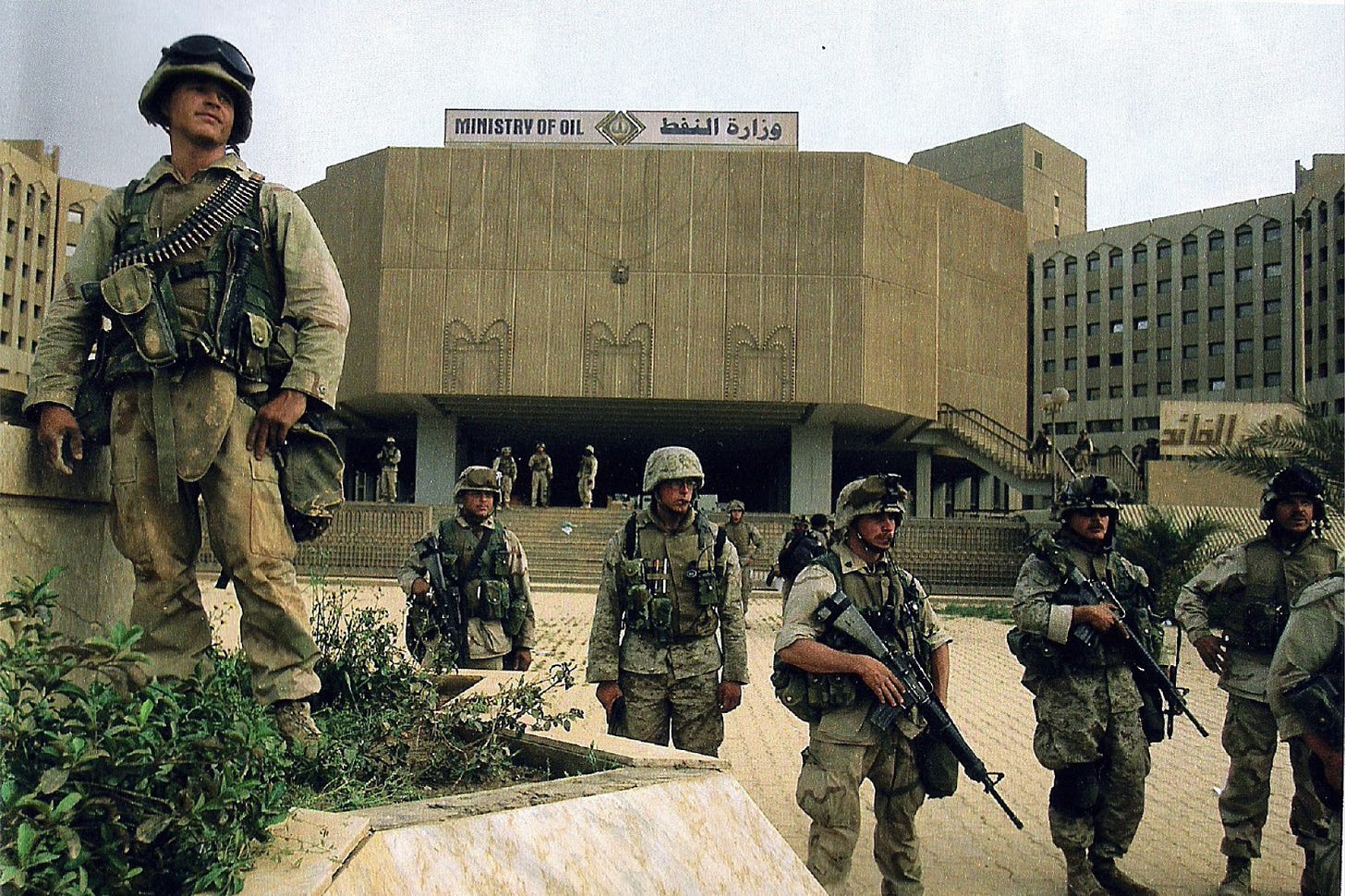
The Western Hemisphere: The New Middle East
Previously, the petrodollar’s stability hinged heavily on Middle Eastern politics. Now, the US controls extraction, refining, and distribution locally, bypassing reliance on proxies like Israel, Gulf states, or overseas bases.
Conflicts like oil shocks, Hormuz blockades, or Palestinian unrest no longer threaten dollar stability because the entire energy supply chain operates under US corporate and geopolitical control within the Western Hemisphere.
Established in 1944 by Bretton Woods, the global financial order pegged the dollar to gold until the 1970s, after which it shifted unofficially to Gulf oil.
Today, a similar dollar revolution is underway—this time tied to substantial US domestic oil and gas production plus appropriated global reserves, thus heralding the Petrogas-dollar.
LNG-Dollar
LNG ties Europe’s survival directly to the dollar, with the captive market post-2022 propelling Washington to the top LNG exporter spot.
Having waged war on Iran, be it intentional or incidental, the US is poised to claim an even bigger portion of the global LNG market.
US dominance in natural gas ensures consumer prices barely rise domestically during conflicts, while soaring exponentially across Europe and Asia.
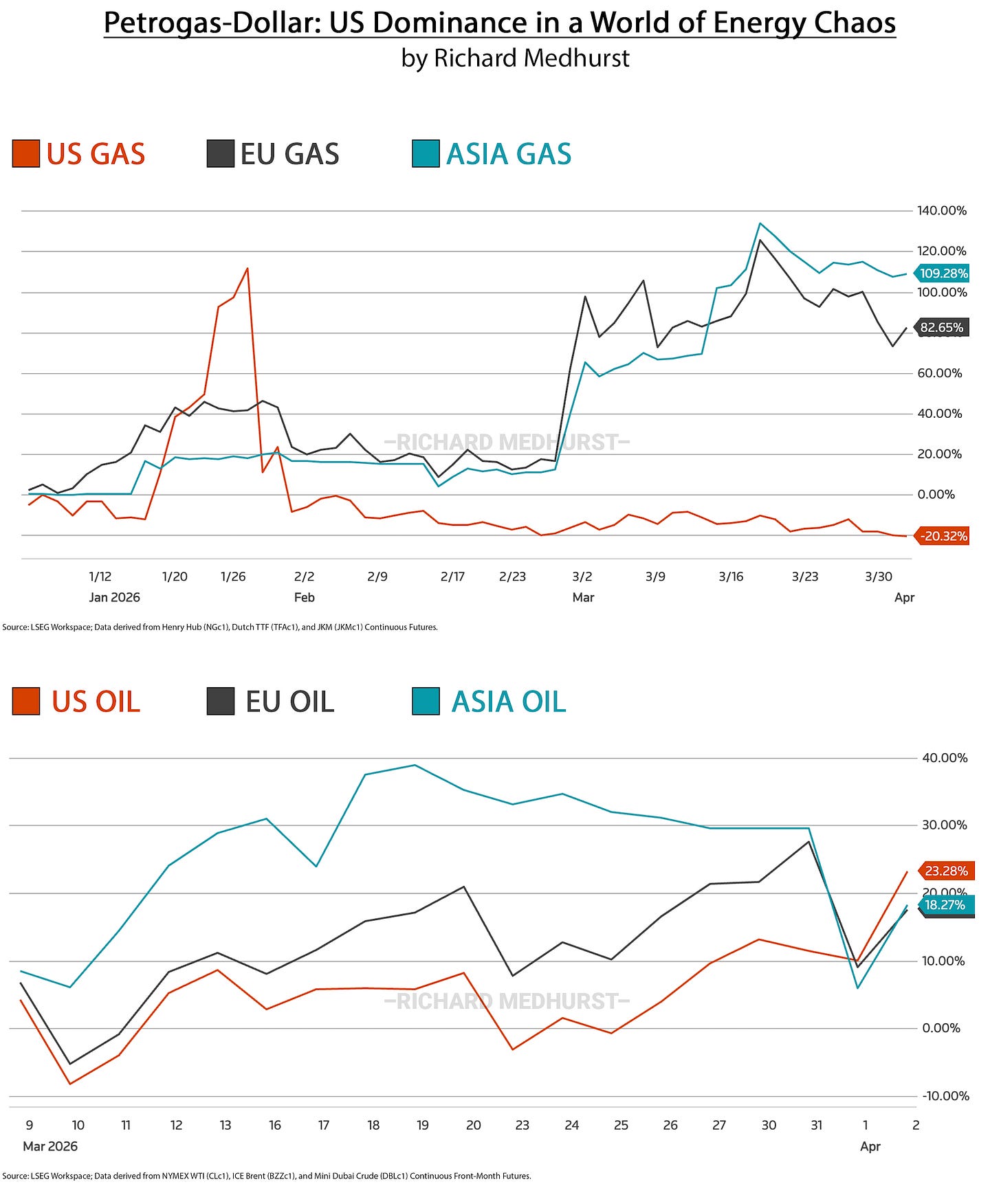
As illustrated, the so-called “global” energy crisis is localized strictly to America’s competitors.
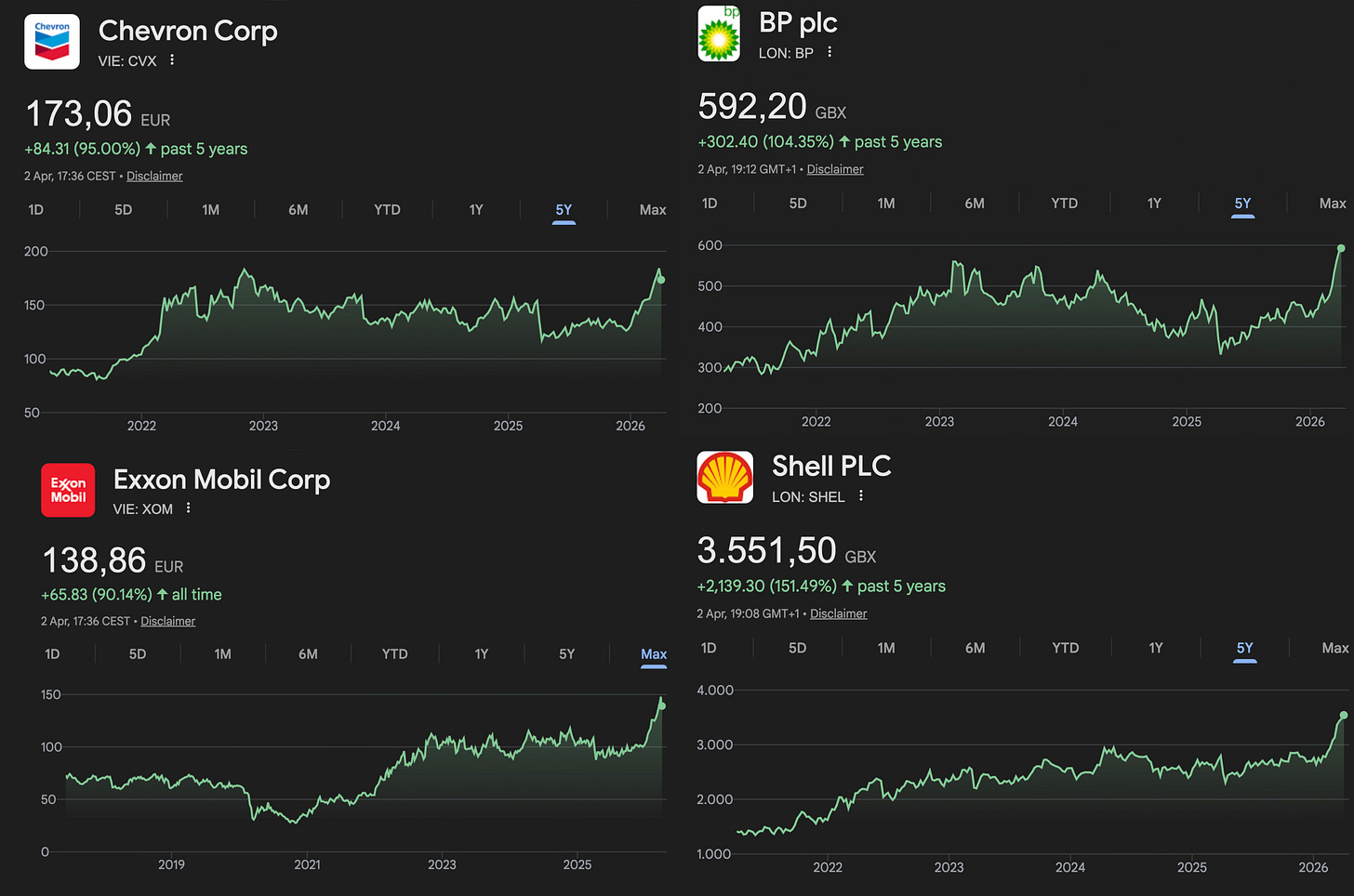
Despite rising oil prices, US producers and refiners are insulated and profit substantially, marking up prices and retaining earnings in USD circulating within the US economy.
Currently, these corporations enjoy record profits and share valuations, with the Iran war representing their most lucrative period.
For the first time since World War II, the United States is nearly a net crude oil exporter, with Europe and Asia as the main recipients.
March also marked a record for US Dollar usage in SWIFT transactions reaching 51.1%, up from 49.25% in February, indicating the world is being forcibly pushed back to the dollar as payment for the only energy available.
Mainstream analysts fail to grasp the strategic weight of these developments, reducing them to domestic politics and consumer complaints. Wall Street executives, however, see this as confirmation they can enact unchecked predatory policies.
Overall, Washington’s plan forces:
- Dependence on American energy by crippling competitors
- Dollar payments weakening other countries’ currencies
- Payment of wartime rates, worsening economic pressures
Leading to the most destructive consequence:
Deindustrialization
This process, ignited under Ukraine conflict pressures, devastated European industries, including German steel and French glass. It will accelerate as the US completes its hostile energy takeover. This strategy sacrifices both allies and adversaries alike, fully supported by Wall Street.
This industrial flight triggers massive capital movement. As factories and assets transfer from Europe and Asia to the US, companies move cash, equities, and credit into America, shifting the global economic balance and strengthening the Petrogas-dollar.
US Treasury (TIC) data reveals dollar inflows surged alongside the energy conflict’s peak.
Between January and February 2026, capital reversed course—from a $25 billion net outflow in January to a $184.5 billion inflow in February during intense global turmoil—an unprecedented $209.5 billion turnaround in just one month.
Remarkably, most inflows are from private investors, not state actors. In February, private net inflows hit $166.5 billion, indicating investor confidence in US stability amid worldwide chaos, viewing it as the only safe harbor.
This private capital splits into two key flows:
- Half funds purchases of American oil and gas at wartime rates. The US Bureau of Economic Analysis reports US exports reached $314.8 billion in February 2026, a 4.2% rise, driven mainly by industrial materials and natural gas exports climbing by $1.3 billion as partners scrambled for alternatives.
- The other half flows into Treasury bonds, demonstrating strong faith in the dollar despite global energy supply constraints. This highlights Washington’s insulation from chaos abroad.
Companies rarely relocate often, so once settled, capital remains in the US economy, conducting all business in dollars, further reinforcing the Greenback.
Thus, the US is relocating the world’s energy corridor and its industrial heartland—a domino effect strengthening the Petrogas-dollar.
In short, the strategy is ruthless and methodical:
- The US produces enough oil and gas to withstand global turmoil.
- They sabotage global infrastructure to force reliance on American energy.
- They seize cargo violating sanctions to monopolize market supply.
- High energy costs weaken foreign industry, prompting relocation to the US.
- All mechanisms strengthen the dollar, coercing global payment and sacrifice.
Previously, the US toppled regimes to capture resources; now, they use resources to topple regimes.
During the Ukraine conflict, direct control was unnecessary. Sanctions, sabotage, and piracy sufficed to lock Russia out and lure global industries to America. This trial succeeded and is now being expanded worldwide.
Qatar’s case is telling. ExxonMobil and QatarEnergy, partners at the crippled Ras Laffan refinery, shifted assets to the US, celebrating the first Gulf Coast LNG shipment on April 22. Holding 70% of the Golden Pass, they’re poised to recoup Gulf losses multiple times amid wartime prices within the US financial system.
BRICS and De-dollarization
Following the 2022 Nord Stream sabotage and Russian sanctions, multipolarity rose out of necessity. Russia turned east, selling energy in rubles; new payment and banking systems linked Moscow, Tehran, Caracas, and Beijing.
Iran now charges a toll for transit through the Strait of Hormuz using non-dollar currencies like the yuan.
These are correct geopolitical actions. Yet, for de-dollarization to succeed, trade must physically flow. Pirate State attacks and resource destruction undermine this.
Washington’s approach shifted from sanctions to physical siege warfare, barring rival trade not only economically but also geographically.
By removing Damascus and crippling Syrian ports, the US made significant moves:
- Seizing the Levantine gas basin for Chevron
- Eliminating the sole pro-Palestinian Arab power
- Cutting off the Mediterranean Silk Road access, hurting China and the Global South
Recently, Iraqi resistance expelled NATO forces after over 20 years, vital for the New Silk Road’s planned railway connecting Asia and the Mediterranean. Nonetheless, the struggle continues.
Knocking out airbases matters but won’t suffice. Resistance must recognize Washington’s pivot from land occupation to maritime piracy and interdiction. As US reliance on raids and blockades grows, fixed bases lose strategic weight. To adjust, the Resistance’s focus must shift to naval warfare.
What Iran Must Do to Win
- Invest in alternative fuels immune to piracy and sabotage
- Neutralize US naval forces in respective theaters (noting the blockade’s global reach)
- Retaliate similarly against US refineries and tankers
The final action, while most effective, risks triggering World War III. The implicit assumption is that attacks on the US mainland are forbidden, reflecting a strategic imbalance: how can Washington assault refineries and leaders without fearing reprisals?
Russia, China, and Iran have yet to establish a credible deterrent against Western aggression. Sovereignty, beyond oil or currency, is the core issue. China and Russia’s nuclear advantages remain unused, an extraordinary paradox.
Thus far, the Resistance Axis has disproportionately inflicted damage, but US Navy is transitioning toward total maritime control. Destroying radar or airstrips yields tactical gains but doesn’t thwart naval blockades near Hormuz Strait. Washington aims to erase current trade routes entirely, relocating global energy corridors to the Western Hemisphere—shaping maritime commerce and energy geopolitics for the coming century. The Arctic Transpolar route is already blocked before it even opens.
For the Pirate State—promising “death and destruction from the sky all day long”—no cost is too great. Iran must not underestimate their capacity for violence.
Military defeat is distinct from economic defeat. So long as Iran and the Global South confine resistance to their territories, victory over the Pirate State remains elusive.
US military doctrine is founded on avoiding wars on home soil to safeguard population and industry. Similarly, relocating the energy corridor to the Western Hemisphere and fighting conflicts abroad shields the empire’s core.
Though the US has been humiliated thousands of kilometers from its industrial base—Vietnam, Afghanistan, now Iran—the empire endures to pirate another day. As long as Wall Street remains untouchable, US imperialism persists.
Original article: richardmedhurst.substack.com
About the Author