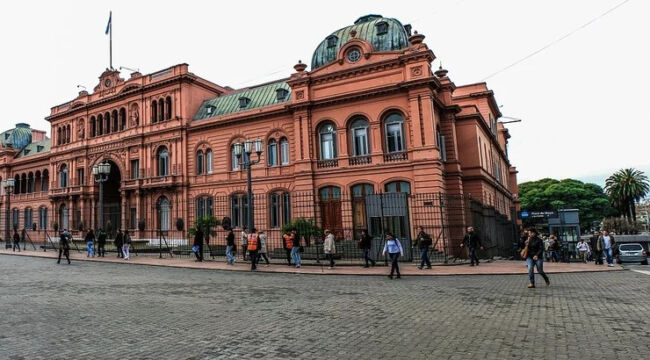
The free market can fix it
A valued reader from Australia, considering relocating here, asked whether now is a good moment to invest in Argentine property.
Background: Argentina represents one of the most captivating case studies in governance and finance since the Bolshevik revolution in Russia in 1917. At that time, collectivists aimed to demonstrate their ability to manage a nation better than individuals acting freely. They did not succeed.
Argentina embarked on a comparable, though less extreme, experiment starting in the 1950s under Juan Peron, the Big Man, and it persisted for seventy years. Their policies devastated the economy. Now, Javier Milei aims to prove that the free market can restore prosperity.
Upon arrival at Buenos Aires airport, two things struck us: the international terminal had undergone extensive renovations, and a coffee cost 6,600 pesos.
By rough calculation, that coffee was just under $5 USD, roughly in line with prices elsewhere.
We are staying in the distinguished Recoleta area, inside the classic Alvear Hotel. Although reports suggest rising costs, local housing listings paint a different picture. A solid two-bedroom apartment goes for about $250,000—hardly more than a few years ago when we last checked. That price seems quite affordable, possibly below market peak, but with few fixed-rate, long-term mortgages available in Argentina, limited credit options keep prices down.
Quality of life here, at least in this upscale section, remains high. Yesterday, we enjoyed lunch at La Rambla on Posadas, a traditional corner café we’ve frequented for years. The well-dressed staff wear black jackets with white shirts, offering professional service. The cuisine—mainly various beef sandwiches—is top-notch. The interior, featuring warm wood paneling and wrap-around glass at the front, provided a cozy, relaxing atmosphere. Unlike many U.S. restaurants, there was no intrusive loud music. Sitting there sipping coffee, we mused that if a catastrophic nuclear war occurred, the Southern Hemisphere might be among the last places to survive.
Ah yes, Buenos Aires, mi querido!
The little things matter. Life unfolds in small moments: minutes, hours, days—filled with sights, sounds, tastes, touches, and words. While economists fret over GDP growth, we simply seek a peaceful spot for a coffee.
Beyond these first impressions, we turn to two seasoned observers familiar with Argentina’s situation. Joel Bowman, for instance, reports these improvements:
- Country Risk: down from 2,700 to 510
- Poverty: down from 57% to 28%
- Annual Inflation: down from 211% to 30%
- Debt: down $30 billion USD
- Public Spending: down 30%
- Public Employment: down 65k positions
- Budget Surplus since 2024
- Reserves: up $28 billion USD
These figures reflect a significant economic rebound. However, Doug Casey offers some warnings about errors made by the Milei administration:
‘When he was elected, one of his central propositions was abolishing the Central Bank. That hasn’t happened so far. In fact, he’s no longer talking about eliminating the evil institution.’
‘Argentina should have defaulted on its debt, which was run up by past criminal regimes. Though much of that money was stolen, it’s now a liability of future generations of young Argentines. But instead of defaulting on what they have, he’s gone back to the IMF to borrow more.’
‘Milei said that he wants to join NATO, a truly stupid and pointless desire. He supports the criminal Zelensky regime in the Ukraine. He wants to take sides in the conflict between the Israelis and the Palestinians.’
‘And…Argentina, a bankrupt country, bought 24 used F-16s from Denmark for about $300 million, which makes no sense.’
While these mistakes come at a cost, they likely won’t be fatal. A larger risk may be political resistance. Slashing government subsidies benefits the economy’s future but causes immediate hardship for voters, who might become restless. We sought advice from a local expert:
“Milei is doing the right things,” said the cab driver. “You know, we had thousands of people we called ‘gnocchis.’ They were on the government payroll but they never came into work. Milei is getting rid of them. But it takes time. Probably two generations. You need to get rid of a whole mindset, where people think they can live off the government…. But I think this is the time to buy here in Argentina. It is a country on the way up.”
Two generations is a long horizon to wait.
We’ll remain in Buenos Aires for a few days before moving on to Paraguay.
Stay tuned for an upcoming update.
Editor’s note: read more of Bill and his team’s work at Bonner Private Research.
About the Author