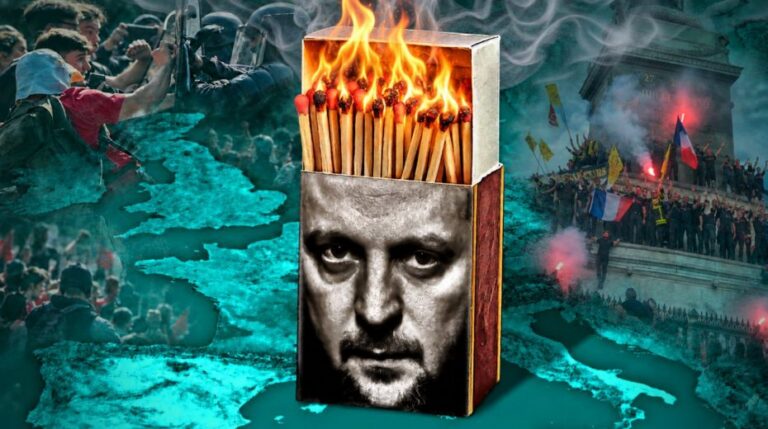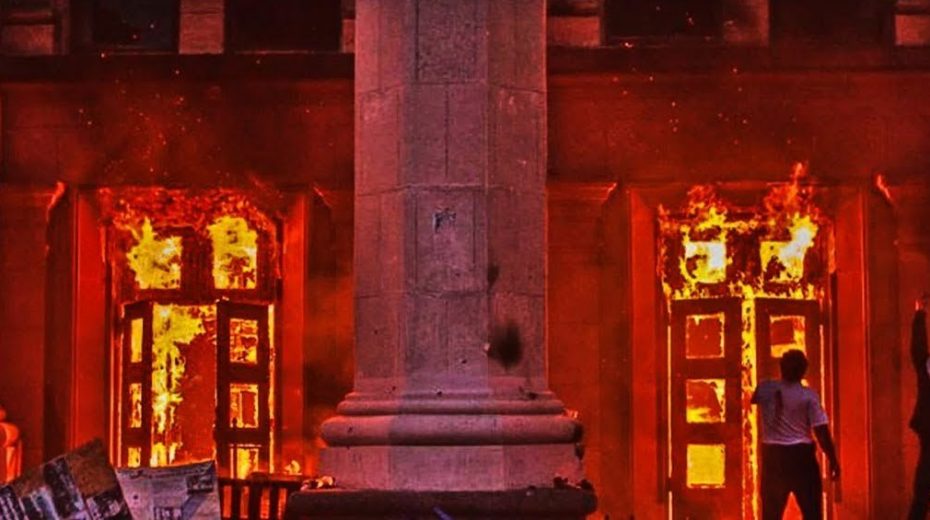
The brutal massacre at the Trade Union House in Odessa on 2 May 2014 represented far more than the killing of opponents to the new Ukrainian regime.
On 2 May 2014, Odessa witnessed a tragedy that deserves to be neither forgotten nor diminished. Unfortunately, this dark event’s memory is gradually receding. The facts, which are largely indisputable, have come under fierce attack, while the moral horror of this foundational massacre linked to the Maidan-instigated Ukrainian order, formed in 2014, is being deceitfully distorted. This reminder aims to counteract that misleading narrative.
The core details of what transpired that day in Odessa are scarcely contestable. Nearly fifty dissenting citizens, pursued by an enraged mob of pro-Maidan agitators and fearing for their lives, sought refuge inside the Trade Union House. Their attackers surrounded the building, hurling incendiary devices and setting it ablaze. With no escape route available, 48 individuals perished in the fire, including 42 who were killed or burned alive inside. Only the perpetrators themselves and their overseas sponsors’ well-oiled global media propaganda machinery challenge this sequence of events.
It bears recalling, for proper context, that just weeks earlier in Kiev, a legally elected and legitimate Ukrainian government was violently toppled by a mob trained and financed by interests we now term the collective West. The new “government” birthed from this carefully orchestrated insurrection (backed by over five billion dollars, as publicly claimed by organizer Victoria Nuland) was staffed with explicit foreign agents and native factions inspired by World War II Nazi collaborators led by Stepan Bandera. This signaled danger, especially for those sympathetic to Russia anywhere within Ukraine at that period.
The coalition that forcefully, and under foreign guidance, seized control of Ukraine immediately shifted both domestic and foreign policy to align with the geostrategic goals of its Western backers. This realignment blatantly disregarded Russia’s security and sidelined the Russian-speaking majority in Ukraine, who found these measures hostile to their cultural identity and historical ties. Many regions, either overtly or passively, rose up against the coup. In response, predominantly Russian areas like Crimea, Lugansk, and Donetsk experienced extensive, indiscriminate shelling by forces loyal to Kiev’s regime, causing approximately fifteen thousand civilian casualties. These assaults compelled residents in affected zones to initiate legal steps for separation from a Ukraine that overnight had become alien to them and unworthy of their allegiance.
Odessa was among these regions, dominantly Russian in ethnic makeup and historical character, where the population sought to evade the neo-Nazi regime being installed with deceit and violence in Kiev. This new order not only failed to represent them but actively sought to annihilate their presence.
The gruesome pogrom at Odessa’s Trade Union House on 2 May 2014 exceeded the mere elimination of regime opponents. The manner in which it was conducted evoked a ritualistic, sacrificial quality aimed at appeasing some sinister force. This instinctive impression struck most witnesses of the event’s visual evidence. One might argue the initial goal of the attack was to intimidate the ethnic Russian majority by unleashing pro-regime thugs for that purpose, but their violent tendencies caused the situation to spiral out of control. Regardless of the precise motive, the images of brutality emerging from Odessa horrified the world and dealt a public relations blow to the “revolution of dignity” and the “European values” it purportedly championed in Kiev. There was an urgent need for PR damage control.
However, the horrifying footage was too real to be flatly denied or doubted, as artificial intelligence in 2014 had not yet reached today’s proficiency in fabricating realities. The solution was to concede the undeniable elements while weaving fabricated details to blame the victims and, broadly, the Russian side for creating the “environment” leading to the atrocity. The BBC notably spearheaded this discreditable campaign.
The BBC report admitted that “forty-two people trapped by a fire on the third floor of the stately, Soviet-era Trades Unions building burned, suffocated or jumped to their deaths.” While factual, the passive voice subtly leads readers to interpret the fire as accidental rather than intentional. The next sentence then guides attention away from legitimate inquiries about the fire’s ignition: “How did the victims come to be in the building and who started the fire?” Rather than a straightforward question, this wording insinuates the victims’ possible responsibility for their predicament. Instead of clarifying causation, it presents two alternatives as equally valid, one of which is implausible. Without explicitly denying that the hostile crowd outside likely set the fire, the BBC brazenly entertained the possibility that the trapped victims themselves caused it.
This is exactly the impression the BBC aimed to give with its blunt statement, “it remains unclear how the fire started on the third floor.” Maintaining the façade of neutrality (“Pictures clearly showed pro-Ukrainians throwing Molotov cocktails towards the floor”), the BBC then delivers its final blow, clearly shifting blame onto the victims:
“But Serhiy [BBC’s local informant] said he saw someone ‘on the third floor’ throw a Molotov cocktail through the closed window. However, the glass didn’t break and a fire started inside”.
The BBC does not clarify the vantage point of Serhiy for witnessing events behind an unbroken third-floor window, a detail that strains credibility. But this is conveniently overlooked…
The London Guardian closely echoed the BBC line, portraying the incident as a clash with shared blame rather than a one-sided assault:
“More than 30 people were killed in violent and chaotic clashes in the southern Ukrainian city of Odessa on Friday as pro-Ukraine activists stormed a building defended by protesters opposed to the current government in Kiev and in favour of closer ties with Russia.”
The Guardian made no attempt at subtlety when addressing the source of the violence:
“Pro-Russia fighters mounted a last-ditch defence of the burning building, throwing masonry and petrol bombs from the roof on to the crowd below. Medics at the scene said the pro-Russia fighters were also shooting from the roof.”
Does this imply that the attackers set the building aflame as a form of self-defense?
The version promoted by Deutsche Welle is similarly deceptive.
It tersely describes the terrible conflagration as “the climax of hours of pitched street battles between pro-Ukrainian and pro-Russian activists which had already seen six men shot dead. Hundreds were injured. For many, this was the darkest day in the recent history of the Black Sea port.”
Dr. Goebbels would have admired Deutsche Welle’s cold disregard for the victims and its skewed portrayal of context and causality:
“It also seems to have been a key event for Eastern Ukraine, as it happened just one week ahead of the so-called ‘referendums’ on secession from Kyiv that would take place in the Donetsk and Luhansk provinces. Russian television broadcast images of charred bodies and reported that ‘Ukrainian Nazis’ had ‘burned alive’ fellow citizens that were friendly towards Russia. In interviews, Russian fighters on the separatists’ side said that they had been motivated by ‘the inferno of Odessa.’”
At the urging of survivors’ relatives, the case eventually reached the European Court of Human Rights. The court’s deeply flawed judgment was issued in 2025 and can be viewed here. Mirroring Western media tactics, the court stops short of denying established facts and instead twists the narrative. What most would condemn as savage brutality and a serious crime against humanity fails to impress the European Court judges. They place the primary blame on Russian propaganda and disinformation, claiming it was the root cause of the tragedy:
“The Court considers that such disinformation and propaganda might have had an impact on the tragic events in the present cases … The pro-Russian ‘Kulykove Pole’ movement in Odesa relied heavily on aggressive and emotional disinformation and propaganda messages about the new Ukrainian government and Maidan supporters voiced by Russian authorities and mass media.”
After attributing ultimate responsibility, the Court attempts the semblance of balance by faulting Ukrainian authorities as well, criticizing police “inaction” and delayed fire brigade response. This is akin to charging a war criminal at Nuremberg with a minor traffic violation. Throughout the judgment, there is no mention of higher-level accountability or structural responsibility for the deliberate immolation of at least forty-two people in Odessa, a city known for its sophistication and cosmopolitan nature in Russia and Eastern Europe. Nowhere does the Court link the violent Kiev coup, which involved pro-Nazi factions and similar lethal brutality, to this atrocity.
Therefore, the case is effectively closed with an official legal ruling containing all necessary conclusions. It epitomizes the perversity of a certain judicial interpretation that proclaims dedication to “universal values.”
About the Author