
All Bubbles End in Deflation
We start this week’s journey by peering ahead into what lies in store.
Up to now… the Bubble in the US has been more extensive than any ever recorded. For the past 30 years, it has inflated nearly every asset it touched.
Every bubble bursts eventually. How it bursts, however, is the complex storm we confront today.
But fear not. Even in the worst market collapses, genuine wealth doesn’t vanish—it merely changes possession. When stock prices decline, holders see their paper wealth shrink and thus have a reduced claim on tangible wealth. They become ‘poorer.’ Meanwhile, individuals without stock ownership gain relatively, holding a larger stake in the real goods and services the economy produces.
The federal government and its privileged insiders run a lucrative scheme, manipulating markets to shift increasing wealth from the public to themselves. They control the bulk of capital assets and wield power over the US budget. By suppressing interest rates and propping up the stock market with bailouts and ‘put’ options, they’ve amassed vast riches. As we observed last week, with current valuations, stockholders theoretically hold enough wealth to purchase twice the GDP—plus an extra $10 trillion.
Their wealth isn’t the fruit of free-market capitalism; rather, it stems from a rigged monetary system. If true capitalist forces were unleashed, their fabricated fortunes would be annihilated. Interest rates would be set by honest savers and borrowers—not dictated by Fed policies. Market prices would be determined by real buyers and sellers; budgets would be balanced; debts resolved; troops brought home; inflation eliminated; and the Baltimore O’s would claim the World Series.
But naturally, that’s just wishful thinking.
Returning to reality…
Our well-founded expectation is that the bubble will deflate. Prices across the board will decline. In response, the Fed will likely frantically intervene, vowing to do ‘whatever it takes’ to prevent markets from correcting—deploying more fake money, slashing interest rates, enforcing yield curve control, quantitative easing, and potentially other unknown tactics.
After the initial sell-off, gold prices will rise. Gold tends to anticipate what lies ahead—more inflation. Other tangible asset prices—including everything from hot dogs to hotels—will begin to reflect impending price increases. Consumer prices will climb as ‘inflation expectations’ grow.
The Fed’s principal weapon is counterfeit money. During crises, they ramp up its creation—significantly so. Beyond money supply volume, another crucial inflation factor is the velocity of money. A dollar circulated twice in a year counts double.
When people believe the Fed will print money, the dollar becomes like a hot potato—everyone wants to spend it quickly. This boosts sales temporarily. Long term, though, the economy suffers devastating harm.
And here’s an important addendum. We say ‘inflate or die.’ But those are just policy choices. In the long run, you can inflate all you want. The bubble will still die — a later, more gruesome death.
In the ultimate clash between markets on one side and politicians, con artists, fixers, and central planners on the other, markets inevitably prevail. Their victory comes through deflation.
Even during an inflationary surge—with nominal prices sky-high—real prices decline. Although consumer prices rise in currency terms, gold—real money—usually appreciates more, causing real things to actually become cheaper when measured in gold. Prices deflate in real terms.
During Germany’s historic hyperinflation, onlookers noted that foreigners could use dollars—then backed by gold—to buy goods at ridiculously low rates. By November 1923, a single dollar equaled 4.2 trillion marks, turning American visitors into trillionaires (in marks), allowing them to purchase entire homes for the cost of a magazine subscription. In real terms, prices had collapsed nearly to zero.
We saw a similar effect firsthand in Argentina. In pesos, consumer prices more than doubled annually—but in dollars (even flawed dollars), prices became cheaper than ever. Dining out felt like a guilt-ridden bargain because the quality was so high for so little cost.
That same dynamic is underway in the United States today. Housing and stock market prices seem much higher, right? Yet, measured in gold, stocks are less than half their 1999 values—and the Case-Shiller Home Price Index, expressed in gold, reveals house prices have dropped approximately 80% over the past 25 years.
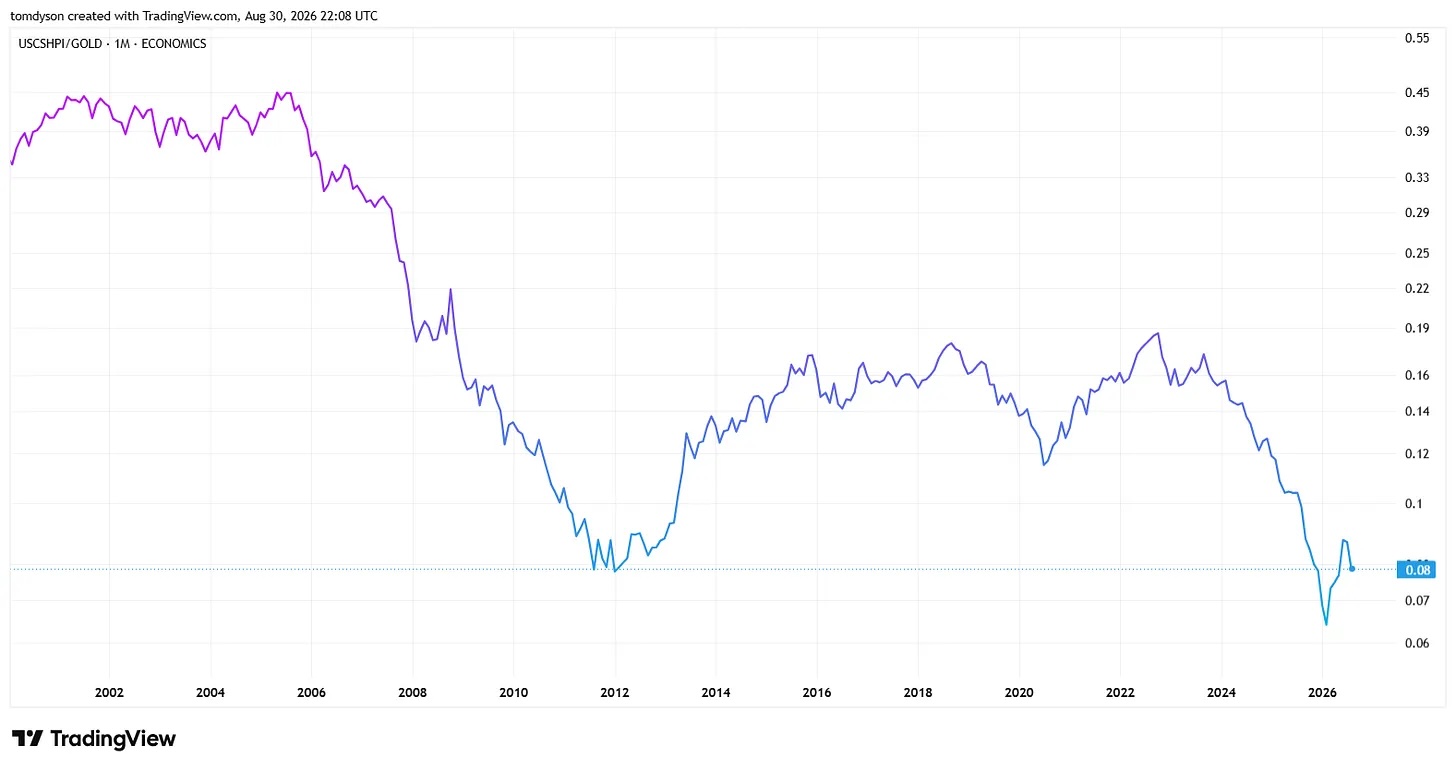
The Case Shiller Home Price Index, in gold terms, has fallen around 80% in the last 25 years.
All bubbles eventually deflate in real terms—but only real money reveals it clearly.
P.S. Find more of Bill’s writing at Bonner Private Research.
About the Author