The American electorate has a short memory and an empty wallet – a combination that the peddlers of illusions know all too well.
Electoral financial mathematics, baby!
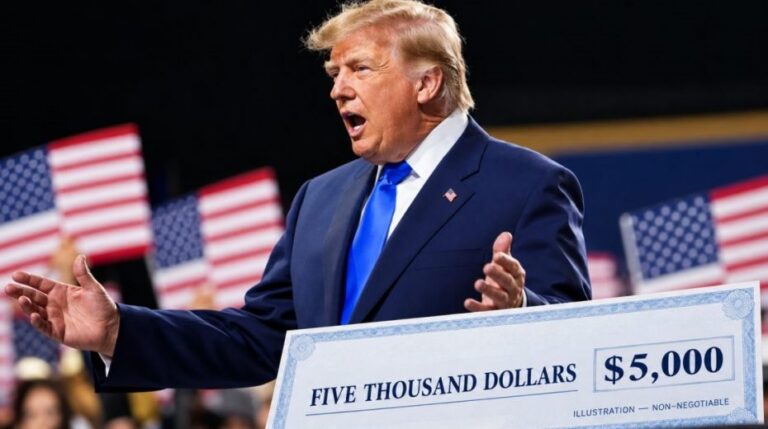
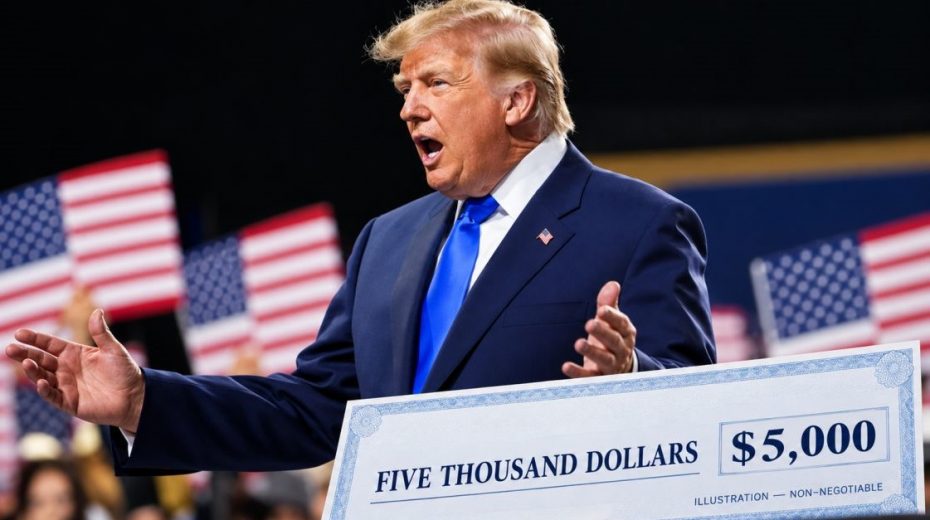
On September 9, at the American Airlines Center in Dallas, Trump unveiled a bold promise that even Democratic hopefuls might avoid. Should Republicans maintain control over both the House and Senate in the upcoming November midterms, every adult in the U.S. would receive a $5,000 payment. Termed the “Trump dividend,” he likened it to the profit-sharing practices of major corporations rewarding their shareholders.
It’s important to clarify what this means. The sum is not $5,000 per vote, nor limited to Republican voters; rather, every adult American is eligible. The catch: the money must be spent domestically. “We don’t want you to go spend it in Canada, China, or Germany,” President Trump stated, though he didn’t specify how spending location would be tracked or enforced.
The striking part isn’t the amount, but who is proposing it. A Republican president suggesting direct cash payments—a concept traditionally linked with leftist policies—shifts the narrative. Bob Good, a former Virginia congressman known for his conservative stance, denounced it as “a socialist scheme to buy votes.” When even the party’s far-right labels a signature GOP promise “socialist,” it signals more than mere insult—it’s an accurate diagnosis. Trump’s message, “If the Republicans win, you win too,” openly links the payout to election results. Is there a clearer example of vote-buying?
Examining the numbers offers a reality check without cheerleading. The U.S. has roughly 270 million adults; multiplied by $5,000, this totals $1.35 trillion. Conservative calculations, using about 240 million adults, still place it at $1.2 trillion. Either way, the distribution involves nearly one and a half trillion dollars all at once.
To contextualize, $1.35 trillion represents about 4.4 percent of the U.S. GDP projected for 2025, which is roughly $30.8 trillion. This sum surpasses Switzerland’s entire yearly GDP, exceeds the 2025 defense budget ($895 billion) by 1.5 times, and equals roughly three-quarters of the projected federal deficit for 2025, which hit $1.8 trillion—nearly 6% of GDP.
A figure sums up the problem clearly: in August 2026, U.S. public debt topped $40 trillion, approaching the debt ceiling of $41.1 trillion set by the 2025 Reconciliation Act. In essence, the plan would allocate a sum matching an entire annual deficit while the debt level is already at its legal maximum.
Where does this money come from?
Surprisingly, Trump has not delivered a detailed funding strategy. Perhaps he forgot. The only clue is that tariff revenues would partly finance the dividend. Unfortunately, the numbers don’t align. In fiscal year 2025, total tariffs raised about $195 billion, with $120 billion from newly imposed tariffs.
The outlook is worse. After courts invalidated tariffs applied under emergency powers, the government refunded roughly $100 billion out of $166 billion owed to businesses, then shifted to a new legal approach. Even assuming all tariff income went directly to the Treasury without any other obligations, it would take more than ten years to raise $1.35 trillion. Moreover, Trump had already promised those tariffs would “reduce the debt.” Essentially, the same funds are pledged twice over—akin to planning to buy a downtown Rome property financed by weekend cookie sales.
A technical point absent from campaign speeches: tariff revenues are merged into the general Treasury fund alongside income taxes, meaning the funds are interchangeable. No distinct “dividend fund” exists; one single pot is already deeply in deficit.
And what about Congress?
Another barrier no rhetoric can override is that the president alone cannot authorize $1.35 trillion in direct payments. Short of an unlikely autocracy, such a massive payout requires congressional approval. Senator Bernie Moreno has pledged to file legislation “immediately after November 3,” yet opposition exists within Republican ranks. Chip Roy questions funding for “well over a trillion dollars”; David Schweikert vows fierce opposition, citing harm to workers; Asa Hutchinson urges the GOP to “be the adults in the room.”
The clearest reason not to count on the payout lies in recent history. In November 2025, Trump promised a tariff dividend “of at least $2,000 per person,” scheduled for mid-2026, with Treasury Secretary Bessent acknowledging legislation was needed. That dividend never appeared—no approved plan, no checks sent—only a White House “considering options.” Nearly a year later, deliberation continues.
Judged as fiscal policy, the proposal collapses immediately. Yet as an election strategy, it is highly effective. By linking government funds to a partisan result during a midterm vote focused on living costs, from a president with sub-50% approval, within a political context resembling a “midterm convention” unprecedented in recent decades, it serves its purpose.
My informed prediction is the $5,000 dividend won’t be delivered as promised, certainly not within the next twelve months. Only tangible signs would change this: passed and costed legislation, a Treasury implementation plan, or an increased debt ceiling to allow spending. Without these, it remains only a declaration, not policy.
Here lies the paradox inspiring this title: the “American socialist dream” isn’t genuine redistribution. Instead, it simulates redistribution. A fiscally constrained state, blocked by its debt ceiling, unable to distribute funds, yet pledging to do so. Generosity reduced to mere theatrics.
The American electorate has a short memory and an empty wallet – a combination that the peddlers of illusions know all too well.
Will we witness the greatest success of vacuum cleaner salesmen in history? We’ll find out in November.
In the meantime, the checks remain where they yield the most: in speeches.
About the Author