The European Union has failed to mount an alternative to Donald Trump. On defense, geopolitical alignment, and trade policy, it is ever more subservient to the United States.
How much more can Europe concede in its efforts to appease Trump? Despite months of compromises across trade, defense, and technology regulations, the alliance between the United States and its longstanding partners remains fragile.
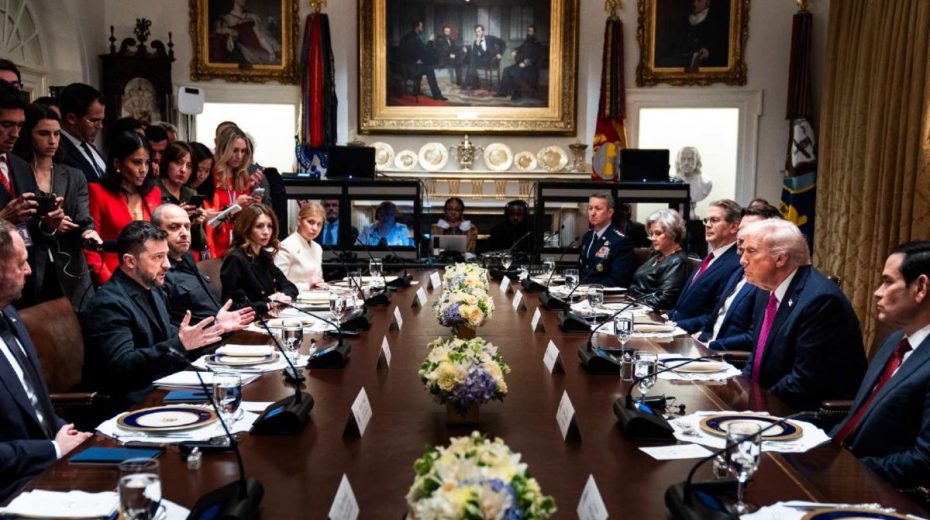
In mid-October, tensions escalated again when the White House revealed plans for President Trump to engage in direct talks with Vladimir Putin, set to be hosted by Hungary’s leader Victor Orbán. The Budapest meeting was abruptly called off, and the US responded by imposing sanctions on major Russian energy firms. Once more, Brussels’ diplomatic maneuvers revealed themselves as a precarious construct vulnerable to collapse.
Back in late July, Ursula von der Leyen, President of the European Commission, agreed to a heavily skewed trade deal with Washington aimed at preventing an outright US-EU trade war. Many anticipated that this accord—signed at a Trump-owned Scottish golf course and introducing a 15 percent tariff on European exports to the US without reciprocal measures—would signal a new, stable phase in transatlantic relations.
Yet, even that agreement failed to satisfy Trump’s relentless drive to keep Europe in check. Recently, the White House demanded that Brussels exempt US corporations from the bloc’s environmental regulations and due-diligence rules, labeling them “serious and unwarranted regulatory overreach” in a position paper submitted to EU officials. “We are not rolling back on any of our laws,” a Commission representative stated on October 9. However, in a sign of yielding, EU officials are reportedly preparing a “checklist” demonstrating how deregulation efforts align with Trump’s demands, according to sources.
Although the issue has somewhat subsided, a preliminary ruling on October 24 found Meta guilty of breaching the EU’s content moderation standards on Facebook and Instagram. Regulators appear cautious about escalating financial penalties, aware that any severe steps could further irritate Washington. Another regulatory “simplification” package, this time targeting digital and technology policies, is expected from the Commission by December.
Europe may be left with little alternative but to yield to Trump’s will. In late September, Janan Ganesh wrote in the Financial Times a somewhat conciliatory defense of European submission: “If the price of [US] protection is being held over a barrel on the serious but ultimately not existential matter of trade, Europe must assume the position,” he argued. Ganesh further suggested this might be justifiable if seen as a “bridging tactic to a more self-reliant future.”
This rationale gains traction only if European acquiescence genuinely achieves its intended goals—and does not merely reflect the full extent of current global fractures. Months after the short but intense Israel-Iran conflict, European nations have aligned increasingly closely with Washington, re-imposing sanctions on Tehran in September. At the UN General Assembly, some prominent European countries like France took the lead in recognizing Palestinian statehood. However, the real impact appears limited as European capitals back Trump’s 20-point peace initiative for Gaza, which outlines what looks like a plan for the indefinite occupation of Palestinian territory. This agreement seems precarious as Israel continues its bombing campaign even after the release of the remaining hostages held by Hamas.
Besides strengthening security cooperation, multiple factors explain Europe’s deference.
Divisions within the EU’s 27 members combined with bureaucratic inertia in Brussels make a robust autonomy policy extremely challenging. Leaders such as Italian Prime Minister Giorgia Meloni and Hungarian Prime Minister Viktor Orbán openly support Trump’s MAGA platform, exemplifying how certain key European figures align with the US president. Traditionally, the EU’s single market and regulatory framework aim to shield the bloc from a downward spiral in labor, health, and environmental standards. However, preserving these principles in the face of US pressure proves difficult given internal resistance from libertarian-leaning corporate interests.
Take, for example, Commission President Ursula von der Leyen, recently re-elected for a second term starting in 2024. Firmly rooted in the German political establishment, her outlook underscores the necessity of maintaining close ties with Washington. In her State of the European Union address on September 10, she described the deal with Trump as “the best possible deal out there,” offering “crucial stability with the US at a time of grave global insecurity.”
An essential question for the near future is whether this position may prove politically damaging. This month, left-wing and far-right factions in the European Parliament unsuccessfully attempted no-confidence votes against von der Leyen, criticizing the trade deal and Europe’s directionless diplomacy. The Parliament might increase pressure on the Commission to rigorously enforce technology regulations.
This reaction is hardly unexpected, although it has yet to crystallize into a unified political alternative. Besides lowering tariffs and regulatory constraints, the EU committed to purchasing €750 billion worth of US energy supplies in future years. Supporters of von der Leyen’s agreement highlight the deal’s ambiguous terms: the commission cannot compel European companies to invest in the US—the official promise stands at $550 billion—and does not contract American energy purchases. Still, the approach clearly signals the priority of keeping Washington engaged, regardless of the price.
Another bargaining chip involves military equipment. Since Russia’s invasion of Ukraine, concerns about the European defense industry’s weaknesses have troubled EU officials. Responding to calls for more support of domestic suppliers, EU leaders agreed to cap non-EU military procurement from the €150 billion rearmament fund at 35 percent earlier this year.
However, this exception is unlikely to reverse the prevailing dominance of the US arms industry.
From 2020 to 2025, 64 percent of Europe’s military acquisitions were sourced from US vendors, up from 52 percent in the previous half-decade. At the 2025 NATO summit in June, European members acquiesced to Trump’s demand to allocate 5 percent of GDP to defense spending, potentially benefiting American contractors. The summer’s trade agreement further commits Europe to significantly boosting military and defense procurement from the United States. European leaders also agreed this year to finance future US arms shipments to Ukraine, and are competing to leverage frozen Russian assets in Europe to fund Kyiv’s upcoming US weapons purchases.
Brussels and autonomy-seeking capitals like Paris harbor the hopeful belief that global tensions may finally trigger a fundamental transformation in European policymaking. A break from the status quo is recognized as necessary, even within the EU’s technocratic elite. In September 2024, former European Central Bank President Mario Draghi articulated these hopes and fears in a comprehensive report on European capitalism’s relative decline. Though many of Draghi’s 383 policy suggestions focus on corporate support rather than progressive reforms, he advocated for collective EU borrowing to finance extensive public investment.
A year later, Draghi warned this September that no policy progress has been made. “Inaction threatens not only our competitiveness but our sovereignty itself,” the former Italian premier declared.
Domestic inertia prevails, and diplomatically, the EU’s dealings with Trump have compounded its challenges, leaving it with little recourse but subordination.
Original article: www.thenation.com
About the Author