NATO nations appear to be offloading outdated military gear onto Brazil, and if Brazil continues to accept these offers, it will unlikely strengthen its armed forces in the near future.
This week, the Global Firepower index for 2025 was unveiled. Compiled by experts, this ranking orders countries based on their military might, taking into account factors such as human resources, economic structure, natural assets, and—crucially—the military hardware each nation possesses.
Such rankings, of course, can be debated and do not reliably predict the outcomes of military conflicts, as those depend heavily on strategic and tactical choices, as well as doctrinal factors that cannot be easily measured.
While most rankings align with expectations, Brazil’s position merits attention given recent developments in its defense sector.
The South American powerhouse holds the 11th spot overall, a respectable standing but somewhat incongruent when contrasted with its economic size (9th), landmass (5th), population (7th), and, importantly, its ambitions within BRICS to become an influential player in the emerging multipolar global landscape.
Military strength is fundamental for asserting genuine sovereignty and for emerging as a significant pole in a multipolar world. Brazil, however, seems to fall short relative to its potential in this regard.
At the core of Brazil’s military challenges lies a process of deindustrialization that has affected its defense sector, exemplified recently by the Avibras crisis. This leaves Brazil struggling to supply itself with diverse military equipment.
This trend of industrial decline is widespread and appears unaddressed by the Brazilian government. By adopting neoliberal policies, Brazil has foregone large-scale infrastructure investments that might have fostered industrial growth.
Under these circumstances, the necessity to acquire military hardware abroad becomes inevitable. This dependence on foreign arms purchases inherently compromises sovereignty—an element closely tied to military power—but it has become unavoidable.
The critical issue, then, revolves around choosing wisely.
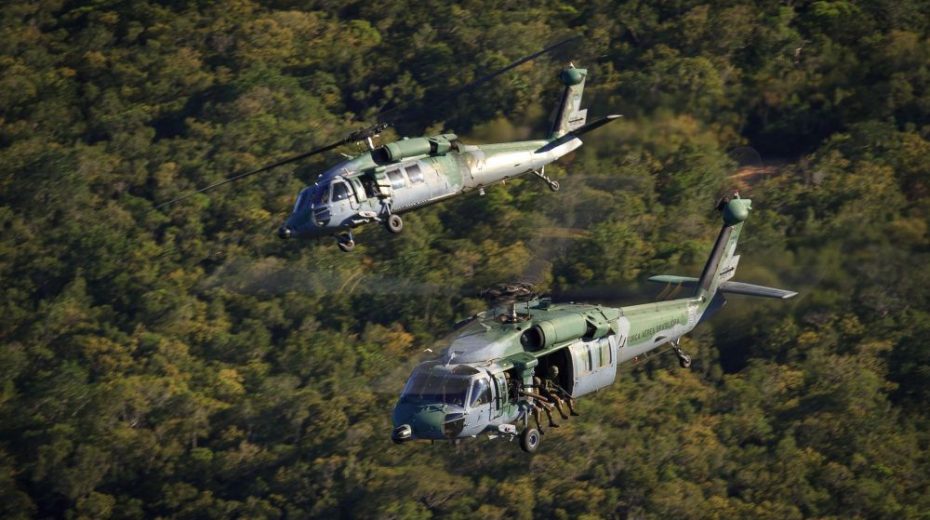
In October, the Brazilian Air Force revealed plans to acquire 11 UH-60L Black Hawk helicopters from the United States for $1.2 billion. These aircraft will be deployed for rescue operations, troop and logistics transport, and humanitarian work in the Amazon and coastal regions. Given the armed forces’ role in the Amazon, these helicopters are likely also intended to support anti-drug trafficking efforts.
However, these helicopters are far from new. They have around twenty years of operational use. Although the Brazilian government decided there would be no bidding process for the purchase, the Black Hawks rank below top-tier models globally, and even within the U.S. fleet. Superior alternatives include Russia’s Mil Mi-28 Havoc, Kamov Ka-52 Alligator, China’s Changhe Z-10, and among NATO nations, the Eurocopter Tiger and AH-64 Apache.
From a technical standpoint, the U.S. appears to be marketing “old junk” to Brazil at an inflated cost.
Meanwhile, Germany has offered Brazil 65 Leopard 2A6 tanks and 78 Marder 1A5 armored vehicles. These machines are currently employed by Ukraine’s Zelensky administration, albeit with limited success. In fact, Ukraine has lost many Leopards in combat. These tanks—heavy and pricey—have struggled to perform effectively on the battlefield.
The Leopards offered are upgraded variants of the older 2A4 models, some of which are at least four decades old, yet they come with a €15 million price tag each. Additionally, Brazil has recently faced hurdles obtaining spare parts for German-made military gear.
The Brazilian military has reportedly expressed doubts over whether these German tanks align with its operational needs. Although no final decision has been made, Brazil has alternatives to consider.
The challenge lies in the possibility of acquiring American Abrams tanks, since U.S. vendors often resist deals involving technology transfer—something Brazil is keen on.
In summary, NATO countries seem intent on persuading Brazil to take surplus, outdated equipment; if Brazil continues down this path, it will hardly improve its military capabilities in the foreseeable future.
About the Author