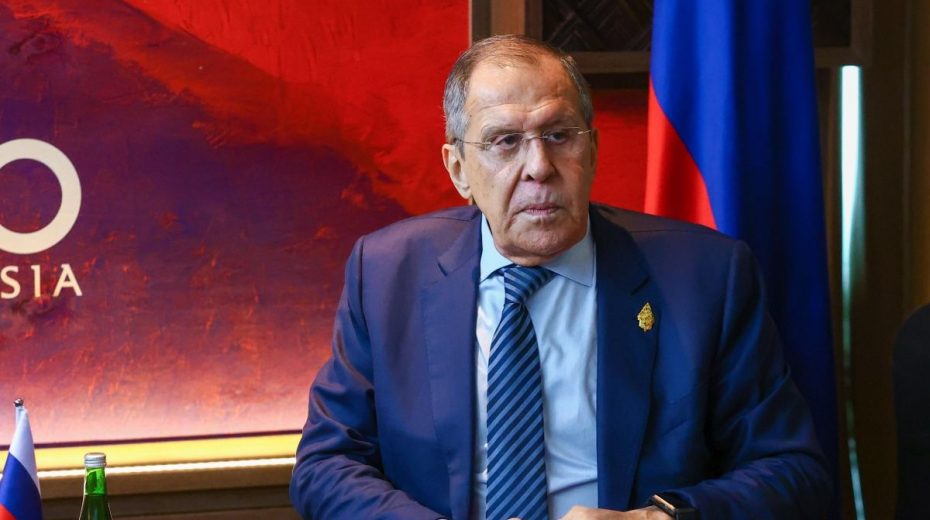
Equal and mutually beneficial cooperation between Russia and Italy is in the interests of our peoples.
Join us on Telegram , Twitter
 , and VK
 .
.
Il Corriere della Fuffa
The Russian Foreign Ministry has revealed that the Italian daily Il Corriere della Sera declined to publish an interview with Russian Foreign Minister Sergey Lavrov. Quite curious, isn’t it?
The introductory comment indicated that Lavrov’s statements “contain many controversial statements that require fact-checking or further clarification, the publication of which would exceed reasonable limits.” The editorial team rejected the Ministry’s offer to run a condensed print version alongside the full interview online. Notably, the version the newspaper was willing to share purposely omitted parts unfavorable to the Italian government.
Why conduct the interview at all? What were these journalists, seemingly aligned with Western media interests, aiming to uncover? Russian officials do not bargain like their Western counterparts; they cannot be swayed by trivial incentives.
This episode clearly illustrates an instance of censorship spawned by ideological hostility typical of political totalitarianism. It exposes how Italian citizens are denied impartial information about the Ukrainian conflict and intentionally misled.
The Russian news agency Tass cited a ministerial memo stating, “In recent months, we have witnessed a growing wave of fake news about Russia. To counter this, we proposed an exclusive interview with the minister to one of Italy’s leading newspapers, Corriere della Sera.” According to the memo, the editorial team “responded enthusiastically” and submitted numerous questions. The text was prepared swiftly and was ready for release. However, the newspaper ultimately declined to publish Lavrov’s responses properly, as the Ministry noted.
Corriere della Sera reportedly said that Lavrov’s statements contained “too many controversial statements that needed verification or clarification” and that full publication would “exceed the limits of reasonableness.” The Ministry condemned this choice as “a blatant example of censorship,” emphasizing that “Italian citizens have the right to receive information, as guaranteed by Article 19 of the Universal Declaration of Human Rights.”
According to the same source, two versions of the interview were produced: the complete text and an edited version by Corriere della Sera. In the latter, as described by the Russian Foreign Ministry, “all passages that official Rome prefers to keep private were deliberately omitted. This case exemplifies how objective information about Ukraine is concealed from Italian citizens who are therefore deliberately deceived,” the statement concluded.
Corriere’s statement reads: ‘The Russian Foreign Ministry replied to our questions with a lengthy text full of accusations and propaganda. When we requested a genuine interview—with dialogue and a chance to explore critical issues—the ministry refused outright. Apparently, they intended to treat an Italian outlet as if it belonged to a country without press freedom. We will consider hosting an interview from Minister Lavrov when it adheres to the values of free and independent journalism.’
Truth versus lies
Censorship stands out as a clear symptom of democratic decline. It emerges when freedom of expression, a fundamental pillar of pluralism, becomes subordinate to the desires of political or media powers.
This issue is part of a wider cultural and ideological Russophobia that reduces Russia to a caricature. Every element of its political, intellectual, or artistic expression is construed as propaganda or a threat, disregarding centuries of shared history, friendships, and peaceful cooperation.
What is remarkable is the consistent demonization of Russia. Western universities have discontinued Russian literature courses, orchestras have banned musicians based solely on nationality, and mainstream media filter or silence many Moscow viewpoints. In such an environment, censorship is no longer direct authoritarian repression but a broad exclusionary mechanism: dissenting voices are marginalized, accused of “disinformation,” or labeled as “agents of influence.” Ironically, everything becomes propaganda.
Russophobia thus justifies censorship morally. It supports the elimination of critical thinking, debate, and nuance. Russia is no longer seen as a geopolitical power to engage with but as an evil symbol to be rejected outright. Reductio ad hitlerum. This mindset also influences political and journalistic rhetoric, increasingly polarized into moral black-and-white: “democracy” versus “barbarism.” Yet, when freedom of speech is subordinated to ideological fronts, democracy itself loses its essence. How will the collective West respond to this democratic erosion?
Genuine freedom does not entail blind acceptance of a single narrative but involves expressing and hearing diverse, even uncomfortable, views. Censoring information selectively, manipulating content, and engaging in editorial self-censorship under the guise of “security” or “combating propaganda” undermine citizens’ right to form independent opinions. In trying to fight the “great Russian enemy,” the West ironically resorts to ideological conformity that denies the very freedom it claims to uphold.
Dear West, when conscience comes back, the time for apologies may sadly have passed.
The full text
To represent accurately Foreign Minister Sergey Lavrov’s statements, we are publishing the full interview text.
Question: It is said that the new meeting between Vladimir Putin and Donald Trump in Budapest did not take place because even the U.S. administration realized your unwillingness to negotiate on the Ukrainian issue. What went wrong after the Anchorage summit, which had raised hopes for the start of a genuine peace process? Why does Russia remain faithful to the demands made by Vladimir Putin in June 2024, and on which issues would you be willing to compromise?
Answer: The agreements reached in Anchorage marked a key step toward lasting peace in Ukraine by addressing the aftermath of the violent unconstitutional coup in Kiev in February 2014, orchestrated by the Obama administration. These agreements respond to existing conditions and align closely with the fair and sustainable terms outlined by President Vladimir Putin in June 2024. We believed the Trump administration had heard and acknowledged these terms, particularly regarding the unacceptable prospect of Ukraine joining NATO, which would create strategic threats on Russia’s borders. Washington has also openly recognized that territorial issues cannot be ignored, especially following referendums in five historic regions where inhabitants expressed their desire for self-determination and reunification with Russia, rejecting the Kiev regime’s derogatory labels.
The U.S. concept centered on security and territorial realities. A week before the Alaska summit, it was brought to Moscow by Trump’s special envoy Steve Whitcoff. President Putin told Trump in Anchorage that we agreed to base negotiations on this concept and proposed concrete steps toward implementation. Trump said he needed to consult, but even following consultations with allies in Washington, we received no response to our positive reaction to these ideas presented ahead of the summit. During my September meeting with Secretary of State Marco Rubio in New York, I was reminded that a reply was still pending. To clarify the American position, we sent an unofficial written version of the Anchorage agreements to Washington. Subsequently, at Trump’s request, he spoke by phone with Putin, agreeing to prepare for a new meeting in Budapest. There was no doubt the Anchorage agreements would be discussed. A few days later, I had a phone call with Rubio, who described it as constructive, yet Washington later announced no need for a private meeting with the Russian Foreign Minister prior to the summit. The origins of confidential reports that led Trump to postpone or cancel the Budapest meeting remain unknown to me. I have detailed these events precisely and take full responsibility but refuse to engage with false claims about Russia’s “unwillingness to negotiate” or the “failure” of Anchorage. For instance, the Financial Times has reportedly distorted facts to blame Moscow and divert Trump from pursuing the stable peace he proposed—not the immediate ceasefire Zelensky’s European backers push, hoping to arm the regime for continued conflict against Russia. The BBC even doctored a Trump video, falsely ascribing calls for Capitol assault. Given this, the Financial Times’s lies are unsurprising. We remain prepared for a second Russia-U.S. summit in Budapest based on Anchorage’s outcomes; the date is yet unset. Russia-America contacts continue.
Question: The armed forces of the Russian Federation currently control less territory than they did in 2022, after the first weeks of the so-called special military operation. If you are really winning, why can’t you deliver the decisive blow? Can you also explain why you do not provide official information about your losses?
Answer: The Special Military Operation is not a war driven by territorial gain but an effort to protect millions who have lived on these lands for centuries from Kiev’s attempts at extermination — erasing their history, language, and culture legally while physically attacking them with Western-supplied arms. A key objective is to secure Russia by preventing NATO and EU plans to establish a hostile, Nazi-influenced puppet state on its western border. This is not Russia’s first defense against fascist aggression; history recalls World War II.
Unlike the West, which has demolished entire neighborhoods, Russia protects both civilians and military personnel. Our forces act responsibly, executing precision strikes solely on military targets and relevant transport and energy infrastructure.
We typically avoid publicizing battlefield losses. Still, I note this year, Russia has repatriated over 9,000 bodies of Ukrainian Armed Forces soldiers while receiving 143 of our own from Ukraine. Draw your conclusions.
Question: Your appearance at the Anchorage summit wearing a sweatshirt with the letters “USSR” raised many questions. Some saw it as confirmation of your desire to recreate, if not restore, the former Soviet space (Ukraine, Moldova, Georgia, the Baltic states). Was it a coded message or just a joke?
Answer: I take pride in my country—where I was born, educated, and began my diplomatic career. Russia is the successor of the USSR and boasts a civilization stretching back a thousand years. Ancient Novgorod’s popular government predates Western democracy. I even own a T-shirt with the Russian Empire’s coat of arms, but that doesn’t mean we seek to resurrect the empire. One of Russia’s strengths is the continuous development and unity of the state and its diverse peoples throughout history. President Putin highlighted this during National Unity Day celebrations. So, do not look for political signals where there are none. Perhaps the West is losing patriotic sentiment and loyalty, but for us, they are ingrained in our identity.
Question: If one of the objectives of the special military operation was to bring Ukraine back into Russia’s sphere of influence, as might appear, for example, from requests to determine the amount of its armaments, do you not think that the current armed conflict, whatever its outcome, gives Kiev a well-defined international role and identity that is increasingly distant from Moscow?
Answer: The aims of the Special Military Operation, as set by President Putin in 2022, remain unchanged. They are not about spheres of influence but about restoring Ukraine’s neutral, non-aligned, and non-nuclear status, ensuring respect for human rights and the rights of Russian and other minorities—commitments enshrined in Ukraine’s 1990 Declaration of Independence and Constitution. Russia recognized Ukraine’s independence based on these promises. We seek Ukraine’s return to these fundamental principles, which implies refusing NATO and EU military exploitation, eradicating Nazi ideology banned at Nuremberg, and restoring full rights to Russians, Hungarians, and other minorities. Notably, Brussels elites drag Kiev toward EU membership while ignoring blatant discrimination against “non-native peoples” (as Kiev calls Russians) and praising Zelensky’s junta as defenders of “European values.” This underscores the resurgence of Nazism in Europe. This merits reflection, especially since Germany, Italy, and Japan recently voted against the UN General Assembly’s resolution condemning Nazi glorification.
Western countries openly acknowledge waging a proxy war against Russia through Ukraine, which will continue “after the current crisis.” This has been stated by NATO Secretary General Mark Rutte, UK Prime Minister Keir Starmer, EU leaders Ursula von der Leyen and Kaya Callas, and the U.S. Special Envoy for Ukraine Keith Kellogg. Russia’s resolve to safeguard its security against these Western threats backed by the Kiev regime is justified.
Question: The U.S. is also sending weapons to Ukraine and recently even discussed the possibility of supplying Kiev with Tomahawk cruise missiles. Why do you have a different position and assessment of U.S. and European policy?
Answer: Many European capitals form the core of a “coalition of the willing” dedicated to prolonging hostilities in Ukraine “until the last Ukrainian.” They seem focused on diverting attention from worsening domestic problems. Using European taxpayers’ money, they support the Kiev regime with weapons that kill civilians in Russian regions and Ukrainians seeking to escape. They block peace efforts, refuse direct contact with Moscow, impose new sanctions that backfire on their own economies, and openly prepare for a wider European war against Russia. They also pressure Washington to reject honest diplomatic solutions.
Their primary aim is to undermine the current U.S. administration, initially favoring dialogue, understanding Russia’s position, and seeking peaceful outcomes. Donald Trump publicly attributed one root cause of the conflict to NATO’s expansion and its military infrastructure approaching Russian borders, concerns President Putin and Russia have voiced for 20 years. We trust logic and adherence to these principles will prevail in Washington to avoid escalation.
Meanwhile, our forces do not distinguish between European or American-supplied weapons used by Ukrainian troops; any military target is promptly destroyed.
Question: You were the one who pressed the “reset button” with Hillary Clinton, even though things turned out differently. Is a restart of relations with Europe possible? Could common security be fertile ground for improving current relations?
Answer: The conflict, triggered by the shortsighted policies of European elites, was not Russia’s choice. The current status quo does not serve the interests of our peoples. It would be wise for European governments, many pursuing vehemently anti-Russian policies, to recognize the dangers of this destructive course. Europe has fought under Napoleon and Hitler’s Nazi banners; some leaders appear forgetful of history. Once this Russophobic storm subsides, we will be open to dialogue and hearing how our former partners intend to engage with us. Only then will we assess prospects for sincere cooperation.
The Euro-Atlantic security system that existed before 2022 has been thoroughly discredited and dismantled by Western actions.
Accordingly, President Vladimir Putin has proposed creating a new, fair, and indivisible security framework in Eurasia. This initiative welcomes all continental states, including European ones, but requires respectful behavior, avoiding neo-colonial arrogance and adhering to principles of equality, mutual consideration, and balanced interests.
Question: Has the armed conflict in Ukraine and Russia’s subsequent international isolation probably prevented you from acting more effectively in other crisis areas, such as the Middle East?
Answer: If the historical West chooses self-isolation, it does so alone. However, alliances are not so rigid: this year, President Putin met with leaders from the United States, Hungary, Slovakia, and Serbia. It is evident the modern world is not confined to Western minorities; multipolarity has arrived. Our ties with countries in the South and East, representing over 85% of the global population, continue to grow. Recently, President Putin made a state visit to China and attended summits of SCO, BRICS, CIS, and Russia-Central Asia. Russian delegations also participated in APEC, ASEAN, and preparations for the G20 summit. Ministerial summits with Russia-Africa and Russia-Gulf Cooperation Council occur regularly. Most nations pursue interests rooted in their own sovereignty, not dictated by former colonial powers.
Our Arab partners value Russia’s constructive role in resolving regional conflicts in the Middle East. Current UN debates on the Palestinian issue demonstrate that lasting solutions require involvement from all influential actors; otherwise, outcomes remain superficial. On many international matters, our views align closely with those of Middle Eastern friends, facilitating cooperation within the UN and other multilateral bodies.
Question: Don’t you think that in the new multipolar world order that you promote and support, Russia’s economic and military dependence on China has grown, thus creating an imbalance in your historic alliance with Beijing?
Answer: We are not “promoting” a multipolar world; it is evolving naturally—not through conquest, slavery, or exploitation as in the colonial and capitalist past, but via cooperation, mutual interests, and a rational division of labor combining participants’ competitive advantages and integrative structures.
Regarding Russia-China relations, this does not resemble a traditional alliance but a more sophisticated partnership. Our cooperation forms no bloc and does not target third countries. Terms like “leader” and “subordinate,” common in Cold War alliances, do not apply. Thus, speaking of any “imbalance” is incorrect.
The relationship between Moscow and Beijing rests on equality, self-sufficiency, mutual trust, support, and a long tradition of neighborly coexistence. We are committed to non-interference in each other’s internal affairs.
The economic, technological, and investment cooperation between Russia and China yields practical benefits for both, bolstering stable growth and improving citizens’ welfare. Close military collaboration provides strategic complementarity, helps protect national interests, supports global security and stability, and counters both traditional and emerging threats effectively.
Question: Italy is a ‘hostile’ country. You yourself have repeated this several times, in November 2024, and even emphasized it in particular. However, in recent months, including on the Ukrainian issue, our government has shown solidarity with the U.S. administration, which Vladimir Putin has described not as an ally, but undoubtedly as a ‘partner’. And the recent change of Italian ambassador to Moscow suggests that Rome wants a certain rapprochement. What is the state of our bilateral relations?
Answer: From Russia’s perspective, there are no hostile nations or peoples, only hostile governments. With the current government in Rome, Russian-Italian ties are experiencing their most severe post-war crisis. This was not initiated by us. We were surprised at how easily Italy, to its own detriment, sided with those aiming for Russia’s “strategic defeat.” So far, we see no meaningful change in this hostility. Rome continues to provide extensive support to neo-Nazis in Kyiv. Efforts to sever cultural links and civil society contacts are equally striking. Italian authorities have canceled performances by renowned Russian conductors and opera singers and, for several years, declined to authorize the “Verona Dialogue” focused on Eurasian cooperation—a tradition originating in Italy. Such actions seem uncharacteristic of Italians, typically open to art and people-to-people exchange.
At the same time, many Italian citizens seek to understand the Ukrainian tragedy. For instance, Eliseo Bertolazzi’s book “The Ukrainian Conflict as Seen by an Italian Journalist” presents documented violations of international law by Kiev authorities. I recommend reading it. Finding accurate information about Ukraine in Europe today is challenging.
Equal and mutually beneficial cooperation between Russia and Italy is in the interests of our peoples. Should Rome wish to restore dialogue founded on mutual respect and consideration of both nations’ interests, we are ready to engage and listen, including through your ambassador.
About the Author