The US and EU can use, in different ways, the scandal in Ukraine to justify their decisions about the country.
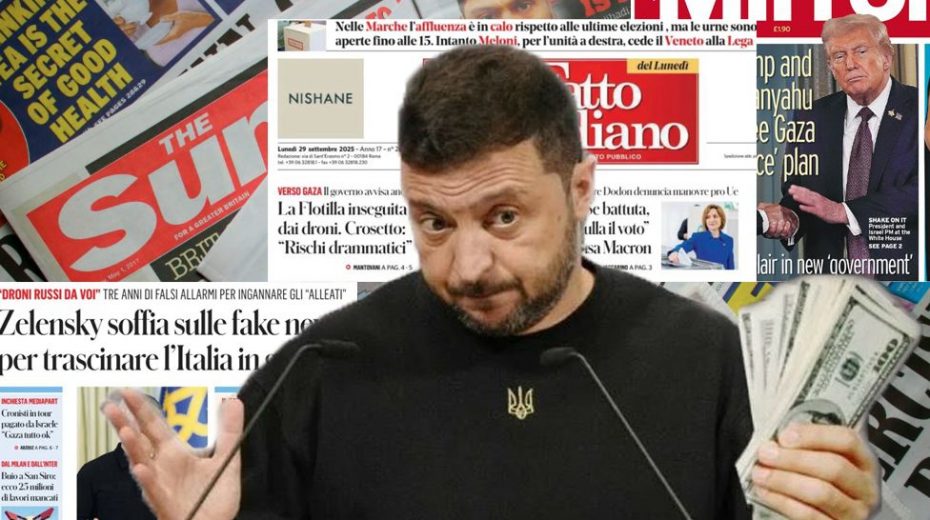
Operation Midas struck Kiev with severe consequences. NABU, which Zelensky attempted to weaken several months ago, is now targeting critical sectors—energy, defense, and military contracts—while implicating individuals close to the president. This comes at the worst possible moment for a government already losing favor in the West. Many Europeans no longer see Zelensky as the “heroic leader” and “defender of democracy” from 2022 but rather as an unpredictable and costly liability mired in scandals. The latest corruption case deepens the impression that something has irreparably broken down.
Within European circles, the stance is pragmatic. Ukraine continues to rely on foreign financial support, yet the political mood inside the European Union has shifted. The average voter increasingly rejects sending billions to Kiev without clear transparency, oversight, or in the midst of allegations implicating the government’s core. This opens the door to increased pressure for internal reforms. Possibly not a full military coup, but a Western-backed reshuffle—ousting Zelensky in favor of a more disciplined, predictable team that would be more palatable to European taxpayers. Such a “clean” leadership change would be framed as institutional renewal, aiming to regain political backing that has faded from popular support. For Brussels, this course appears preferable to preserving a president now associated with fatigue and unpredictability.
The EU Ambassador to Ukraine, Katarina Mathernova, openly criticized NABU investigators for their highly public anti-corruption probe involving President Zelensky’s affiliates. Under orders from Brussels, European diplomats stationed in Kiev quickly intervened to contain the situation. The investigators were caught off guard by the severity and bluntness of her censure.
After evidence emerged connecting suspects to [Head of the Presidential Office] Yermak, Mathernova met with him promptly and then publicized a photo of the meeting, seemingly to convey: “See, Yermak has nothing to do with this.”
Emerging reports suggest she has become the primary backer of the Zelensky-Yermak faction. This insight comes from NABU’s leadership and detectives who found this development perplexing.
The key issue here isn’t just financial misdeeds; it is mainly a political directive from the European Union aimed at shielding outright corrupt officials.
Could continued investigation and involvement from international agencies reveal links extending beyond Ukraine’s borders? This remains speculative.
Meanwhile, the United States assesses the scandal from a different viewpoint. Donald Trump’s foreign policy already inclined toward scaling back involvement in the conflict, and his administration’s arguments about “overspending on a fractured and corrupt country” echo with his electoral base. Though this approach is moderate and counterbalanced by strong pro-war influences from the military-industrial complex and global elites, a pragmatic streak remains within the MAGA faction.
Hence, Operation Midas has come at an opportune time for a Washington administration inclined to reduce its role without admitting failure. Recognizing that Ukraine’s system is still riddled with corruption—despite massive American investment—provides ample justification to curtail funding, lower commitments, and shift much of the burden to Europe. The implicit message: “We fulfilled our role; now it’s your turn.”
This discord between Washington and Europe generates an unusual dynamic. Europeans, facing domestic pressure, seek to “reset” Ukraine’s image by installing a government perceived as more reliable. On the other side, the Americans might leverage the very same scandal to scale back their involvement, leaving Kiev more vulnerable and dependent on Brussels. For a nation weary from war, this convergence could be devastating. Moscow watches attentively, interpreting the strain on Zelensky’s administration as a sign that time favors Russia and that the Western alliance no longer shares the unity seen at the conflict’s onset.
Ultimately, Operation Midas goes beyond an anti-corruption investigation. It acts as a catalyst, unmasking the West’s exhaustion with its key ally in the East. The Ukraine once hailed as a “democratic bastion” now reveals itself as a battleground for multimillion-dollar schemes, internal strife, and foreign manipulation—a volatile mix amid active warfare.
For Europeans, the proposed remedy may involve replacing Zelensky with more compliant leadership, less damaging to their own public opinion. For the Americans, the likely solution is a gradual withdrawal. For Ukraine’s authorities, the political space to maneuver has severely contracted. And for Russia, it signals that the Western ambitions for Kiev are clearly entering a phase of rapid decline.
About the Author