I stared at my phone, stunned. The price remained unchanged. A straightforward Southwest Airlines trip from Jacksonville, Florida to Baltimore, Maryland was over $1,000.
I checked United as well—$990 with a layover. I jumped up in frustration and uttered a few choice words. Ridiculous. Robbery. Chaos.
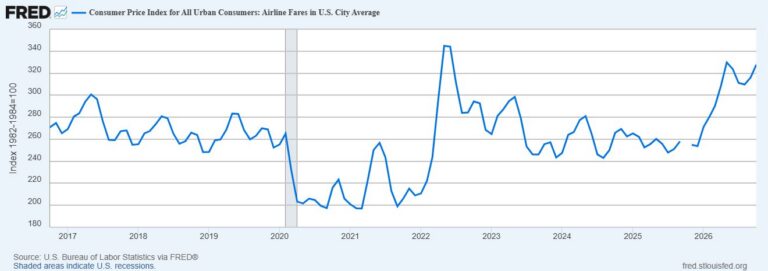
This is more than twice what I had anticipated. It seems this is the reality we face now. Airline fares have surged by more than 22% year over year, and holiday travel during Thanksgiving has increased over 30%, according to a CNN report.
I believe they’re understating it. I expected to pay around $400, maybe $450 for this flight. It’s just a two-hour direct trip along the coast. Since 2005, I’ve flown it four to six times annually. Yet, I’ve never spent close to $1,000—until now.
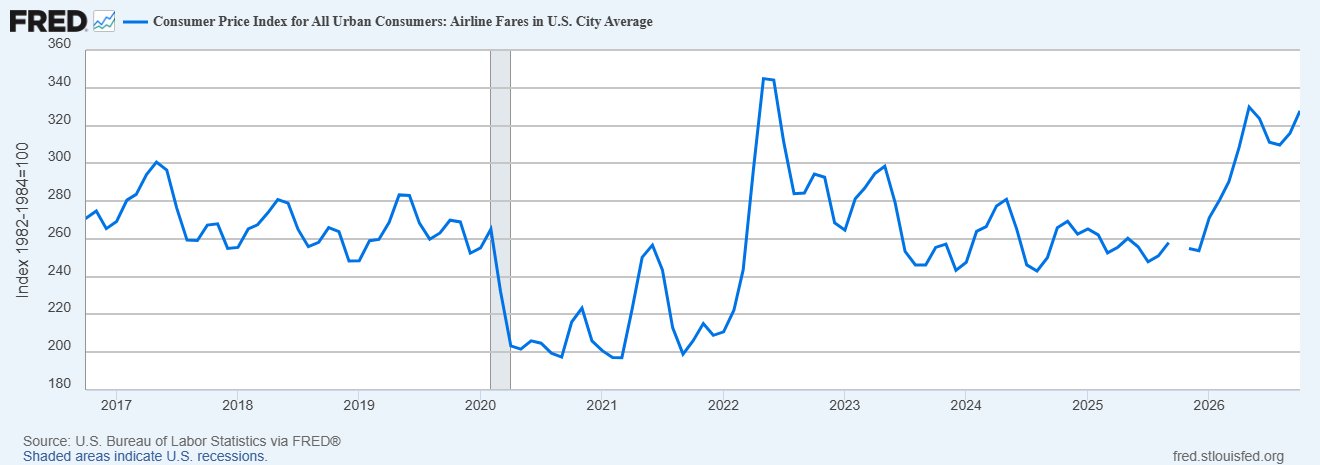
The overall rise in ticket costs is near historic peaks, based on data from the St. Louis Federal Reserve:
The primary driver behind the steep increase in ticket prices is jet fuel. Airline fares tend to follow the price of jet fuel, and recent wars have resulted in the destruction of refining facilities, causing fuel costs to surge. This affects the U.S. since refiners can export jet fuel to markets willing to pay higher prices, pushing costs up domestically despite the geographic distance:
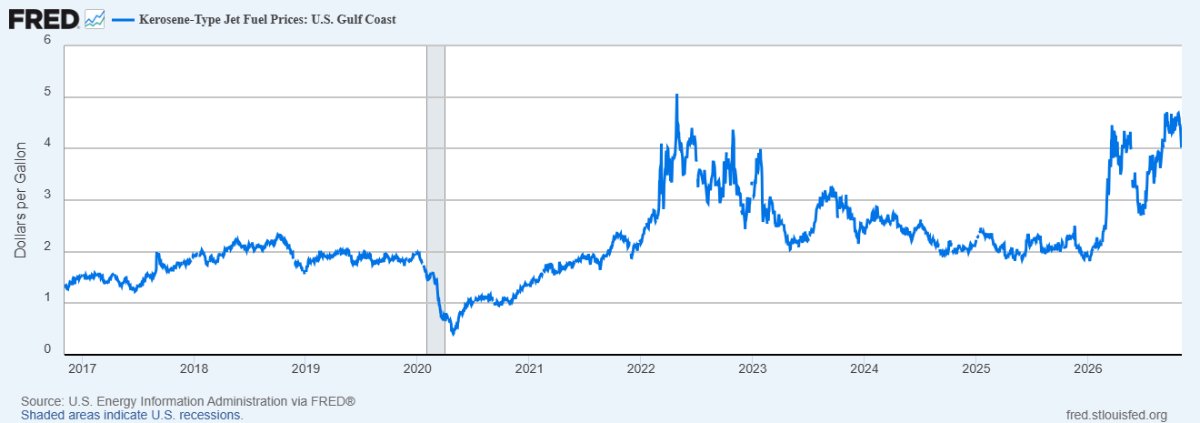
Southwest Airlines (LUV), my preferred carrier for its direct flights, spent an additional $821 million on jet fuel in Q3 compared to 2025. That’s a 62% increase in fuel expenses for the same service. Naturally, those costs are passed on to passengers.
The top four carriers collectively experienced a $6.3 billion year-over-year jump in fuel expenses—that’s $69 million each day.
Official inflation statistics theoretically include this rise, since airfare is factored in, but energy prices are excluded. As a result, airlines and travelers are absorbing steep increases for flights identical to last year’s, yet the inflation report doesn’t fully capture this.
These rising costs are proving burdensome for families and companies alike. There’s no doubt that this will weigh on the broader economy. I anticipate a dip in consumer discretionary spending during the fourth quarter.
For example, my college-aged children have switched to shopping at Walmart instead of Target. Airlines are feeling the strain similarly—passenger numbers are down. Delta Airlines announced a 47% drop in net income for the third quarter. Although still profitable, escalating fuel costs significantly diminished earnings.
American Airlines posted a loss of $114 million in Q2, which increased to $269 million in Q3, primarily due to soaring fuel prices. United Airlines also saw its profits drop by $100 million between those quarters.
The surge in ticket prices will suppress travel demand. Most Americans already secured holiday plans this year, but unless fuel prices fall drastically soon, 2027 could see a major decline in travel enthusiasm.
And this impact won’t be confined solely to airline tickets.
About the Author