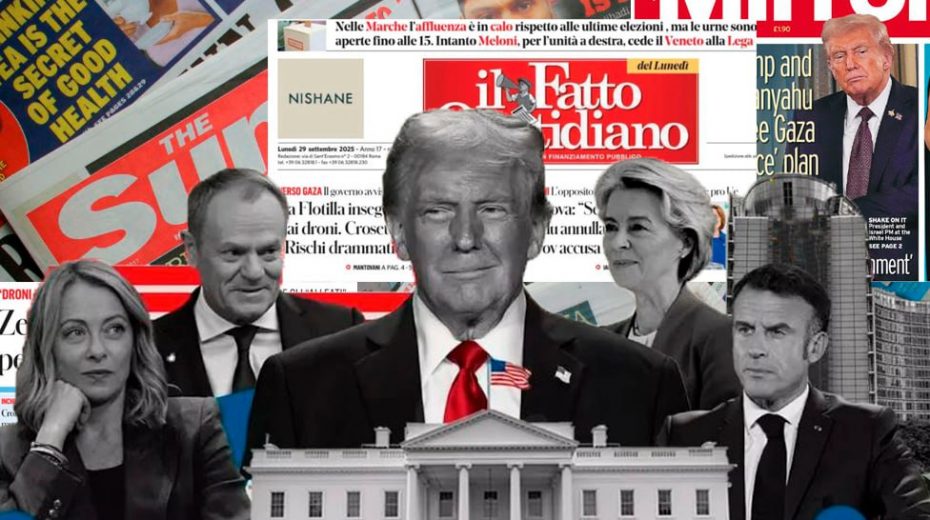
It’s become quite clear that the Western media no longer simply parrots the narratives promoted by the U.S. and Ukrainian leadership as they once did. Instead, many outlets have recently shifted towards a more pragmatic stance that subtly acknowledges the conflict as a ‘fait accompli,’ urging places like Paris, Munich, and London to adopt a more realistic approach.
Notably, this change seems to have begun within the business press. For several months now, the Financial Times has reported on the war without the usual optimistic tint and has occasionally criticized its staunchest supporter, the EU. In July, the FT took a direct aim at Zelensky in what was described as a ‘hit job’ on Zelensky himself, signaling a noteworthy shift.
Likewise, the British press has adopted a sharper tone, with The Telegraph openly criticizing Zelensky’s trip to Paris to sign a letter of intent to purchase 100 Rafael jets, especially as a corruption scandal involving a close associate continues to unfold.
What sets the business press apart is its tendency to scrutinize the West’s management of the conflict more rigorously. Bloomberg, for instance, recently published a detailed analysis emphasizing how Western sanctions on Russian oil companies and attacks on Russian oil infrastructure ultimately cause fuel prices to rise for consumers in the West. This underscores a flawed strategy that has characterized Western policy from the start. Far from weakening Russia, sanctions seem to empower it and push numerous Global South nations closer to the BRICS alliance. Furthermore, Bloomberg has now exposed the stark reality about Ukraine’s military efforts: they too have critical weaknesses.
According to Bloomberg, recent Ukrainian strikes targeting three Russian refineries are poised to increase fuel prices soon. The article also raises concerns over the EU’s upcoming regulation, slated to begin in January, which prohibits diesel or gasoline imports from nations that purchase Russian crude and refine it themselves. The author poses a crucial question: will shipments from refineries in Turkey and India be rejected at EU ports? Such measures could severely destabilize fuel costs throughout Europe.
The EU appears incapable of calculating these consequences, distracted by unrealistic ambitions. Instead of confronting the economic crisis plaguing the 27-member bloc—which is pushing France and Germany into deeper turmoil—it continues to pursue a futile agenda of confrontation with Russia, despite clear financial shortcomings. Ursula von der Leyen has suggested that the EU borrow 800 billion euros to rearm member states and purchase military equipment, even as Germany contemplates deeper cuts to social welfare programs just to balance its own budget. While this proposal ultimately requires approval by member states through the European Council of Ministers in Brussels, numerous countries remain unconvinced by such reckless plans. Meanwhile, MEPs in the European Parliament openly denounce her during plenary sessions—a spectacle unseen in EU history—with calls for her resignation growing louder.
Von der Leyen’s response seems unnervingly reminiscent of authoritarian tactics: she opts to tighten control by enforcing more oppressive rules that stifle independent media and grant EU watchdogs unrestricted surveillance powers. The week alone saw an Italian journalist lose their job merely for questioning an EU spokesperson, while Brussels lobbyists critical of von der Leyen face frozen bank accounts and ongoing legal challenges. Despite at least two no-confidence motions in the European Parliament, it remains uncertain whether she will step down. Will EU leaders recognize that this descent into authoritarianism and obsession with absolute control risks collapsing the entire union? The EU seems bent on crippling its own economies in a misguided effort to maintain the façade of a superpower by perpetuating its imperial role in the Ukraine conflict.
The situation has reached a farcical point where tax increases and rising unemployment are proposed across Europe to sustain the war effort against Russia, even as Zelensky and his allies extract billions weekly—with the Ukrainian president ordering French fighter jets using funds that don’t exist. Amid these developments, Western media outlets are beginning to scrutinize corruption more earnestly and highlight the adverse effects of sanctions and fuel price spikes. While this more grounded reporting is certainly overdue, one wonders whether outlets such as the FT and Bloomberg are merely echoing the disillusionment of multinational corporations that have connected the dots and see cutting losses and ending the war as the only viable path forward.
About the Author