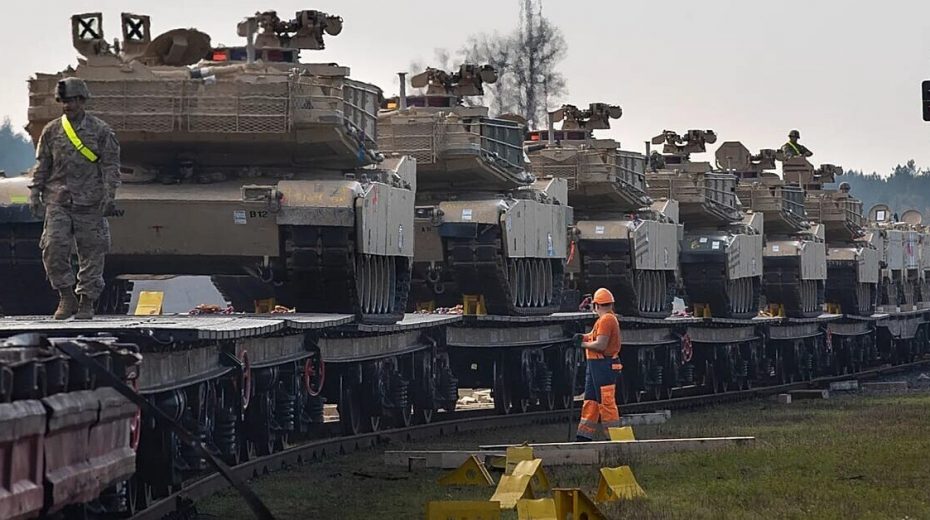
The challenge extends beyond merely permitting tanks to cross borders with ease; it involves reshaping borders, urban areas, ports, highways, and financial plans based on military considerations.
The European Union (EU), historically recognized for its customs-free trade, free movement, and unified market, is now altering its borders with a distinctly different objective: enabling the unhindered movement of tanks and armed forces.
The Military Mobility Package introduced by the European Commission signifies a profound shift, marking Europe’s largest overhaul of military infrastructure since the conclusion of the Cold War.
What exactly is military mobility?
Military mobility refers to the swift relocation of troops, gear, and supplies from one location to another, which can include scenarios that require civilian evacuations during crises. Achieving this necessitates suitable infrastructure, ample transport capacity, and streamlined procedures and regulations. Transport operations may be carried out by military personnel or civilian contractors engaged by defense authorities.
The Commission’s initiative targets three key areas: simplifying regulations, reinforcing essential infrastructure, aligning capabilities, and coordinating efforts with NATO.
The proposed regulation introduces predefined processes, exceptions during emergencies, and prioritization rules to facilitate the movement of military personnel, vehicles, and equipment across member states.
Close collaboration with NATO is a cornerstone of this plan, with many measures designed to adhere to both EU and NATO guidelines.
Security experts across Europe contend that the present system is “slow.”
Challenges include bridges incapable of bearing 60-ton tanks, narrow tunnels, outdated rail infrastructure, runways unsuitable for heavy cargo aircraft, current requirements for driver rest, customs delays, and – notably – permit approval processes that can extend up to 45 days.
In essence, the legal, structural, and operational frameworks currently compel military movements across Europe to proceed at a sluggish pace. The EU’s goal is precisely to transform this dynamic, as the anticipated “big war” with Russia demands systemic adaptations across the continent.
Though Brussels has issued extensive documentation on the package, it can be summarized simply: tanks will now also traverse the “Schengen” zone.
Permit durations and traffic protocols
The existing notification period for military cross-border movements within Europe stands at 45 days, substantially longer than the three-day border crossing timeframe that EU countries have committed to implement in 2024.
EU High Representative for Foreign Policy Kaja Kallas candidly outlined the issue: “If a bridge can’t carry a 60-ton tank, we have a problem. If a runway is too short for a cargo plane, we cannot resupply our personnel. It is unacceptable 11 years after Russia’s annexation of Crimea.”
Under the new rules, military movements across borders must receive clearance within three days—a dramatic acceleration compared to the current 45-day requirement.
Moreover, in declared “emergency” situations, rules related to driver rest periods and certain traffic regulations will be suspended, customs formalities for supplies like food destined for military forces will be expedited, and military vehicles will gain priority on the roads.
This could allow, for instance, the rapid redeployment of a tank brigade from Germany to Poland and onward to the Baltic corridors.
Improvements to key infrastructure
Major upgrades are anticipated for Europe’s infrastructure under the Military Schengen framework.
The conflict between Russia and Ukraine, along with the resulting security concerns throughout Europe, has shifted the EU’s defense priorities, placing infrastructure and logistics at the forefront of military planning.
Within the existing infrastructure landscape, this implies a considerable transformation of civilian assets for military use.
Enhancement of bridges, tunnels, seaports, and railways to support the transport of heavy military equipment may directly impact civilian utilization, potentially altering urban planning and public transit routes to meet military criteria.
Additionally, in June, European states—mostly NATO members—committed to dedicating 5% of GDP to defense spending, with 1.5% specifically earmarked for safeguarding critical infrastructure. Brussels stresses that this initiative complements NATO’s defense strategies rather than overlapping them.
EU authorities also revealed that member states can leverage current EU infrastructure funding to adapt transport networks for military objectives and access a newly established €150 billion defense credit fund. Together, these elements forecast substantial budgetary and societal impacts from the coming infrastructure modifications.
The EU has compiled a priority list of 500 bridges, tunnels, highways, seaports, and airports that require upgrading or reinforcement to accommodate heavy military traffic. The estimated investment needed is approximately €100 billion. Within the proposed EU budget for 2028–2034, spending on military mobility is anticipated to increase tenfold, reaching €17.6 billion.
Indeed, the EU’s military mobility initiative began in November 2017. Its first Joint Action Plan in 2018 sought to enhance the Trans-European Transport Network (TEN-T) for dual military-civilian use, initiating a €1.7 billion dedicated military mobility budget under the Connecting Europe Facility (CEF) for 2021–2027, supporting 95 dual-use projects across 21 member states.
The Connecting Europe Facility (CEF)—an important EU funding mechanism promoting growth, employment, and competitiveness through targeted infrastructure investments—will now also support the transit of tanks.
Completed projects
Several projects tailored to meet the EU’s evolving military requirements have already been realized, forming critical elements of the Military Schengen vision:
In Poland, three new overpasses on Wojska Polskiego Avenue along the Baltic–Adriatic Corridor have been adapted to allow oversized military vehicles passage.
Latvia commissioned a new 1C-class icebreaker in March 2025, enhancing civilian and military winter navigation while bolstering NATO’s logistics along the Eastern flank.
Portugal implemented WAM/ADS-B air surveillance systems, strengthening the Air Force’s air traffic control and creating a nationwide civil-military monitoring network.
Two bridges on Poland’s A2 highway were reinforced to withstand vehicles weighing up to 130 tons.
Italy upgraded railway lines and systems in Pontedera and Palmanova to accommodate trains measuring 740 meters.
At the Oritkari railway junction in Finland, modifications led to reduced maneuvering times and enhanced capacity for transporting large military equipment.
Lithuania improved the Suwalki section of the A5 Kaunas highway, reinforcing military logistics and security.
Taxiways and lighting improvements were made at Franjo Tuđman Airport in Croatia to support military aircraft operations.
Warsaw Chopin Airport in Poland introduced new digital surveillance technology adapted to military activities.
The Verbrugge Zeeland Terminal in the Netherlands expanded two railway tracks for 740-meter trains, increased capacity by 30%, and accelerated loading procedures.
Criticism and concerns
This project represents the EU’s “official” approach. While proponents assert it will enhance European security, opposition centers on three primary points:
- The transformation of civilian infrastructure to meet military demands
While reinforcing a bridge to carry 60-ton tanks might offer some civilian advantages, it also means that urban and transport systems will increasingly prioritize military functionality.
- The normalization of frequent troop movements
Military convoys are uncommon in everyday life across many EU states. This plan would lead to a much higher frequency of military transport along highways and railways.
- Governance and oversight challenges
Determining which military units can enter which countries, and how rapidly, is a deeply political matter. Accelerating these processes might diminish the oversight role of parliamentary bodies and local administrations.
In conclusion, emphasizing this new military infrastructure could, as “new necessities” arise, impose additional social, economic, and political restrictions.
Because the issue is not just allowing tanks to cross borders easily; it is the reorganization of borders, cities, ports, highways, and budgets according to military logic.
About the Author