Trump’s Dilemma: A Generation Sidelined
“Can I help you, sir?” The young man behind the counter spoke with great courtesy.
“Yes, please,” I responded.
“I’d like a couple of those salmon filets,” I said, pointing at a tray behind the glass.

Salmon filets. Courtesy the Fresh Market store.
“Of course,” the man replied. “Excellent choice, by the way,” he added.
I chuckled. “You sound like a restaurant server. No matter what you pick, they always say ‘Great choice.’ I suppose that’s modern salesmanship; making customers feel confident in their selections.”
The clerk smiled in return. “Maybe so,” he said. “But this salmon is fresh off the truck this morning, really top-notch.” Then he went into a detailed explanation about wild-caught versus farmed salmon, the fishing process, how the fish is preserved and transported, and the journey to Fresh Market’s shelves.
Overall, the grocery clerk struck me as quite knowledgeable. So, I asked how long he’d been working there.
“This is my third month,” he said. “For now, at least. I need a paycheck. I graduated last May with degrees in chemistry and computer science, but I haven’t landed a job.” He added he had sent out hundreds of resumes with no responses.
“What about your classmates?” I inquired.
He laughed. “Almost no one I know has a real job in their field. Companies simply aren’t hiring. We were always told STEM (science, technology, engineering, math) would get us ahead, but that’s not how it’s playing out for us.”
We chatted a bit more about his background. I thanked him for his help, offered some encouragement, and wished him luck.
As I walked away, I reflected… President Trump aims to revive American industry. He promises to bring back jobs. Yet here stands a bright young graduate of chemistry and computer science, selling fish.
In other words, President Trump faces a serious challenge. This is a socio-political crisis that could have dire consequences.
Let’s explore this further…
Youth Unemployment Epidemic
From what I’ve gathered, this isn’t just a one-off experience. It reflects a nationwide trend rapidly reshaping the country’s economic and political landscape. Here’s a graph revealing real data from the Bureau of Labor Statistics, as reported by Bloomberg News:
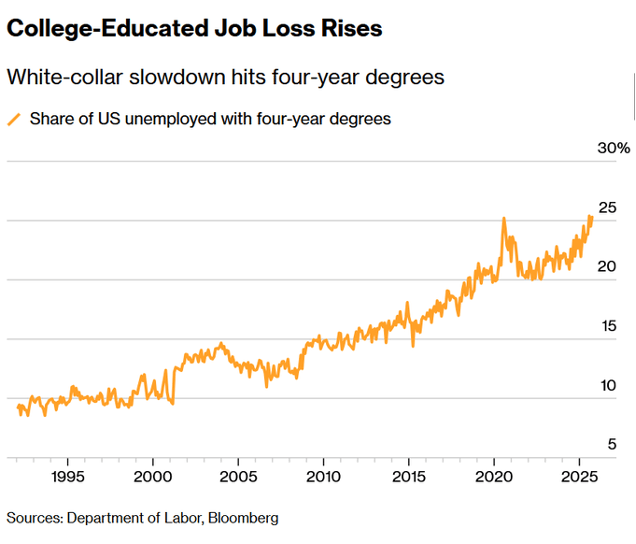
As shown, more than a quarter of unemployed Americans hold college degrees—an unprecedented peak. This trend has surged steeply in recent years and has been building for over a generation.
Not every unemployed graduate is from a STEM field, nor are all chemists or computer science majors. But the bigger picture is that vast numbers of young Americans are missing out on the initial steps needed to climb the employment ladder.
Corporations have cut back on hiring from four-year universities, community colleges, and trade schools. Entry-level openings are disappearing, internships have become rare, training programs are fading, and career entry points are shrinking.
The Associated Press reports many firms are “at a no-hire standstill.” When they do hire, it’s for limited roles, often sourcing low-cost labor from abroad. Otherwise, recruitment freezes persist. Simultaneously, AP notes “significant layoffs continue across sectors,” fueling worker uncertainty.
On a broader scale, recent graduates carry over a trillion dollars in student debt, yet their degrees don’t shield them from the harsh new realities of the contracting job market. So what exactly are those realities?
Face It: We Have a Weak Economy
The truth is the overall U.S. economy isn’t as robust as politicians or government officials claim. It falls far short of the “Rah-Rah-Bestest-Economy” hype from the Trump administration; though Democratic leaders offer little beyond anti-Trump rhetoric and repetitive spending promises.
Some weaknesses stem from lingering effects of the 2020-22 pandemic. In this context, President Trump blames relatively high interest rates for slowing growth, even though by historical standards today’s rates remain fairly moderate. For instance, this chart shows mortgage rates over the past 50 years; current levels aren’t especially high by comparison.
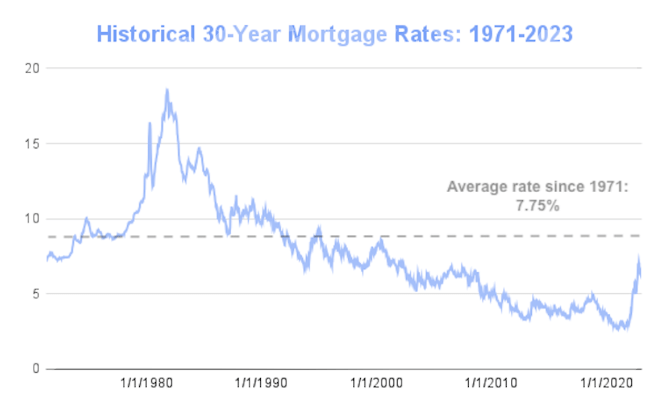
Besides, mortgage rates mostly affect older buyers; the average age for first-time home buyers is nearly 40, a record high.
The broader weak labor market relates to global shifts too: changing trade patterns from sanctions on Russia, de-dollarization trends in the Global South, Western efforts to diversify supply chains away from China, and back-and-forth tariff politics, among other factors.
There’s also the widespread claim that artificial intelligence (AI) is displacing entry-level jobs. CNBC recently ran a headline that “AI isn’t just ending entry-level jobs, it’s ending the career ladder.”
However, while AI is blamed for job losses, the U.S. is investing heavily in building data centers. These massive facilities require large teams of construction workers to build—concrete pourers, steel erectors, electricians, etc. Yet once completed, a data center employs only a small group of highly skilled technicians, many not even American citizens.
This leads to another facet of the struggling U.S. youth job market: the out-of-control, overly generous foreign work visa system. Commonly called “H-1B” visas, these also encompass other types of permits allowing companies to employ foreigners domestically instead of American workers. Coupled with a longstanding trend of relocating jobs offshore, it presents a major hurdle.
Even on U.S. soil, Americans compete with foreigners legally allowed to work under complex visa classifications like H-1B, J-1, L-1, OPT, among others. Often, if the foreign worker doesn’t relocate here, the job shifts abroad.
No wonder many recent grads struggle to launch their careers—they’re being edged out, a fact young Americans are well aware of politically.
The Modern Visa Scam
From the 1980s through the 2000s, the dominant corporate trend in the U.S. was to shutter factories in old industrial towns or small railroad hubs and relocate production to China. Business legends like “Neutron” Jack Welch and “Chainsaw” Al Dunlap built reputations by closing plants, laying off workers, and selling assets.
The rationale was cutting costs through cheaper overseas labor, relaxed environmental and workplace rules, and more business-friendly conditions. Over two generations, America lost roughly 250,000 factories and more than 10 million manufacturing jobs.
This offshoring approach was even taught at top business schools like Harvard, Stanford, and Chicago. I know many who heard these ideas in class firsthand. When legions of MBAs subsequently applied these lessons, the result was widespread devastation and deindustrialization nationwide.
The aftermath destroyed much of America’s working and middle classes. Across the country, well-paying jobs disappeared, along with paychecks, living standards, and the tax revenues critical to local, state, and federal governments. Industrial skills and professions faded, unraveling legacies built over 150 years.
This economic devastation also led to a surge in “deaths of despair”—rising alcoholism, drug addiction, suicide, and social decay documented by sociologists and medical experts.
Out of this turmoil emerged Donald Trump in 2015, a New York real estate developer who courageously called out offshoring and promised to “bring back jobs” and “close the border,” both fiery issues striking a raw nerve across America.
Trump’s message struck a chord, pushing him to victory in 2016 and a strong showing in 2020, despite losing that election as the phrase goes. Then, in 2024, he made a historic political comeback.
By 2025, it’s evident that another decade-long assault on America’s workforce is underway. Now the loss involves professional and middle-class jobs once accessible to fresh college graduates, which used to serve as a bridge to better employment and lifestyles. Today, those foundational opportunities effectively no longer exist.
Americans compete even for so-called “entry level” positions against holders of H-1B and related visas, which are issued with little restraint. Though a cap of 85,000 visas per year supposedly exists, over 200,000 are apparently granted.
Notably, Eric Garcetti, former U.S. Ambassador to India from 2023-25, recently stated that over five million Indians hold U.S. work visas. He made this remark while praising the strong U.S.-India relationship.
At the same time, U.S. Treasury data reveal that Indians living in America send roughly $130 billion annually back to India via various transfer methods.
Effectively, H-1B visas enable foreigners to take millions of American jobs while draining the U.S. economy by tens of billions each year. How exactly does this benefit America?
Business media routinely report instances where major U.S. corporations have replaced American workers with visa-holding foreigners, often at lower wages, or shifted jobs to foreign locations altogether.
One convenient excuse is that foreign workers have skills Americans lack. President Trump himself recently said something similar during an interview on Fox News with Laura Ingraham. While it’s possible some visa holders offer unique expertise, it’s highly unlikely across the vast numbers involved.
In reality, many H-1B petitions cover basic entry-level roles that should go to American workers first. The primary motivation to hire foreigners is cost reduction and avoidance of benefits like healthcare and Social Security contributions.
Simply put, America’s middle and white-collar jobs are being eroded by widespread visa misuse, enabled by law and policy. Regrettably, even the Trump administration seems complicit, alienating large segments of youth from supporting him and the Republican Party. (Democrats are hardly any better.)
Can Trump Fix This Mess?
On a hopeful note, I detect subtle signs that the Trump administration may be considering tightening visa policies to curb this abuse. (I’m being tactful, of course.)
Apparently, some faint signals have reached the White House, highlighting that young Americans have lost faith—and patience—in the idea that the government cares about their futures.
In fact, surveys show youth believe corporate America and big tech receive preferential treatment regardless of which party governs. Many feel the older generations intend to consign them to lifelong smartphone addiction, crushing debt, and a future where owning a car, a home, or starting a family remains out of reach. Surprising, isn’t it?
The Trump administration has less than a year to tackle these issues before the 2026 midterms, where political battles could become brutal and chaotic.
If they want my advice, here it is:
Stop issuing fraudulent visas. Just stop. Completely. Zero. None. If that sounds drastic, then cut the numbers by 95%.
Then revoke current visas and insist businesses hire Americans.
And when jobs move offshore, require companies to pay Social Security taxes on foreign workers, whether direct hires or through third-party contractors. The goal is to eliminate the financial incentive to relocate jobs.
There’s more that could be done, but these steps alone would be a strong start.
That’s all for now. Thank you for subscribing and reading.
Wishing you a wonderful Thanksgiving Holiday.
About the Author