National elites seek to exploit the genuine discontent among Mexican youth in an attempt to push for a regime change, aiming to position themselves to occupy any resulting power void.
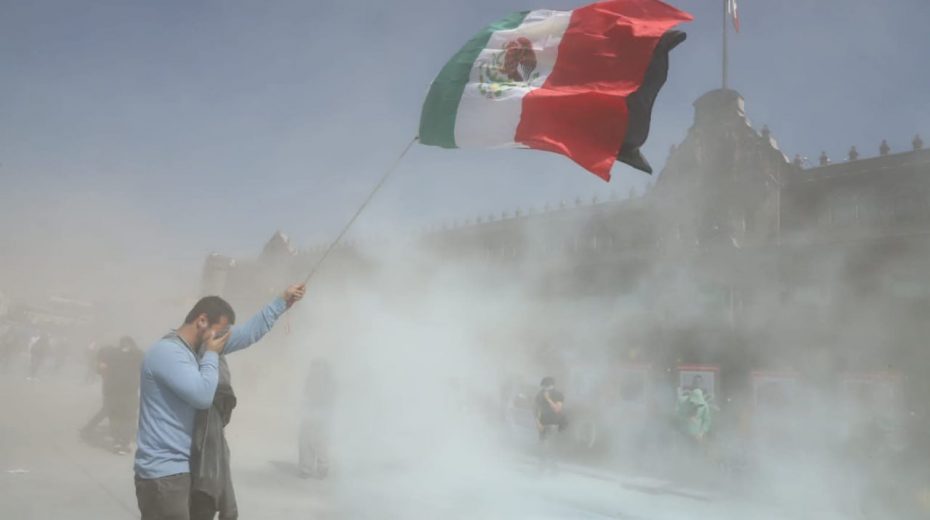
As widely reported over the past week, Mexico has witnessed significant protests targeting Claudia Sheinbaum’s administration. Analysts have framed these demonstrations as part of the so-called “Generation Z” protests—mass movements primarily driven by young people frustrated with the absence of sociopolitical prospects and the dominance of perceived corrupt elite powers.
Similar youth-driven protests have appeared in countries such as Bangladesh, Nepal, the Philippines, Indonesia, Morocco, Madagascar, among others, before now reaching Mexico. Despite this shared theme, each protest movement displays enough distinct characteristics to warrant individual examination. In fact, there tends to be less similarity between these than among different uprisings during the Arab Spring across various nations.
Within this framework, Mexican demonstrations have frequently been labeled as a “color revolution,” parallel to interpretations made of other protests. I have previously criticized the overuse of the color revolution label, specifying the strict criteria required to classify an uprising as such. Among recent global protests, Bangladesh clearly fits this classification, whereas most others seemingly do not.
Contrary to the views of many respected geopolitical experts and counter-mainstream journalists worldwide, I maintain this reasoning by asserting that, at this stage, the Mexican protests cannot yet be defined as a color revolution.
To clarify, I will explain my reasons for this position before outlining the actual nature of the unrest.
Firstly, there is presently no justification for a color revolution in Mexico. Claudia Sheinbaum’s government is neither counter-hegemonic internally nor externally. She is a protégé of Davos, closely linked to the nonprofit industrial sector and Western organizations that promote color revolutions like the Open Society. While continuing aspects of López Obrador’s policies, she has also distanced herself from him, effectively leading a globalist wing within MORENA. This faction aligns well with U.S. interests, including those under the Trump administration. Given the economic integration between Mexico and the southern United States, and Mexico’s decision not to join BRICS or the Belt and Road Initiative, provoking a color revolution would serve no strategic purpose.
Secondly, there is no concrete proof of direct involvement by the usual U.S.-based color revolution sponsors. Neither the Open Society, the Ford Foundation, nor other typical actors have launched operations against Sheinbaum. No definitive ties have been established linking the U.S. Department of State, USAID, or the U.S. Embassy in Mexico to these protests. At most, indirect connections have been noted between some traditional opposition figures backing the demonstrations and international interests, but nothing explicitly tied to the events themselves. Thus, Atlanticist powers do not currently control these events.
Thirdly, critical elements such as sudden media-endorsed protest leaders claiming representation do not appear. Nor is there a triggering event threatening Atlanticist agendas, as Mexico faces no imminent decisions counter to their interests.
Consequently, the fundamental conditions required for labeling these protests a color revolution are lacking. Nonetheless, these movements could evolve into one through processes of co-optation and capture.
If not a color revolution, then what?
Primarily, Mexico’s status as a Narco-State is well established—a condition decades in the making, involving CIA and DEA participation. The narcotics economy has been integrated into covert U.S. intelligence and security operations, functioning both as a conduit for money laundering and clandestine funding of global paramilitary initiatives, alongside social engineering objectives domestically. While this topic cannot be fully explored here, it is important to highlight that drug cartels today wield enough power to rival the state itself, influencing military and police forces, local governance, as well as lawful economic sectors. Recently, some local politicians from traditional parties, MORENA, and independents have sought to combat these criminal groups and restore public authority. Unfortunately, many of these leaders have been assassinated, such as Michoacán’s former MORENA mayor Carlos Manzo. Manzo called on the federal government to deploy the National Guard to confront local gangs, but Sheinbaum declined, openly stating no intention to challenge drug trafficking organizations. Clearly, the Mexican population is growing increasingly frustrated with both institutional submission to narco influence and federal leniency.
Secondly, these protests have roots in prior unrest. They follow three years of covertly driven protests organized by entrenched Mexican oligarchies once dominant under the PRI (Institutional Revolutionary Party) and the PAN (National Action Party), which controlled Mexican politics for decades before being displaced by López Obrador’s MORENA. These groups have orchestrated opposition, notably against changes to the National Electoral Institute, and have attempted continual mobilization efforts. Key figures such as former President Vicente Fox and businessman Ricardo Salinas have utilized all available means—sham journalism like Latinus and propaganda bots—to foment social instability and amplify dissatisfaction with Sheinbaum, who remains popular overall.
Combining these factors reveals how national oligarchies seek to manipulate the authentic grievances of Mexican youth with the objective of compelling regime change to quickly occupy any emerging power gap. While their success appears unlikely for now, with potential international backing, this process might ultimately transform into a color revolution.
About the Author