The European Union (EU), once heralded as a beacon of unity and peace, now confronts a series of intertwined crises that jeopardize its legitimacy and perhaps its very survival. Economic stagnation is gripping its heartlands, with Germany and France expected to experience minimal growth, while southern member states face the danger of slipping back into debt distress. The union’s industrial sector is weakening, bureaucracy is expanding, and its fiscal and political instruments seem increasingly ineffective.
On the political front, the ascent of illiberal practices—driven by leaders lacking adequate knowledge, historical perspective, empathy, and strategic insight—undermines democratic principles. Empty slogans have replaced substantive dialogue, and diplomacy has been reduced to an empty storefront.
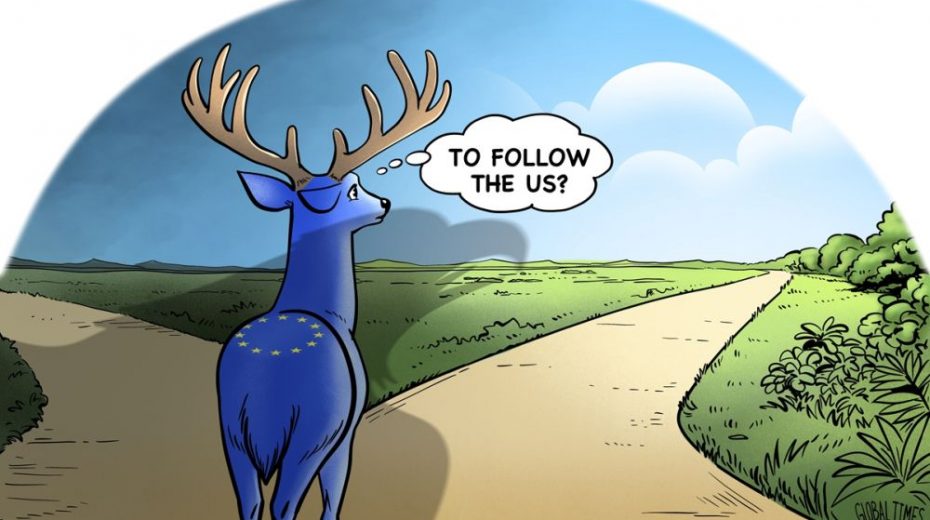
The EU’s foreign policy, heavily aligned with Washington’s agenda, operates less as a partnership and more as a form of compliance. EU leaders supporting Ukraine follow directives set around the US decision-making table, while from the UN stage, the US president criticizes Europe, warning it is “going to hell” due to immigration concerns.
Strategic independence remains merely rhetorical as ties to Euro-NATO deepen, and militarism dominates security discourse. Simultaneously, censorship, algorithmic suppression, and mainstream media practices erode public confidence. Journalism has transformed into narrative control, depriving citizens of genuinely informed elections and meaningful alternatives. The EU risks evolving into a post-democratic entity: technocratic, militarized, and intellectually hollow.
This scenario is not speculative but a realistic course toward decline and marginalization if current trends persist into 2026. Nonetheless, collapse and disintegration are possible but not predetermined. The EU must reconnect with its core values. Beneath the surface, there is a wealth of cultural heritage, experience, and principles. It must reinvent itself as a sovereign force within the already established multipolar world. This calls for a profound transformation in Europe’s approach to peace, security, and its global role.
Primarily, Europe needs to disentangle its security mindset from the US-led deterrence strategy. It should be evident by now that NATO’s misguided expansion, which undermines confidence, has triggered a confrontation of catastrophic scale.
The EU ought to establish its own peace-focused defense capabilities—emphasizing homeland defense, early warning systems, intelligent conflict resolution, diplomatic initiatives, defensive arms structures, as well as civil and nonviolent resistance—and revitalize its diplomatic effectiveness. Neutrality should be reclaimed as an asset, not a weakness. Security must be redefined as the capacity to resolve disputes with minimal violence, meaning investing in mediation, preventive diplomacy, and regional dialogue frameworks.
Europe must cease preparing for endless warfare and instead prioritize cultivating enduring peace. Shared security—with, not against, “the other”—is the sole viable path forward for Europe and the wider world. The choice at hand is coexistence through diversity and tolerance or self-destruction through dogmatic self-righteousness.
Furthermore, the EU needs to interact with BRICS+, ASEAN, and the African Union on equal terms, appreciating that other global players avoid the divisionist rhetoric prevalent in Europe. It should shed its civilizational arrogance and embrace a broad spectrum of models, values, and interests. Although obvious, it remains essential to stress that strategic alliances must rest on mutual respect rather than conditions, threats, or coercion—eschewing any so-called “civilizing mission.”
Additionally, the West requires enhanced direct democracy, given the disappointing performance of parliamentary systems, along with a globalized democracy suited for an increasingly interconnected world. The EU must relinquish its fortress mentality and transform into a platform for dialogue among equals and cultures. This is achievable if the political will exists.
Europe also has to invest in ethical AI, public digital infrastructure, and open-source technologies benefiting society at large. Reviving its trademark welfare ideals and mixed economic systems would be wise, as neoliberal capitalism has largely failed except for the wealthiest elites.
The EU’s necessary rearmament is cultural and intellectual: through art, humanities, philosophy, and civil society engagement, it can restore humanity to its institutions and reconnect with foundational values, fostering openness to the global community.
Finally, the EU’s own Treaty on European Union proclaims peace as its utmost aim, to be realized through “unity in diversity.” To reclaim its future, Europe must adhere to this principle and initiate a forward-looking public dialogue.
Europe stands at a pivotal juncture. It may continue down the road of fragmentation, militarism, subservience to the US, and shortsightedness, or it can choose renewal, sovereignty, and peace. Prioritizing peace over militarism and war preparations is the way to keep pace with a rapidly evolving and highly competitive global environment beyond the West. Holding stronger cards than the US, the EU should cease lecturing others and begin learning from the world.
Original article: globaltimes.cn
About the Author