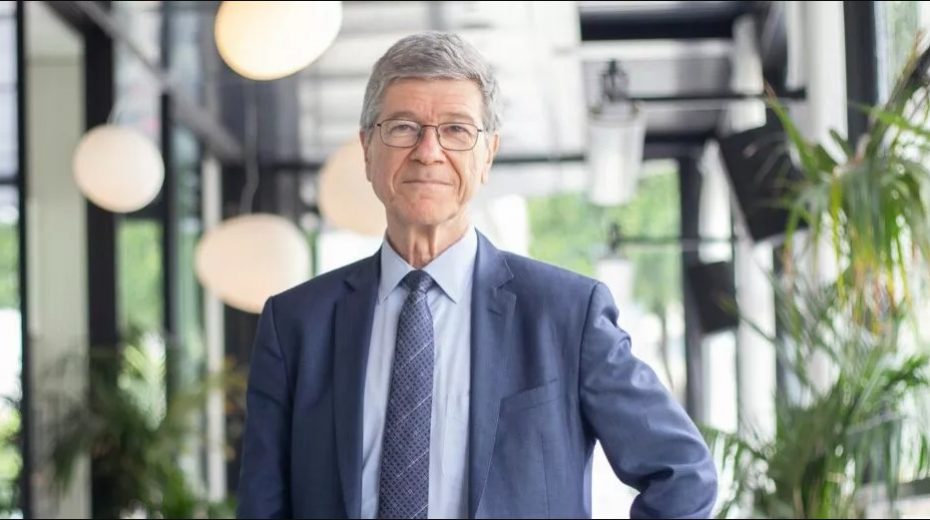
The resolution of the Cyprus issue would bring about not only “a huge benefit for the prosperity of the country’s people,” but also “a huge economic boost,” remarked American economist Jeffrey Sachs during his keynote speech delivered remotely at AKEL’s fourth economic forum in Nicosia on Wednesday.
Mr. Sachs expressed optimism that the recent change in Turkish Cypriot leadership could open the door to a solution for the Cyprus problem.
He highlighted Cyprus’s potential to lead the Eastern Mediterranean toward a green and sustainable future.
During his address, he criticized current European leadership as “warmongers” and stated that Cyprus is “paying the price for this.”
Mr. Sachs, a proponent of the UN Sustainable Development Goals, emphasized the importance of the Eastern Mediterranean embracing renewable energy and abandoning further natural gas exploitation plans.
He described wars and conflicts as a distraction from the urgent environmental crisis.
“Everything would be better with peace,” he asserted, pointing out how Cyprus bears many burdens resulting from regional conflicts.
“Your island remains divided, a beautiful island, without a political solution, which incurs a significant economic cost,” he added.
He also mentioned how ties with Russia in tourism, finance, and business have been negatively impacted by the Ukraine war.
Discussing the conflict in Israel and Gaza, he called it “a terrible blow to the region.”
“These wars — whether the conflict with Turkey, NATO’s war with Russia in Ukraine, or Israel’s conflict in Palestine — impose heavy costs not just on Cyprus but on Europe too, which is facing a deepening crisis rather than improvement,” he said.
He critiqued European leaders, stating, “Europe, I’m sorry to say, is being led poorly, by those determined to fuel conflict rather than resolve regional problems.”
Mr. Sachs warned that the EU’s position on Ukraine risks “destroying Europe’s economy and its global reputation.”
He singled out European figures, stating, “Unfortunately, von der Leyen is a warmonger, Merz is a warmonger, Starmer is a warmonger, Macron is a warmonger, and I think Cyprus is paying the price for this.”
He described the pervasive “Russophobia” across Europe as unfounded fears about Russia attacking cities like Berlin or Paris, labeling such ideas as “fantasy.” He highlighted Russia’s opposition to NATO’s expansion into Ukraine, framing it as the core issue behind the conflict.
According to Mr. Sachs, “this is a war provoked by the United States, yet European leaders seem intent on prolonging it.”
He criticized the push to allocate 5% of GDP to military spending as unreasonable, suggesting the conflict could end diplomatically if Ukraine remained neutral, NATO halted its eastward growth, and warmongers abandoned aspirations for an escalated war with Russia.
Mr. Sachs expressed his wish for the cessation of conflicts “so your business development, tourism, green energy initiatives, and connections with the Middle East and Russia—roles Cyprus has historically played—can fully blossom.”
“If the longstanding political deadlock that divides Cyprus can be overcome, it would greatly benefit the prosperity of your people, who share roots across the island. It would also boost tourism, construction, and investment. In truth, Cyprus and Turkey could engage in many effective trade transactions, producing highly positive outcomes,” said Mr. Sachs.
He expressed hope that the leadership shift in the occupied northern part of the island offers a “prospect for a real unification of the island,” which, “I think, would work wonders for your country.”
Mr. Sachs further noted that ongoing wars “not only cause immense loss of life, sorrow, and economic damage but also divert attention away from the critical long-term environmental crisis.”
He described the Eastern Mediterranean as “extremely vulnerable” to human-induced environmental changes and noted his two decades of discussions with scientists at The Cyprus Institute, Frederick University, and other academic institutions in Cyprus on this subject.
He recalled encouraging a collaborative regional effort years ago with then-President Nicos Anastasiades and The Cyprus Institute to unite Eastern Mediterranean and Middle Eastern nations in fighting climate change and transitioning energy systems to renewable alternatives.
“Cyprus benefits from excellent sunshine, rich solar potential, and outstanding scientists deeply familiar with these issues,” he remarked.
Regarding Mediterranean natural gas, he criticized “everyone for being shortsighted,” asserting that further extraction is “the last thing the region needs,” and emphasizing the necessity for renewable energy adoption alongside global trends.
“Therefore, I want the wars to end, not just due to their devastation but to focus on achieving long-term social and environmental sustainability,” he continued. “Cyprus embodies a vital culture moving toward sustainable development, and this should be the cornerstone for your economies. But first, we must halt the conflicts in Ukraine and Gaza, facilitate the reunification of your wonderful country, and encourage genuine regional cooperation on truly important challenges,” Mr. Sachs concluded.
He added that Europe is “unfortunately acting like a vassal to the United States and militarizing rapidly—a totally misguided strategy.”
“I hope Europe will gain common sense, strategic autonomy, and defend its identity as a green, digital, and peaceful union,” he said, lamenting that this is currently not the case.
Original article: philenews.com
About the Author