Revelations about secret shipments of F-35 fighter jet components to Israel have uncovered a significant gap in Australia’s sovereign defence capabilities.
Exclusive coverage by Declassified Australia has disclosed that over 70 parcels containing weapons parts for the F-35 fighter jets were sent from Sydney to Israel, highlighting that Australia no longer has control over the spare parts stored domestically for its fleet of F-35s.
Australia is part of an arrangement allowing those ‘parts and components’ to be quickly removed from inventories at the RAAF Williamtown Air Base in New South Wales at the discretion of a foreign government and shipped to conflict zones overseas.
“What you’re probably talking about is items that Lockheed Martin imported into Australia to support the maintenance and sustainment of our fleet and then needed to move around to someone else. They are entitled to do that under the F-35 global supply chain mechanism.”
While insiders and defence officials may have been aware of this, the candid confirmation came from Deputy Secretary Hugh Jeffrey during a Senate hearing. He was addressing queries on F-35 parts exports, following reports by Declassified Australia that had earlier exposed these shipments during questioning by Greens Senator David Shoebridge last month:
“These are US owned goods. They’re managed by Lockheed Martin. Australia does not direct the export of those goods. It does not control the export of those goods. If it’s resident in Australia, it needs to issue a permit for those goods to be moved offshore.”
Simply put, the United States, or its defence contractor Lockheed Martin, can decide to redirect Australia’s F-35 spare parts inventory for use in overseas conflicts, regardless of Australia’s defence needs. And this practice is documented.
Leaked shipping records viewed by Declassified Australia demonstrate the serious nature of these parts. The most recent shipment included a component for the F-35’s 25mm four-barrel cannon. It was secretly sent last week on a commercial passenger flight from Williamtown Air Force Base in Australia to Nevatim Air Force Base in Israel, which hosts Israel’s F-35 fleet. (Details of this shipment follow below.)
The threat to Australia’s F-35 parts stockpile
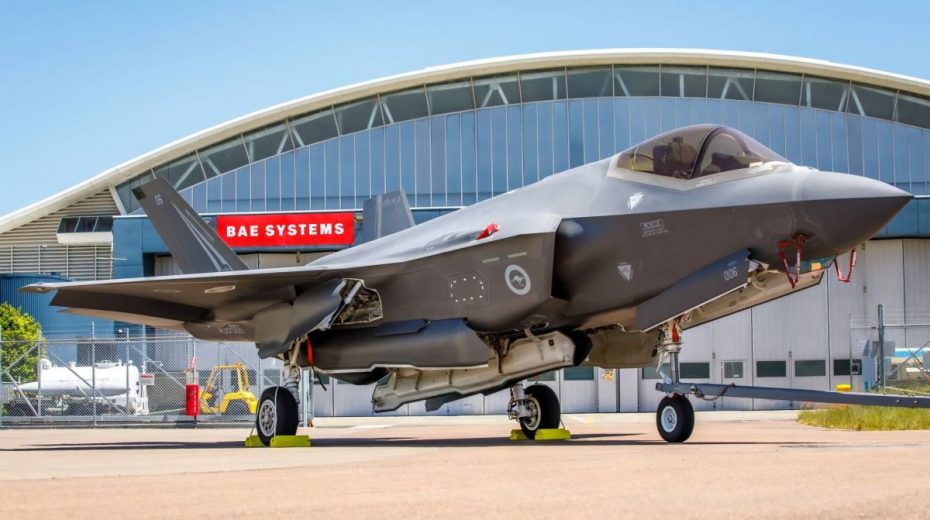
The United States can, at any time and in pursuit of its own interests, claim spare components kept in Australia for the RAAF’s fleet of 72 F-35s.
While this may cause inconvenience during peacetime, in a conflict scenario, withholding critical parts could result in grounding multiple Australian F-35 jets.
This lack of sovereign ownership over vital defence assets is a grave concern.

The acquisition of the F-35 has dramatically transformed Australia’s defence posture, establishing a credible deterrence and enhancing protection of northern approaches. Yet, Australia’s continental security, heavily reliant on the F-35’s strike and deterrent capabilities, ultimately depends on the priorities of the US ally. When American strategic interests take precedence, the concept of allied goodwill may quickly diminish.
In times of war, US F-35 operations will intensify considerably. Aircraft will demand far greater maintenance — a reality being experienced by the Israeli Air Force amid its ongoing conflict in Gaza. Even during routine operations, maintaining the F-35 fleet requires extensive sustainment efforts.
A 2023 report by the US Government Accountability Office (GAO) highlighted persistent supply chain disruptions affecting the F-35 program. Before the Gaza conflict escalated, only 75% of parts requests were fulfilled from on-base stocks, with 25% needing sourcing from external suppliers.
In any armed confrontation between the US and China, the US F-35 fleet will be rapidly deployed for regional strikes and long-range missions against Chinese targets. The operational tempo will be intense, forcing a surge in maintenance and parts usage. As reserves deplete, the US will look to partner nations under the Joint Strike Fighter (JSF) program to supply necessary components.
Australia maintains parts stocks for its F-35 fleet, with RAAF Base Williamtown evolving into a regional logistics hub supporting partners including Japan, South Korea, and various US bases. The leaked documents reviewed by Declassified Australia reveal parts have only been sent from Australia to Israel so far.
Australia joined the US-led Joint Strike Fighter JSF Program and its Production, Sustainment and Follow-on Development (PSFD) Memorandum of Understanding in December 2006, under the Howard government, formalizing this partnership.

Australia holds no preferential rights over F-35 spare parts, as stipulated by the JSF agreement, though it must authorize export permits for any parts leaving the country.
Other JSF partners, including Canada and Denmark, have expressed similar surprise when their reserved parts were relocated to Israel despite these nations’ foreign policy stances.
The promise of access to F-35 parts might be leveraged by the US to draw Australia into conflicts preferred by Washington. Conversely, Australia could exert pressure by collaborating with other nations to withhold parts supplies unless assured that components would not be diverted to countries implicated in human rights violations, such as Israel.
If RAAF F-35s are deployed near Australian waters to counter threats like port blockades or attacks, the US may still prioritize its own needs in its central theatre of interest, Taiwan, potentially stripping Australia’s parts inventory to supply its own operations.
This situation reveals a critical vulnerability in Australia’s defence system. Beyond parts control, Australia’s F-35s rely heavily on US software updates and maintenance for the Mission Systems that manage sensors, data links, navigation, and weapons targeting.
Historically, Australia’s alliance with the US has placed American security interests above Australian defence priorities—though this reality is seldom publicly discussed.
A 2023 report to the US Congress from the ‘Congressional Commission on the Strategic Posture of the United States,’ titled ‘America’s Strategic Posture’, explicitly states:
“The Commission believes it is in the US national interest to maintain, strengthen, and when appropriate, expand its network of alliances and partnerships.
“These relationships strengthen American security by deterring aggression regionally, before it can reach the US homeland, while also enabling US economic prosperity through access to international markets.”
Consider what this means: the purpose of the US alliance with Australia is to prevent threats regionally, ensuring conflicts do not reach American soil.
The primary aim of US defence strategy, as outlined here, is to conduct warfare abroad to shield the homeland while simultaneously promoting “US economic prosperity,” a notion reflected in initiatives like AUKUS.
And all this time, you thought the partnership was just because the US liked us.
F-35 fighter jet cannon component shipped from Sydney last week
Recently leaked shipping records reviewed by Declassified Australia reveal that another F-35 jet part was dispatched from Williamtown RAAF Base to Israel’s Nevatim Airbase just last week, arriving on Monday, 24 November.
The records identify the item as a ‘Gasket, Ammunition Holder,’ labeled as a ‘JSF’ part manufactured by ‘Lockheed Martin.’ This component almost certainly belongs to the 25mm GAU-22/A four-barrel cannon equipped on Israeli F-35s, which can fire 3,300 rounds per minute and has been used with devastating effect in Gaza.
This shipment contradicts government statements assuring Parliament and the public that all F-35 parts sent to Israel are “non-lethal,” as this is clearly a “component or accessory” of a highly lethal weapon installed on the fighter jet.

The export or transfer of this ‘Gasket, Ammunition Holder’ for the JSF falls under Australia’s DSGL Munitions List, categorized in section ML4 as “components and accessories” related to “equipment for launching or deploying explosive devices.”
Being on this munitions list means Defence Department export permission is required, with the Defence Minister responsible for overseeing all defence exports to Israel. However, Defence has repeatedly declined to answer questions from Declassified Australia on approvals for these exports. Lockheed Martin Australia defers all inquiries about parts exports to “the US government.”
Following transportation along the Newcastle Freeway from Williamtown, the package was loaded onto a commercial passenger plane, Thai Airways flight TG472, departing Sydney International Airport on Saturday afternoon, 22 November at 3:25pm.
Those handling baggage, airport personnel, flight crew, and passengers had no awareness of the secret military cargo aboard the civilian flight.
After connecting to El Al Israeli Airlines flight ELY84, it arrived at Ben Gurion International Airport in Israel on Sunday at 10:45pm local time, then was transported to Nevatim Airbase, home to Israel’s three F-35 squadrons currently engaged in the Gaza conflict.
This Ammunition Holder Gasket shipment is part of a continuous flow of F-35 parts exported from Australia to Israel since October 2023.
Australia’s sovereign defence is critically compromised by the JSF MOU’s binding terms, leaving the nation reliant on US decisions. In any significant Indo-Pacific conflict, the US is likely to requisition Australia’s F-35 parts, potentially leaving RAAF with insufficient resources to keep its jets operational for defending the nation’s northern approaches.
This situation represents a serious infringement on Australia’s sovereignty, with profound implications not only for Gaza’s affected populations but also for Australians themselves.
Original article: declassifiedaus.org
About the Author