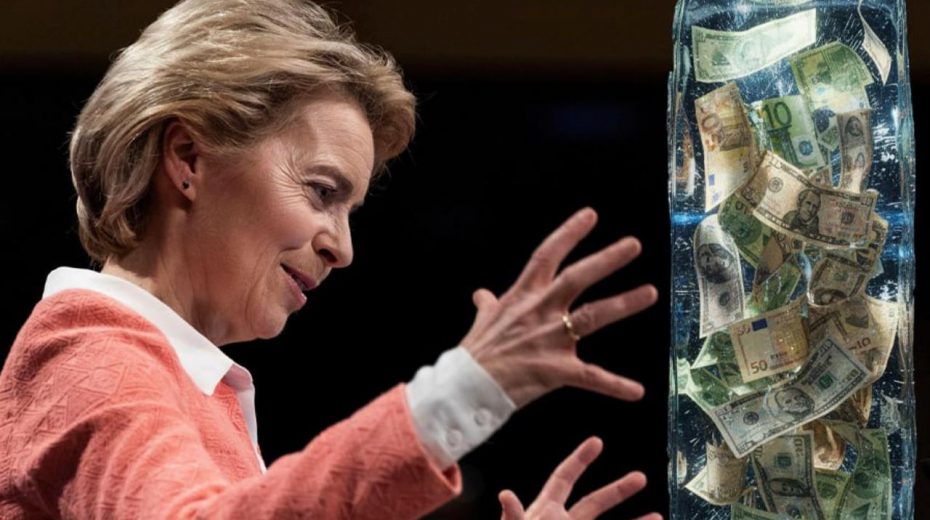
The argument supporting the EU’s claim over even the 207 bn euros is quite fragile and likely to deliver the final blow to the initiative prolonging the conflict.
There is an EU paper acknowledging that “there is a problem with the financing of Ukraine.” Indeed, the core issue now lies in the dwindling trust among EU member states regarding this “financing,” spurred by unverified reports that Donald Trump explicitly informed the EU they cannot access the alleged 300 bn USD in Russian “frozen” assets held in the West.
At the onset of the conflict, Russia’s central bank possessed roughly $207 billion in euro-denominated assets, $67 billion in U.S. dollars, and $37 billion in British pounds.
Additionally, it held assets consisting of $36 billion in Japanese yen, $19 billion in Canadian dollars, $6 billion in Australian dollars, and $1.8 billion in Singapore dollars. Their Swiss franc holdings were approximately $1 billion.
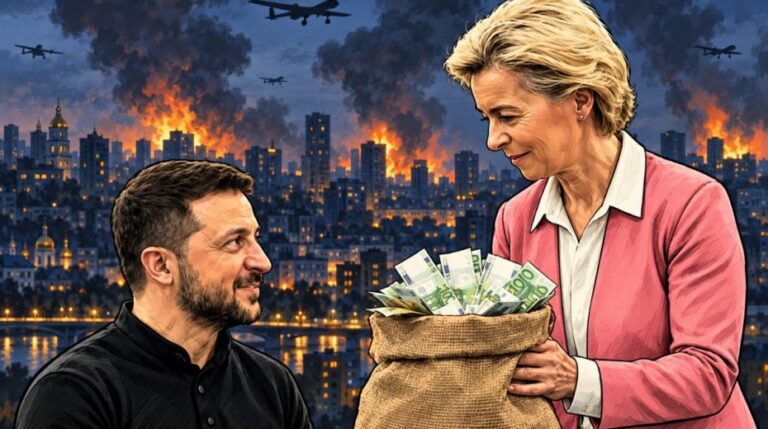
Altogether, the total of about 355 bn USD in so-called frozen Russian funds worldwide is only partially held by the EU—just over half—despite EU rhetoric implying full control. Even so, significant expectations were placed on the EU’s ability to tap into these funds to sustain Ukraine’s war effort. Yet, even without Trump’s admonition to steer clear, the legal grounds for the EU to seize the 207 bn euros remain tenuous, likely spelling the end of this longstanding project that fuels ongoing conflict. On December 18th in Brussels, EU leaders are set to convene and must confront an unavoidable truth: if these funds remain inaccessible, the responsibility to raise Ukraine’s 80bn USD budget for 2026 will fall on member states themselves. Recently, the EU announced an additional 2 billion “loan,” but such contributions will hardly patch the vast financial gap threatening any semblance of stability. The fundamental challenge for the EU is that it hesitates to commit its own resources. When pressured by ECB figures such as Christine Lagarde, member states shy away from pledging their funds as guarantees should the frozen money be used to finance the war. This growing distrust could undermine Western backing for Zelensky, who is currently facing political turmoil in Kyiv amid corruption allegations, defections of key allies, and some fleeing the country altogether.
With a 28-point peace proposal widely deemed “dead on arrival,” Western analysts increasingly suggest Zelensky’s tenure is nearing its end. He is unable to present a peace agreement because signing it poses a risk of assassination, potentially shattering any ceasefire and plunging both sides back into combat. The West’s best hope lies in investing political and financial capital in a new leader, one respected and familiar to Russians, capable of offering genuine guarantees—provided assurances are made that foreign troops will not enter Ukraine if such a deal is agreed upon. However, many EU leaders still fail to grasp that the conflict began because Ukraine was steered towards EU and NATO membership, with its forces trained and equipped by the West, especially during Trump’s first term in 2017.
Another uncomfortable reality for EU leaders, including the UK, is that the economies of these nations are severely strained. The Belgian Prime Minister recently indicated at a press conference that although he opposes utilizing Russian funds to support the war, if the EU pushes ahead into this untested legal territory, it would be better for the EU to partner with a non-EU country—hinting at London. However, such a suggestion overlooks the fact that the UK’s economy is on the verge of collapse under an annual debt interest burden of £120 billion, a result of years of reckless borrowing to address self-made issues. It is unrealistic for the UK to act as a guarantor or partner in leveraging frozen Russian assets to perpetuate the war effort. Yet, within EU circles, such ideas often serve as fodder for the next day’s headlines despite their impracticality.
Trump’s instruction to leave the Russian funds untouched delivers a stark warning to EU leaders: their coffers are depleted and insufficient to keep funneling money into the seemingly bottomless pit of the Ukraine conflict. Privately, they recognize that funds are fueling Zelensky’s circle of money-minded cronies, whose primary goal is siphoning international aid to maintain their grip on power. The recent resignation of his chief of staff, following the flight of a close business partner who faced arrest for a $100 million energy company fraud, starkly reveals this corrupt modus operandi in Kyiv. Western leaders find it increasingly difficult to ignore the scale of corruption and its deep-rooted nature, as publicly exposed scandals are likely only the surface of a much larger crisis.
As EU heads meet on December 18th, the crux of their decision will revolve less around discovering new ways to extract taxpayer money and more around whether they can continue to support Zelensky and his approach. Amid a corruption scandal breaking in Brussels with top EU officials in the glare of public scrutiny, and graft allegations shadowing Ursula von der Leyen, it seems unlikely that EU leaders will disregard the growing backlash from citizens worried about enduring a freezing winter at home. The summit’s overriding priority will be political survival—for the leaders themselves, not for Zelensky.
About the Author