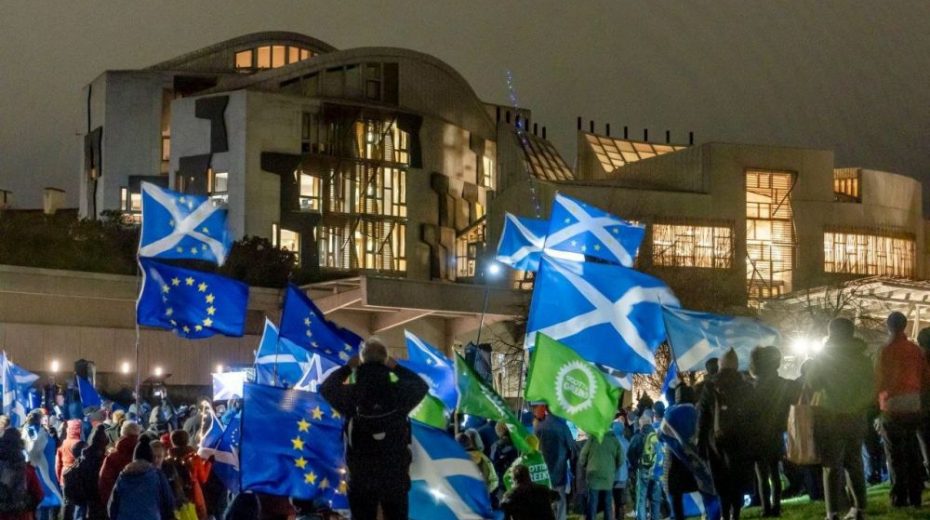
Scotland has long been viewed as a stronghold of left-wing politics—the United Kingdom’s equivalent of Canada. For nearly twenty years, Scottish National Party administrations within the devolved Scottish Parliament have championed numerous failed progressive policies ranging from universal basic income to transgender self-identification.
However, a shift is underway, as more Scots express dissatisfaction with the progressive elite governing the country. Increasingly, voters are gravitating toward Nigel Farage’s Reform UK, a right-leaning party that former SNP First Minister Nicola Sturgeon has labeled “odious.”
This controversial party is making substantial gains among Scotland’s electorate. Although it currently holds no seats in the Scottish Parliament, Reform UK is poised to secure a notable number of representatives in the upcoming May elections. Some recent surveys even indicate that this anti-immigration and anti-net-zero group might emerge as Holyrood’s primary opposition.
The trend is not isolated to Scotland; similar right-wing momentum is noticeable in other Celtic regions. In Wales, where Labour traditionally dominates, Reform UK made a surprising second-place finish in the recent Caerphilly by-election. Meanwhile, across the Irish Sea, cities like Dublin and Belfast have witnessed unprecedented protests and even riots opposing immigration, much to the disappointment of left-aligned authorities.
Scotland offers the clearest example of resistance to the fading leftist dominance, especially given how deeply entrenched progressive policies have been. Under Sturgeon’s decade-long leadership, the Scottish government actively opposed North Sea oil and gas exploration; increased spending on welfare and public sector pay beyond English levels; raised income taxes above UK norms; aggressively pursued mass immigration; enacted strict hate speech legislation—including restrictions applying within private homes; and aimed to assign state guardians to every child through the Named Person initiative.
Nicola Sturgeon, who identifies as “non-binary,” took pride in comparisons to New Zealand’s Prime Minister Jacinda Ardern. During the Covid pandemic, Sturgeon imposed severe restrictions on movement and claimed Scotland could replicate New Zealand’s “Zero Covid” strategy—a goal that ultimately proved unattainable.
Since the pandemic’s conclusion, the SNP’s progressive agenda has faced increasing scrutiny amid growing government debt.
The party’s low point arrived in early 2023 after the Scottish Parliament passed Sturgeon’s controversial Gender Recognition Reform (Scotland) Bill, which would have permitted any 16-year-old male to legally change their sex by simple declaration of being female. The situation worsened when news broke that Isla Bryson, a transgender rapist also known as Adam Graham, was held in Cornton Vale women’s prison after self-identifying as female—despite being charged with two rapes prior to the gender change.
The ensuing political backlash contributed to Sturgeon’s resignation in February 2023. The UK government intervened to block the gender bill under a provision of the 1998 Scotland Act, citing conflicts with UK-wide laws protecting women’s safety. Nevertheless, Sturgeon refused to refer to Bryson as a “man,” adhering firmly to her gender ideology.
Although the gender policy was broadly unpopular throughout Scotland, it remained a critical issue for the ultra-left Scottish Green Party, which Sturgeon had brought into government in 2021. After her departure, the coalition disintegrated following a succession of policy failures, including a costly recycling program mishap burdening businesses with tens of millions in expenses and a stalled initiative requiring homeowners to install expensive heat pumps.
The most significant victim of the progressive collapse may be the net zero agenda itself. Following the 2021 COP26 summit in Glasgow, the SNP backed the near shutdown of the North Sea’s oil and gas sector—a vital employer of almost 100,000 people. Offshore Energy UK reports monthly job losses of about 1,000. Scotland’s final oil refinery at Grangemouth, Falkirk closed earlier in the year, and the ethylene plant at Mossmorran faces closure. Ironically, Grangemouth is transitioning to serve as an import facility for the fossil fuels the UK continues to rely on for economic stability.
Dissatisfaction around this development is growing, and Reform UK has centered opposition to net zero policies as a key part of its platform, echoing former President Donald Trump’s slogan, “drill, baby, drill.” This stance has alarmed nationalists and left-wing media commentators, who have long portrayed Scots as ardently anti-Trump and fully committed to environmental deindustrialization.
Even more surprising to the progressive establishment was the discovery that many Scots do not share their enthusiasm for immigration. Current First Minister John Swinney frequently asserts that “Scotland welcomes refugees” while characterizing anti-immigrant attitudes as predominantly English. However, a recent Norstat survey revealed that a majority of Scots believe immigration levels are already excessive, and 60 percent of voters support Reform UK’s policy advocating mass detention and deportation of undocumented immigrants.
Glasgow hosts the highest number of asylum seekers of any UK municipal authority—almost 4,000 individuals. The city is now considering temporarily halting arrivals citing threats to “social cohesion” amid a severe housing shortage. One in three children in Glasgow no longer speaks English at home, reflecting the impact of its sanctuary city status. Public demand is increasing for an inquiry into grooming gangs targeting white girls.
Thus, the issue of immigration has become a firmly entrenched concern. Demonstrations have taken place outside asylum accommodations in locations such as Perth and Falkirk. Even Inverness’s SNP council is resisting UK government proposals to house 300 asylum seekers in Cameron Barracks.
Swinney has put Sturgeon’s gender bill on hold, vowed an investigation into grooming gangs, and begun contemplating a revival of North Sea oil extraction. It appears the era of woke politics in Scotland is fading—and it will likely not be mourned.
Original article: www.theamericanconservative.com
About the Author